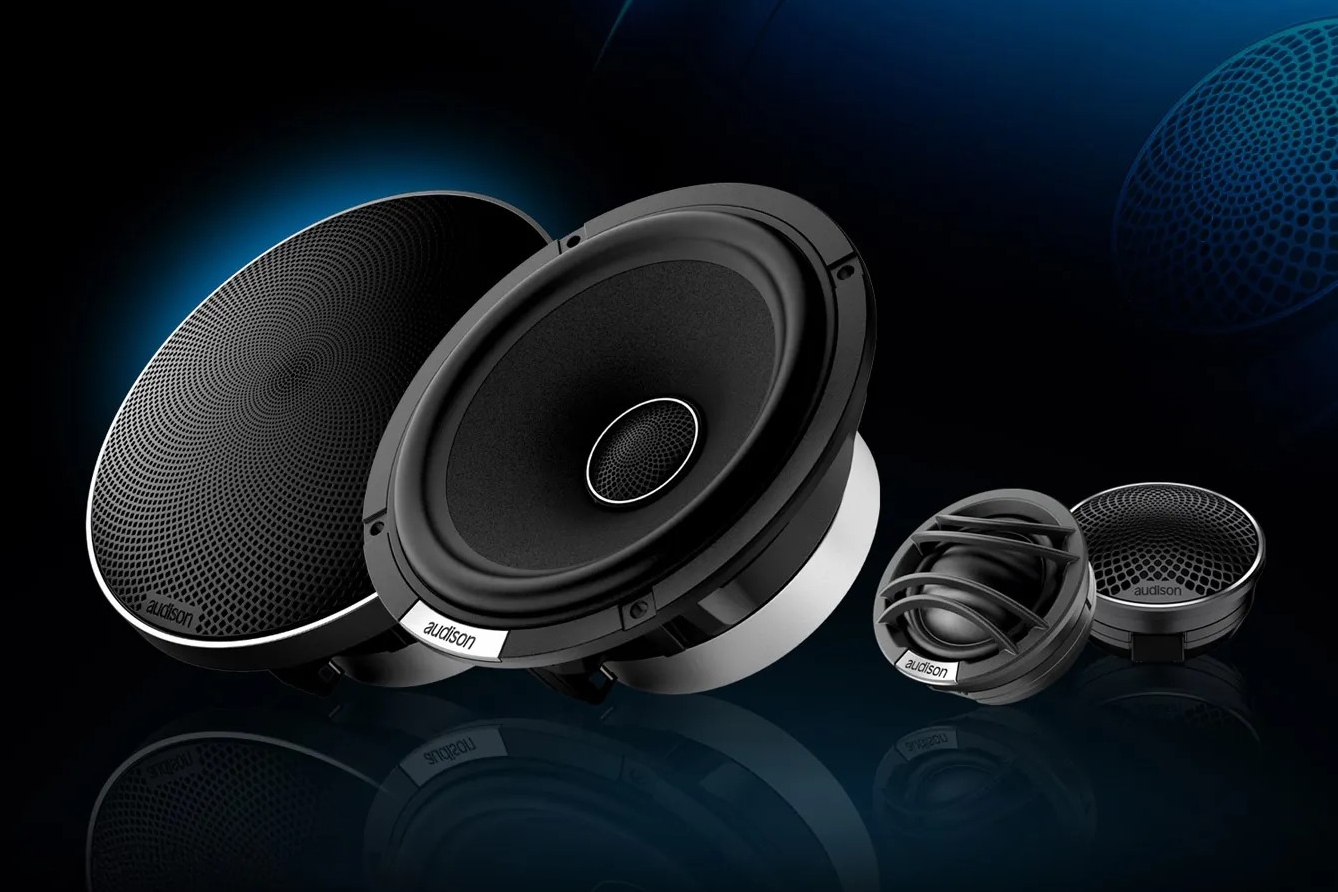
In addition to playing music, modern car audio systems offer many other features – infotainment is closely linked to the car's electronics, controlling navigation, comfort features, voice assistants, and safety systems. However, the quality of the sound itself is often overlooked. Built-in converters, active filters, and factory equalization can modify the signal to such an extent that even high-quality equipment may not be able to show its full potential. The key to better sound therefore lies not only in the speakers or amplifier, but much closer than it might seem – right at the beginning of the signal path. In this article, we will show you why the source is important and what options are available to achieve ideal sound quality.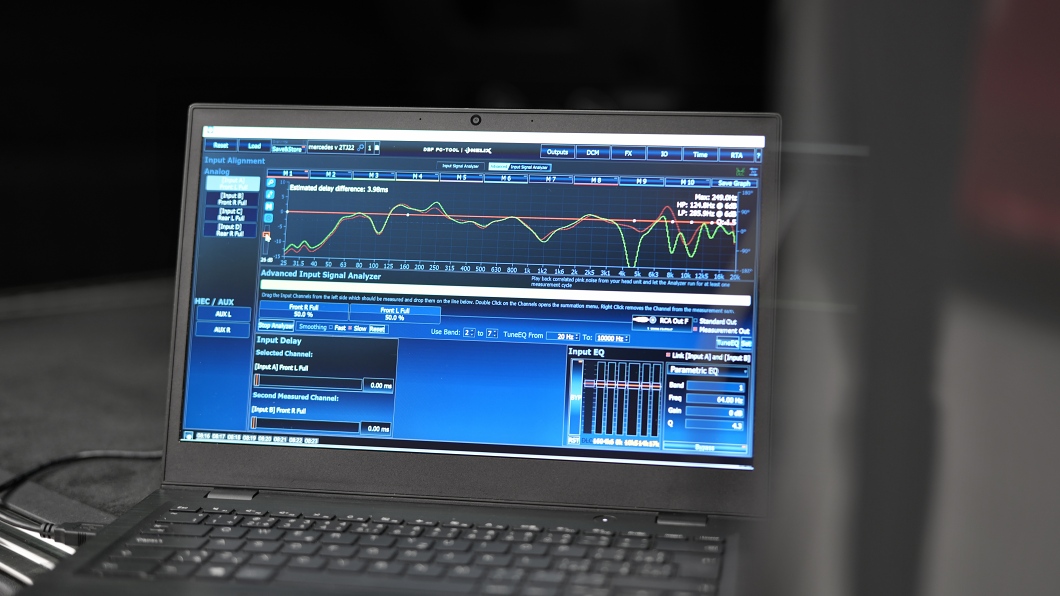 The signal is the basis of every audio system. The photo shows a unit that has already been significantly equalized by the manufacturer, with all-pass filters applied.
Why is the factory main unit often a compromise
In recent years, infotainment systems in cars have advanced incredibly. The single-purpose car radio has become the central brain of the car, controlling virtually everything from navigation and air conditioning to safety assistants. However, with the increasing complexity of the system, the quality of the audio signal itself has been neglected. Today's head units handle a huge number of functions, but there is often no room left for precise sound processing. The result is a signal that is far from ideal, both technically and acoustically.
The most common problems we encounter with factory units:
Active crossovers and factory equalization. Car manufacturers try to mask the weaknesses of speakers with software, and especially with optional systems, this often results in a heavily modified signal that cannot be fully "corrected" even with a DSP processor. The music then never sounds as natural as it could.
All-pass filters. These filters are used to synchronize individual speakers without changing their volume or frequency response. In practice, however, they often cause unwanted signal phase shifts that impair the spatiality and clarity of the sound. We encounter them mainly in Japanese and Korean cars, where their settings tend to be very aggressive.
Weak D/A converter and limited dynamic range. Digital-to-analog converters in factory units often have low accuracy, higher noise, and lower signal-to-noise ratio. This results in a flat sound lacking the detail and space that a high-quality audio system can offer.
Compressed transmission via Bluetooth. Most vehicles use basic codecs such as SBC or AAC, which limit data flow and lose some of the finer details. The result is less depth, poorer separation of instruments, and lower overall fidelity of the recording.
Fortunately, there are solutions to minimize or completely eliminate these limitations. Adding a high-quality external source can significantly improve the clarity, dynamics, and naturalness of the sound, taking the entire system to a level that a standard head unit cannot offer.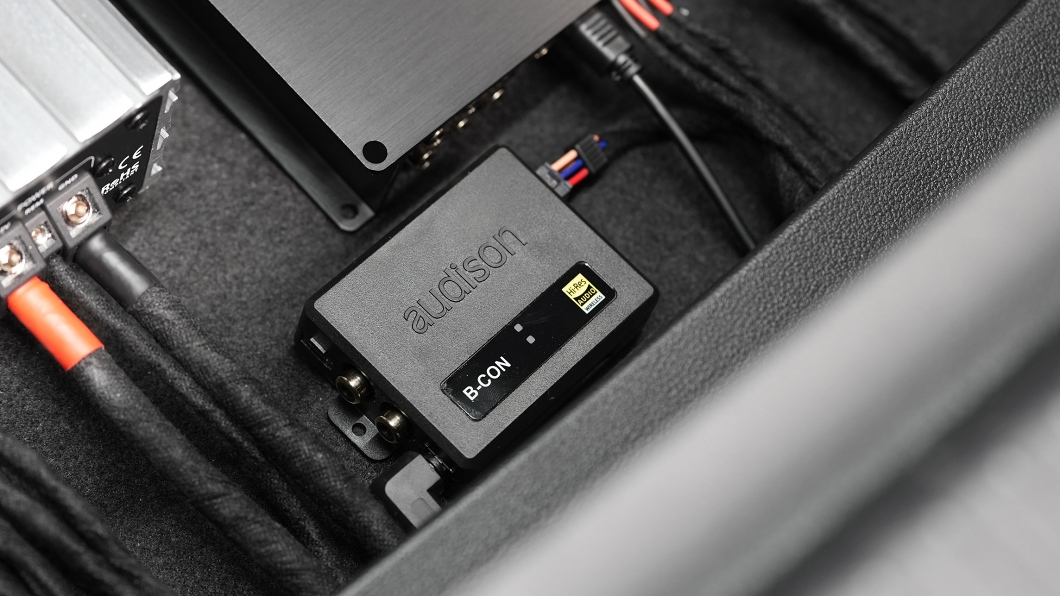 Audison B-Con Hi-Res Bluetooth module: an easy solution for adding a high-quality source to any installation.
What is an external source and what forms does it take
If we want to get the most out of a car's sound system, it is necessary to ensure that the amplifier or DSP processor receives the cleanest possible signal. While it used to be enough to replace the factory radio with a high-quality aftermarket unit to solve the whole problem, this is practically impossible in modern cars today. This is where external sound sources come in. These devices bypass the weaknesses of the factory unit and provide a digital or analog output that matches the capabilities of high-quality components.
Basic types of external sources used in practice:
Hi-Res Bluetooth moduls – the most common, affordable, and technically simplest solution for achieving high-quality sound without complicated modifications. They allow for convenient wireless connection of a phone or player, while modern LDAC or aptxHD codecs can transmit signals with high data rates and minimal compression. The quality is significantly better than that of conventional Bluetooth systems in cars and, in practice, very close to a wired connection. These modules can be used as standalone devices connected to any DSP processor or amplifier, or as an integrated card directly in the DSP unit, saving space and simplifying installation.
Integration modules – devices designed to be installed directly in the car, usually in place of the factory amplifier. They receive a digital signal from the infotainment system (e.g., via AVB, MOST, or CAN buses) and convert it to a clean analog or digital output without factory equalization, crossovers, or corrections. They retain all the original functions of the car, such as volume control, parking sensors, and system sounds. This provides the ideal source signal for connecting external amplifiers and DSP processors. However, it should be noted that this is a relatively expensive solution that is not available for all types of vehicles.
Hi-Res players – the most popular solution among audiophiles, ensuring uncompromising sound quality. These players feature top-of-the-line internal components, precision D/A converters, and often separate power supplies. The quality can be further enhanced by choosing higher-end models with first-class DAC chips that offer exceptional clarity, space, and dynamics. Hi-Res players can play music from lossless streaming services (such as Tidal, Qobuz, or Apple Music Hi-Res) as well as from a USB drive or memory card with your own music library. Most also support high-quality Bluetooth transmission, but for maximum fidelity, a cable connection is recommended here as well.
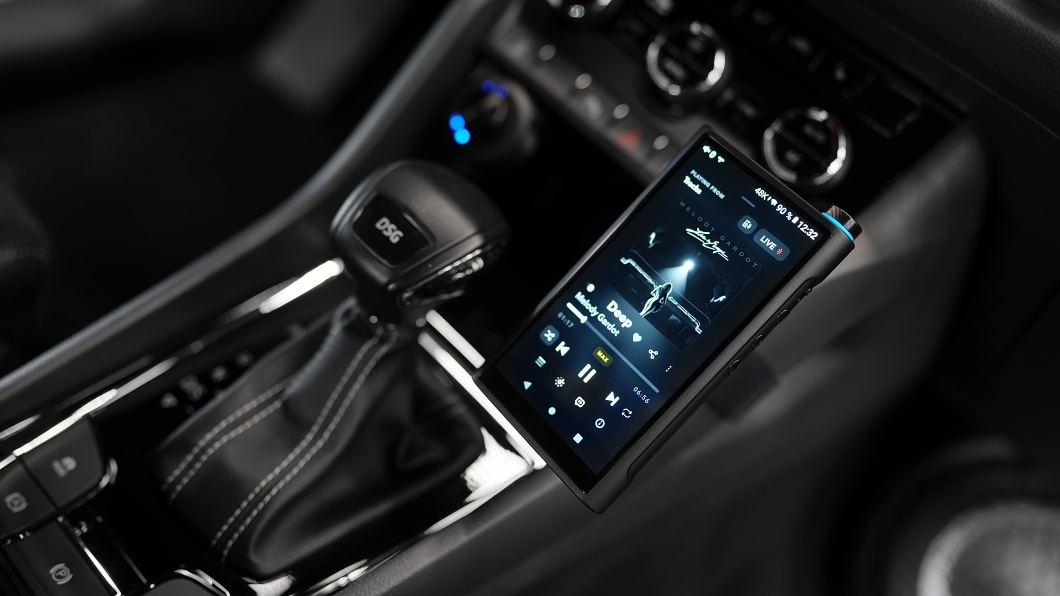 The most perfect sound solution – an external Hi-Res player that allows you to listen in studio quality.
What are the advantages of an external source
Using a high-quality external source means moving towards studio fidelity. Music sounds the way the artist intended – without the modifications, compression, and coloration that factory units introduce into the signal. Every detail can be heard with a precision that conventional systems simply cannot offer. The sound gains depth, space, natural dynamics, and liveliness. Combined with high-quality components and a properly configured DSP, the result is a chain that is no longer limited by the weaknesses of the factory unit. The sound is thus elevated to a level comparable to home hi-fi listening.
The improvement is not just subjective – it has clear technical reasons:
Higher quality D/A converter (DAC). Every digital device must convert the signal from ones and zeros into an analog form that the amplifier can process. Factory units use inexpensive integrated DAC chips with limited dynamic range and higher noise. External hi-res devices use high-end converters with precise timing, low distortion, and high signal-to-noise ratio, which results in clear and detailed sound.
Higher dynamic range. High-quality converters achieve a range of up to 120 dB and more, while standard OEM units range around 85–90 dB. In practice, this means a greater difference between silence and the loudest moment – music sounds more vivid, with better gradation and natural space.
Higher sampling frequency and bit depth. Hi-res devices can process music up to a resolution of 32-bit/384 kHz. This preserves subtle details and micro-information that are missing from regular CDs or compressed formats. These differences are most noticeable in acoustic, classical, and studio music, where the naturalness of reverberations and instrument textures are important.
Direct digital stream without unnecessary conversions. Factory units often convert the signal between digital and analog form several times, with each conversion introducing distortion. An external hi-res source sends digital data directly to the DSP or amplifier, minimizing losses and preserving maximum accuracy.
DSD playback. Some players and DSP processors support the DSD (Direct Stream Digital) format. This uses an extremely high sampling frequency and a single-bit data stream, resulting in exceptionally smooth and natural sound.
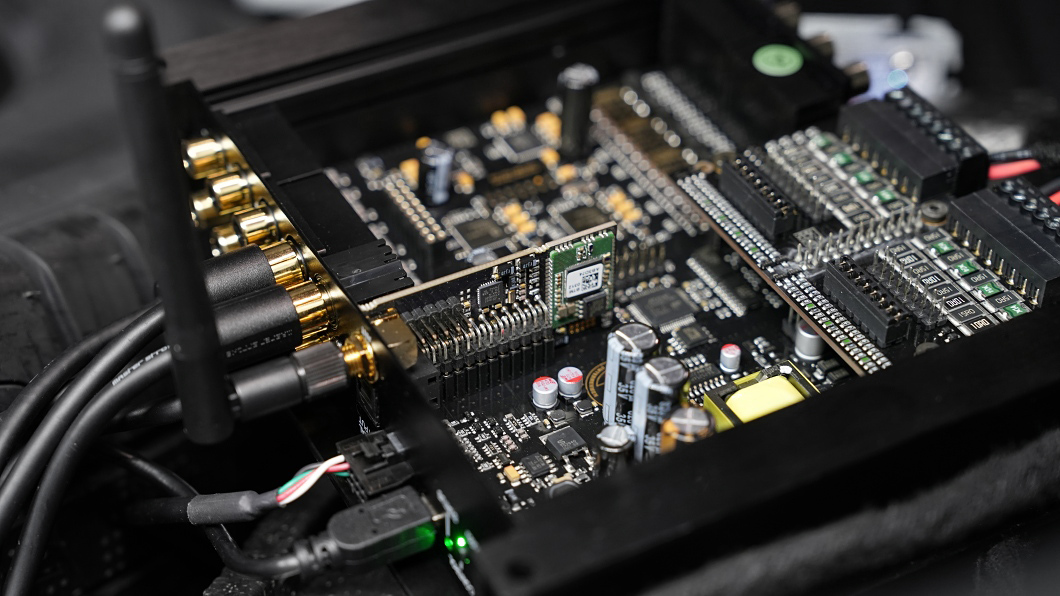 It can also be done discreetly – Helix DSP processors allow integration of a Bluetooth module using a special card.
It is important to mention the disadvantages and limitations as well.
An external audio source can significantly improve listening quality, but it also comes with several technical and practical limitations that need to be taken into account. These aspects are not a major obstacle in themselves – rather, it is a matter of choosing the right solution for a specific car and method of use.
More complex integration into the car. Modern cars are full of electronics and interconnected systems. Installing an external source requires experience with connecting to factory buses and ensuring proper communication with other vehicle components. In some cases, special interfaces or additional modules are required.
Preserving infotainment functions. In some vehicles, it is difficult to preserve all the original functions of the main unit, such as system sounds, voice control, or hands-free. Therefore, the correct installation design must take into account the need to preserve the full functionality of the vehicle.
User discomfort. After switching to an external source, music control often moves from the main unit to a mobile phone or separate player. This may seem unusual at first, but after a short time, most users appreciate the simplicity and, above all, the significantly better sound. Once you hear the difference, you won't want to go back to the original system. In some cases, full control can also be achieved via the main unit – for example, when using integration modules and Apple CarPlay or Android Auto systems.
Higher purchase price. High-quality hi-res players and integration modules are not cheap. Although they bring significant improvements in quality, for the average user, the investment in an external source may be higher than expected. On the other hand, for the discerning listener, the benefits are clearly audible and the investment makes sense.
The need for tuning and calibration. An external source alone does not guarantee perfect results. For the system to perform at its best, it must be properly connected to a DSP processor and then professionally tuned. Only the combination of a clean signal, high-quality components, and precise settings delivers the desired effect.
However, with proper design and professional installation, these factors are not a problem – they only confirm that high-quality car audio is a complex discipline where experience and a precise approach are reflected not only in the technology, but above all in the result itself.
In conclusion
Sound quality is always determined by the weakest link in the chain – and in modern cars, this is usually the factory head unit. An external source can remove this barrier and deliver music with the full fidelity, dynamics, and clarity of a studio recording. Whether it's a hi-res Bluetooth module, an integration interface, or a high-end player, proper connection and precise tuning of the entire system is also key.
However, an external power supply is not essential for every audio system. Its use makes sense primarily when investing in high-end components and for audiophile listeners who are only satisfied with the very best. In such cases, an external power supply can open up another level of detail, space, and naturalness—transforming ordinary listening into a true experience..jpg) The PAC integration module for Toyota vehicles allows you to bypass the factory amplifier and obtain a clean signal for an aftermarket amplifier.
The PAC integration module for Toyota vehicles allows you to bypass the factory amplifier and obtain a clean signal for an aftermarket amplifier.