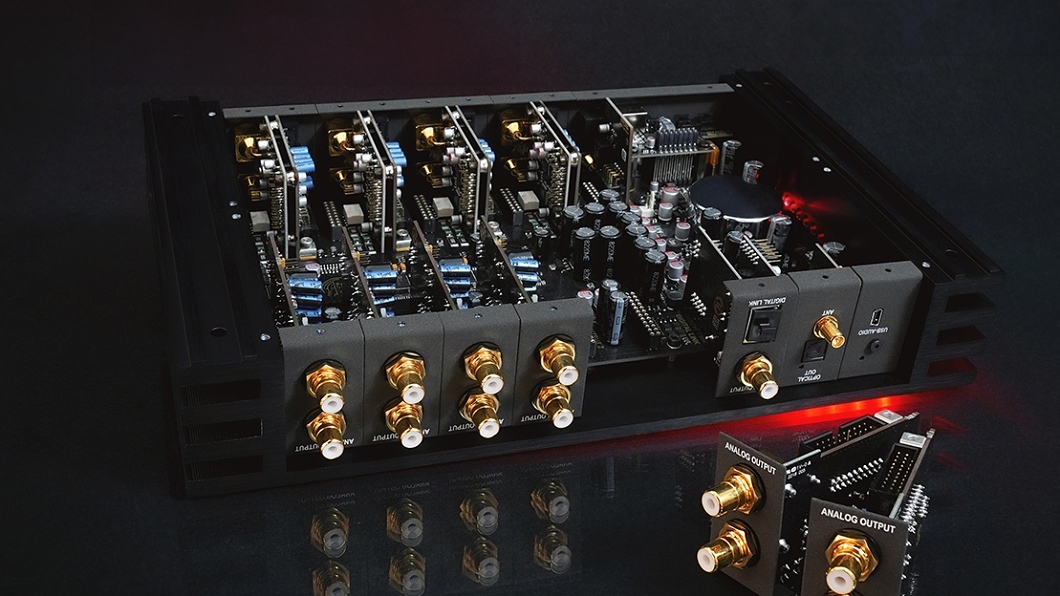
DSP processor – a control center that transforms a standard signal into perfectly balanced sound.
What is a DSP processor?
A DSP (Digital Signal Processor) is a digital processor that processes audio signals in real time. It receives a digital or analog signal from the main unit, modifies it using mathematical algorithms, and sends it on to amplifiers and speakers. Unlike a classic equalizer, which can only perform basic tone adjustments, DSP offers complete control over every detail of reproduction – from precise equalization and time corrections to crossover settings for individual speakers.To make this possible, the DSP processor combines several key processes. The ADC (Analog-to-Digital Converter) converts the analog signal from the car radio or other source into a digital form that can be processed mathematically. The microprocessor is literally the brain of the entire system, performing complex calculations, filtering, balancing, and optimizing the signal in real time with minimal delay. At the end of the process is the DAC (Digital-to-Analog Converter), which converts the modified digital signal back into analog form so that it can be amplified and sent to the speakers.
In other words, the DSP processor can take a standard or factory-modified signal and transform it into a form that respects the acoustics of a specific car and the capabilities of the speakers and other components used. In the hands of an experienced technician, it can create a faithful, balanced sound with a perfectly coordinated soundstage, even in the acoustically challenging environment of a car interior.
DSP as an essential part of any high-quality sound system
From an acoustic point of view, a car is an extremely complex environment, which until recently was more of a compromise in terms of high-quality music listening. Speakers are located in places that are definitely not ideal for listening to music – they are often poorly directed, placed low in the doors, asymmetrical to the driver, and at different distances from the listener's ears. The sound reflects off the windshield, steering wheel, plastic trim, and other obstacles, so each channel reaches the listener with a different delay and distortion.The problem is exacerbated by the factory units in modern vehicles. Most of them have active crossovers, hard-coded equalization, or all-pass filters that alter the character of the signal so that the weak factory speakers sound "nice at first listen." However, these interventions cannot be easily turned off, and any audio upgrade loses much of its potential as a result.
With the advent of DSP processors, however, the situation has changed dramatically, as they allow you to have full control over the sound in your car – delaying individual channels so that all sounds reach the listener's ears simultaneously, setting precise crossovers and phases, and correcting factory signal adjustments. Suddenly, the car no longer has to be a compromise, but rather an environment where, thanks to smart signal processing, it is possible to achieve listening quality comparable to that of high-quality home equipment.
.JPG)
Helix DSP Pro – a standalone DSP processor for those who want absolute control over their sound.
Main functions of the DSP processor
The power of the DSP processor lies primarily in its ability to influence every aspect of sound in detail. It is not just about adjusting bass or treble, but about complex tools that allow you to truly control the sound in your car. Thanks to them, you can eliminate acoustic problems in the interior, distribute the work between the individual speakers correctly, and create a natural sound scene directly in front of the listener.Equalization
Every car has completely different acoustic conditions, so without corrections, there will always be significant fluctuations in individual bands. Equalization in DSP allows these peaks to be balanced, resulting in a much more natural sound. Basic DSP processors typically have a 10-band equalizer available, and advanced models have up to 31 bands for each channel. This allows the sound to be fine-tuned with high precision and brought as close as possible to the linear ideal.Time corrections
In a car, we never sit in the middle between the speakers like we do at home with a stereo. The left tweeter and mid-bass speaker are usually closest, while the right one plays from a much greater distance, so the sound reaches our ears at different times. In addition, the rear speakers send the signal with a long delay from behind, resulting in a fragmented, unnatural soundstage. The DSP processor allows each channel to be precisely delayed by milliseconds so that all tones arrive simultaneously. This "aligns" the sound and creates a natural musical image that feels compact and spacious.Crossovers
Each speaker is designed for a specific frequency range, but if it receives a signal outside its capabilities, the sound will be distorted or the speaker may even be damaged. The DSP processor allows you to set precise crossover frequencies, slopes, and filter types so that each speaker plays only what it is supposed to. A major advantage of DSP is the possibility of so-called active connection, where each speaker is controlled by a separate amplifier channel. This allows you to set the crossovers individually for each driver and gain complete control over the entire band.Phase
The sound from individual speakers is made up of waves that combine in space. If the speakers are not properly phased, they can interfere with each other in some bands or, conversely, amplify each other unnaturally. The result is unbalanced and inaccurate listening. The DSP processor allows you to fine-tune the phase so that all speakers complement each other and play as one. This makes the music sound full, cohesive, and natural.In addition to these main functions, the DSP processor offers other options that significantly expand its potential. These include detailed level settings for each channel, a choice of different filter types (such as Linkwitz-Riley or Butterworth), the ability to mix signals from multiple inputs, and equalization of the input signal itself, which can remove factory audio adjustments. Another advantage is the ability to save several presets, for example for different music styles and sound sources. All this makes the DSP processor a true sound control center, without which it is impossible to achieve top results today.
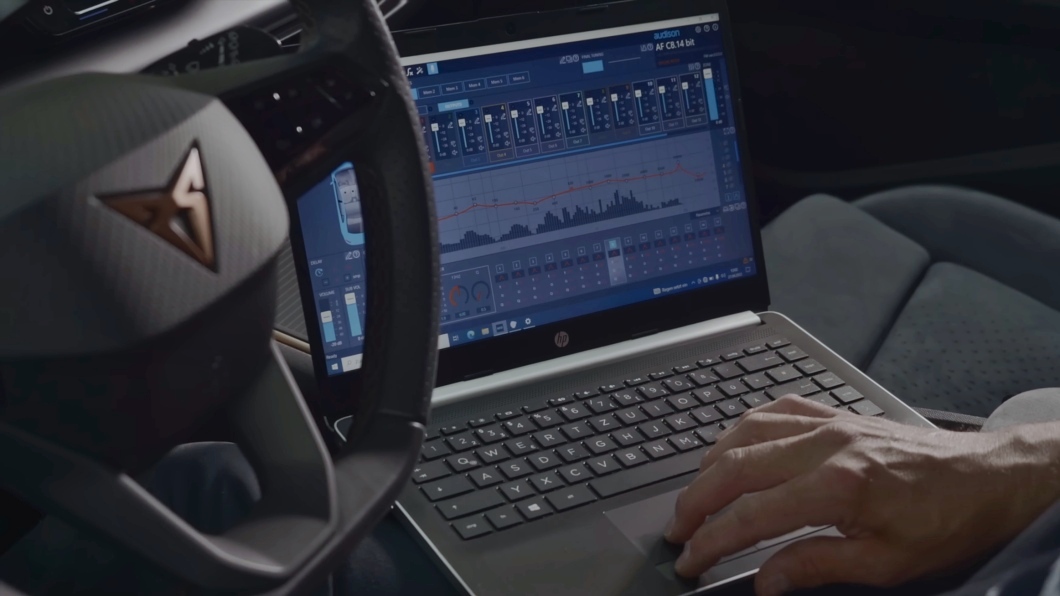
Modern DSP software (Audison BitDrive pictured) offers advanced signal processing features and maximum flexibility in tuning.
Frequency response measurement as the basis for faithful sound
All DSP processor functions only make sense if they are set correctly. Basic sound tuning by ear is theoretically possible, but it will never achieve the results that can be achieved with advanced techniques. The most important of these is measuring the frequency response of individual speakers. This makes it possible to determine exactly how each driver behaves in a specific car – where it has peaks and dips and at what frequencies problems arise.There are several measurement methods, and at Ahifi we use a calibrated measuring microphone and REW (Room EQ Wizard) software, which is the most widely used tool for acoustic measurements. We have tried several methods and approaches over the years, but REW has proven to be the right choice. This is also thanks to the demanding training provided by Peter Steinbacher, one of the most respected sound engineers in the field, which our sound specialist Ján completed in the past. From Peter, he gained detailed know-how not only in measurement technology, but also in advanced software settings. Thanks to this experience, REW is not just a measurement program for us, but a key tool for getting the most out of the DSP processor.
Based on the measurements, we then enter the data into the DSP processor software. Each speaker is assigned its own equalization curve, which takes into account its position and the acoustic conditions of the interior. The result should be the most linear frequency response possible, with the left and right sides sounding symmetrical and all bands flowing smoothly into each other. However, the DSP processor and software alone are not enough – the technician's experience and feel for the final adjustments are always crucial. Measuring the frequency response is fundamental, but the correct technique for setting time corrections and speaker phasing is equally important. The goal is not only to achieve analytically accurate sound, but also sound that is natural, entertaining, and pleasant to listen to. And ultimately, it should also lean towards the listener's musical taste.
Integrated DSP solutions vs. standalone processors
A DSP processor can be part of an amplifier or function as a standalone unit. Amplifiers with an integrated DSP processor combine both functions into one device, which offers the advantage of easier installation, lower space requirements, and usually more favorable prices. They are therefore the ideal choice where simplicity, quick connection, and space savings are a priority—for example, in smaller cars or for customers who want to upgrade their factory system to a higher level without more complex modifications. The disadvantage is less flexibility, usually lower sound quality, and limited space for future expansion, as the manufacturer must combine the amplifier section and DSP circuits into a single chassis.Separate DSP processors, on the other hand, are specialized devices designed exclusively for digital signal processing. This allows them to offer higher-quality ADC/DAC converters, more powerful microprocessors, and a wider range of settings. They often have a larger number of inputs and outputs, the option of expansion with higher-quality DAC cards, and more flexible signal routing. In combination with separate amplifiers, they provide maximum freedom in system design and generally achieve higher sound quality than most integrated solutions.
That is why separate DSP processors are the preferred choice of audiophiles and anyone who wants absolute control over sound. They allow you to exploit the full potential of high-quality speakers, set up your system without compromise, and achieve a level of fidelity that is more common in the world of home hi-fi.
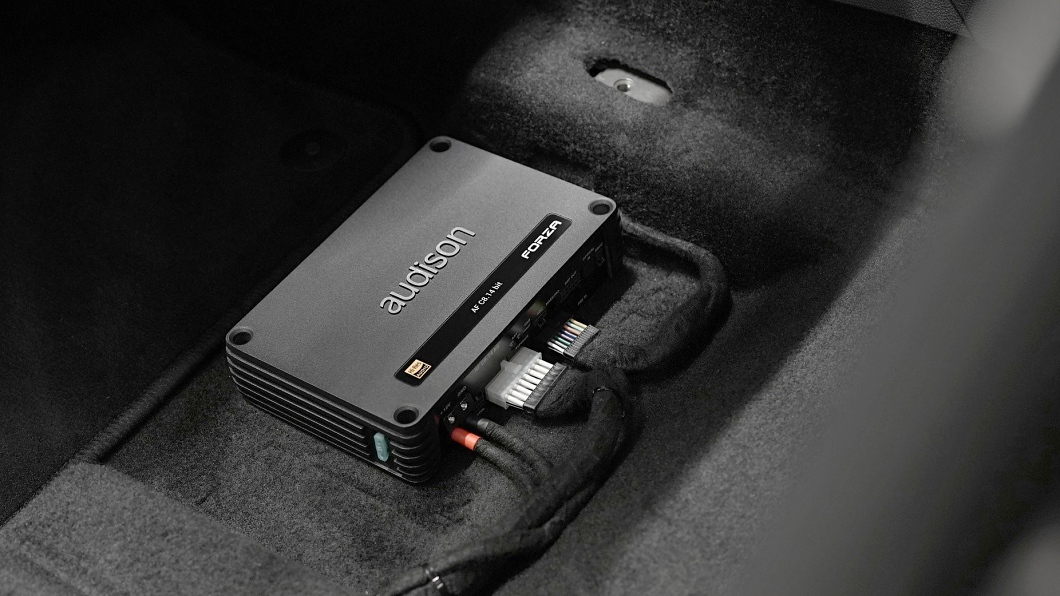
Amplifier with integrated DSP – a compact solution that saves space and simplifies installation.
Software and accessories – the key to getting the most out of DSP
When choosing a DSP processor, it is important to consider the software used to configure the entire system. This determines how accurately and flexibly the technician can control the processor and whether working with it is reliable and efficient. It is not uncommon for even a processor with first-class components and great sound to lose its potential due to insufficiently developed software, limited functions, or poor stability.When it comes to sound quality and configuration options, it is therefore worth choosing processors not only according to their parameters, but also according to the environment in which they are tuned. The current market leader is the German company Helix with its DSP PC-Tool software, followed by the Italian company Audison with its Bit Drive platform. Both manufacturers regularly update their products and constantly introduce new features to ensure the best possible results. Each has its advantages and disadvantages, so it is up to each individual to decide which platform to choose. At Ahifi, we use DSP solutions from both manufacturers for advanced audio installations where maximum quality and precise control are required. However, even basic amplifiers with DSP and simpler software can take standard sound systems up several notches, making them an ideal compromise for more affordable installations.
Accessories play an equally important role. High-quality remote controls allow you to easily switch between presets, select sources, or control the subwoofer volume, and thanks to their sophisticated design, they can fit elegantly into the interior of your car. Expansion cards (e.g., with premium DAC or additional inputs, etc.) and special Hi-Res modules for high-resolution music playback add another dimension to the system. Helix and Audison are also ahead of the curve in this regard, offering a wide range of accessories and long-term support for their products.
Conclusion
Today, a DSP processor is the basis of every audio installation that aims for true quality. It allows you to bypass the limitations of factory systems, adapt the sound to the acoustics of the car, get the most out of speakers and amplifiers, and, above all, evoke the emotions that music brings. And that's what we're all about – that's why we invite you to visit us at Ahifi, where we'll make sure that music accompanies you with joy on every journey..JPG)
DSP allows you to set equalization based on frequency response measurements for each speaker individually.