
Speakers Audison AV 6.5 S II
More about the product
- You can return the goods to us within 14 days
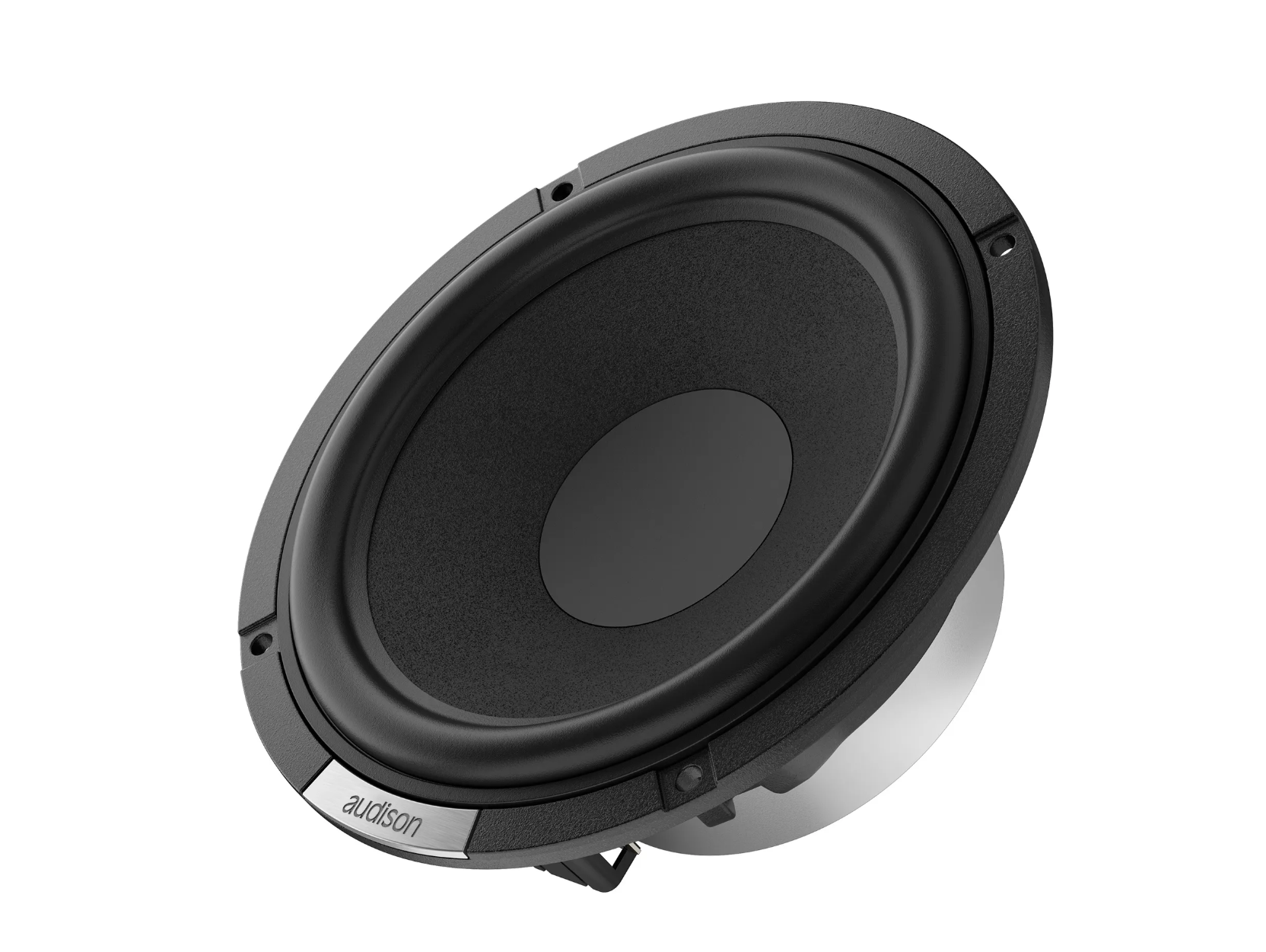
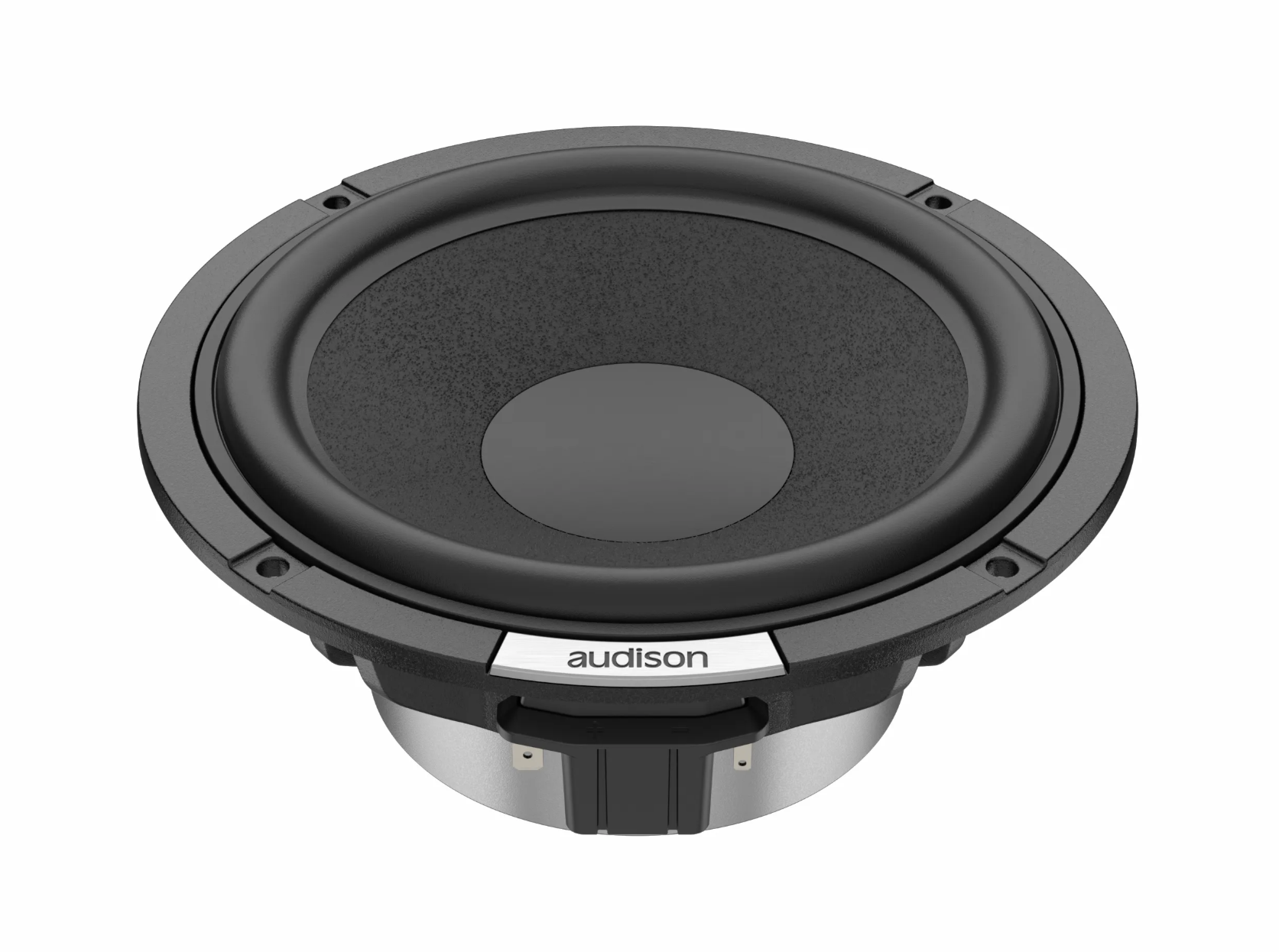
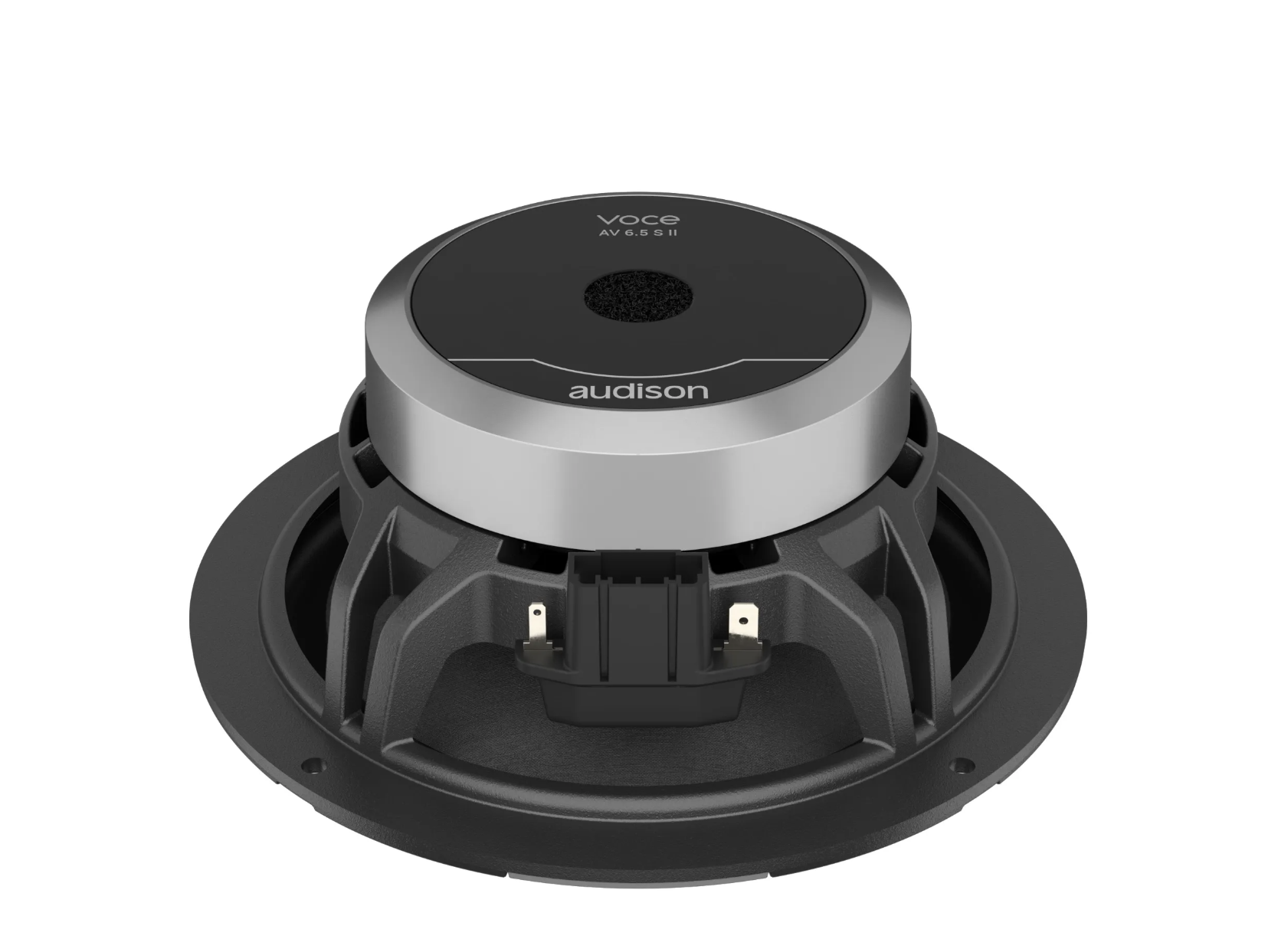
Audison AV 6.5 S II
Audison AV 6.5 S II is a premium 165 mm woofer from the second generation of the Voce line, designed for high‑quality 2‑way car audio systems that require a combination of high power, natural sound and shallow mounting depth. With a depth of just 61 mm, it is also ideal for door applications with limited space.
The driver uses a 36 mm CCAW voice coil and a powerful ferrite magnetic system that ensures precise control of the cone even at higher volumes. The aluminum shorting ring reduces motor inductance and helps improve clarity in the upper midrange.
The semi‑pressed paper pulp cone with cotton fibers combines low weight, stiffness and good internal damping. As a result, the AV 6.5 S II offers natural vocal reproduction, accurate midbass and a wide frequency range up to 5.5 kHz. The die‑cast aluminum basket increases mechanical rigidity and aids heat dissipation.
The AV 6.5 S II is an ideal choice for high‑quality 2‑way systems and OEM upgrade installations where there is not enough space for a deeper woofer but the customer does not want to compromise on power or sound quality.
Main features
- Premium 165 mm woofer from the Audison Voce II series.
- Power 125 W RMS and 250 W peak.
- Impedance 4 Ω.
- Minimum impedance 2.9 Ω.
- Sensitivity 91 dB.
- Frequency range 50 to 5,500 Hz.
- 36 mm CCAW voice coil.
- Powerful ferrite magnet with high magnetic flux density.
- Aluminum shorting ring to reduce inductance and distortion.
- FEM‑optimized magnetic circuit.
- Semi‑pressed paper cone with cotton fibers.
- High‑excursion rubber surround.
- Xmax 4.2 mm.
- Die‑cast aluminum basket.
- Compact mounting depth of only 61 mm.
- OEM connector and classic Faston terminals.
- Especially suitable for high‑quality 2‑way systems.
- eID technology for traceability and product authenticity verification.
- Optional black or silver protective grille.
About the brand
Audison is an Italian brand with a tradition since 1987. Its goal is to produce the best mobile electronics in the world and to continue in an innovative spirit. Sound reproduction has always been a fascinating world where emotion and technology come together. The best result is achieved when these two values are at their peak. Thanks to this combination, each project Audison develops—born from a natural stance fueled by a love of music and an inner need—challenges existing standards. Since the introduction of the first HR 100 amplifier, Audison has created products that have truly marked the history of car hi‑fi. At Audison they are unwaveringly dedicated to research that leads to perfection in in‑vehicle sound reproduction. Audison is a pioneer of innovation and accepts nothing less than perfection in every product it brings to life. Innovation is something that disrupts the standard process and requires a demanding approach that goes beyond common solutions adopted by others. This is where the essence of the Audison brand shows itself. Innovation shapes the entire design process, beginning with the conception of car audio products that deliver unique value and enhance the in‑car listening experience. Audison continually pushes technological boundaries and files dozens of patents. Acoustic quality simply cannot accept compromises!| Catalog number | 69030024 |
| Brand | Audison |
| Links | Official web presentation (English) |
| Speaker typeCoaxial speakers: Coaxial speakers are characterized by a so-called all-in-one design. The tweeter and mid-bass speaker are in one basket. The advantage is simpler assembly, but thanks to the connection or proximity of the bands in one speaker, the sound quality will usually be reduced. As a rule, in the middle of the mid-bass speaker, there is a tweeter whose voice coil works in the second air gap of the common magnetic circuit. The three-way coaxial speaker consists of a mid-bass speaker, a center speaker and a separate tweeter in the front on a special beam. Component Speakers: Component speakers are characterized by a division into individual frequency bands, treble + mid-bass + or. bass band. The individual speakers can be placed completely separately, which results in a better sound and acoustic performance. In the vast majority of cases of component speakers, an external crossover is also supplied, which divides the treble, middle / mid-bass, and into the three-band the bass band or allows setting the decibel level of the tweeter (e.g. +2 dB, 0 dB, -2 dB), steepness (e.g. 6dB/Oct. 12dB/Oct.) or active or bi-amp connection. | Mid-bass |
| RMS powerRMS speaker power is the constant power of the entire system, not just one speaker or one side. This is also the performance of continuous use of the speakers. If the RMS power is exceeded for a long time, the speakers may be irreversibly damaged! | 150 W |
| Max. (maximum performancePeak performance , which the speaker can play for a moment (approx. 0.5 s), for example when hitting drums in a song. If the max power is exceeded, the speakers will usually be damaged! | 300 W |
| Sensitivity (SPL 2.83V/1m)Sensitivity, sensitivity or efficiency of the speaker. Speaker sensitivity is given in decibels (dB) and simply put, the higher the value, the lower the demands on the amplifier's power. This is a defacto rating of how a speaker converts watts to sound. Sensitivity ratings are in noise level measured at 1 meter from the speaker using 1 W (watt of power) or using 2.83 volts at the source at 1 meter. A higher decibel level means the speaker is louder with less power. For every 3 dB increase in sensitivity, the speaker requires half the power to reproduce the same volume. For example, if an 88 dB speaker needs 100 Watts to produce a certain volume, then a speaker with a sensitivity of 91 dB needs only 50 Watts to reach the same volume. | 91 dB |
| ImpedanceImpedance - measurement of electrical resistance. When buying speakers, it is important to make sure that the impedance matches the amplifier or car stereo you are using. Example: A 2 Ohm speaker cannot be connected to an amplifier that is only stable up to 4 Ohms! A 4 Ohm speaker can easily be used with an amplifier that is stable up to 2 Ohms. The most common speaker impedance today is 3 - 4 Ohm. | 4 Ω |
| Frequency rangeThe ability of the speakers to play a signal from the lowest frequency to the highest, or the speaker's ability to faithfully reproduce sound in a specific frequency band. Professionally: In the frequency range from 40 to 16,000 Hz, the vast majority of fundamental and overtones (harmonics) of all musical instruments are found. We are interested in the course of the radiated sound pressure in this range of frequencies when the loudspeaker system is supplied with constant power. We call this course the frequency characteristic, which tells us the level of radiated sound pressure in decibels (dB) depending on the frequency. The frequency characteristic of a speaker or speaker system can be expressed most succinctly with a graph. Mostly, however, the frequency characteristic is indicated by indicating the maximum tolerance of the sound pressure in the given frequency range, e.g. 50 to 15,000 Hz -+ 6 dB. Since the frequency characteristics of loudspeakers and systems in general are quite uneven, some manufacturers do not even specify this maximum tolerance of sound pressure in decibels in their catalogs for reasons of prestige. Data impoverished in this way is unfortunately worthless. What is valid is that the manufacturer offers a speaker system with a frequency range of 30 to 20,000 Hz, if he is worried about stating the maximum unevenness of the sound pressure in this range, because he can have a tolerance of, for example, +- 20 dB. The unevenness or undulation of the frequency curve in good speaker systems for high-quality music performance should not exceed +-3 dB in the 80 to 12,000 Hz band and +-6 dB in the 40 to 16,000 Hz band. Greater unevenness already depletes or emphasizes certain tonal areas, which can cause audible or even disturbing distortion. The proportion between fundamental tones and higher harmonics also changes, thereby changing the color of the sound, and individual musical instruments as well as the entire musical image sound unnatural. | 50 - 5500 Hz |
| The diameter of the mid-bass speakerWe state the diameter of the speaker as the diameter of the entire speaker, not including the mounts, when smaller speakers (87, 100, 130 mm) have extra mounts. Some speakers are oval and there the dimension is given in inches, always the shortest side to the longest side. One inch is approx. 2.5 cm. | 165 mm |
| Installation depth of the mid-bass speakerThe installation depth of the speaker is measured from the bottom edge of the magnet to the bottom edge of the tin, plastic or cast speaker basket, or speaker bearing surfaces. | 61 mm |
| Mid-woofer diaphragm materialThe material that was used for the speaker diaphragm. Don't be afraid of the paper, it surprisingly has a very natural and high-quality sound and, thanks to the surface treatment, it can withstand moisture without any problems. | Pressed paper |
| Cover grids included in the packageOriginal cover grilles in speaker packaging. | No |
| Price forIf the price is for a pair, the package always includes 2 pieces of everything, e.g. 2x mid-bass, 2x tweeter and 2x crossover. | Pair |
Evaluation
Recently viewed products
 -40 %NewQuick previewcomponent speakers, Ø 100 / 20 mm, 50 W RMS, 4 Ω, 88 dB (2.83V/1m), cone: paper / silk52,56 EUR
 -27 %Quick preview4-channel amplifier, 4 x 120 / 2 x 400 W RMS (4 Ω), 4 x 200 W RMS (2 Ω), Class D174,91 EUR
 -27 %Quick preview1-channel amplifier, 1 x 700 / 1200 / 2200 W RMS (4 / 2 / 1 Ω), Class D233,31 EUR
 -40 %NewQuick previewcoaxial speakers, Ø 130 / 13 mm, 50 W RMS, 4 Ω, 88 dB (2.83V/1m), membrane: paper / mylar35,76 EUR
 -27 %Quick preview1-channel amplifier, 1 × 600 / 1000 / 1500 W RMS (4 / 2 / 1 Ω), Class D, remote control204,11 EUR
 -40 %NewQuick previewcoaxial speakers, Ø 100 / 13 mm, 45 W RMS, 4 Ω, 87 dB (2.83V/1m), cone: paper / mylar33,36 EUR