
ESB Audio HR 4C speakers
More about the product
- You can return the goods to us within 14 days
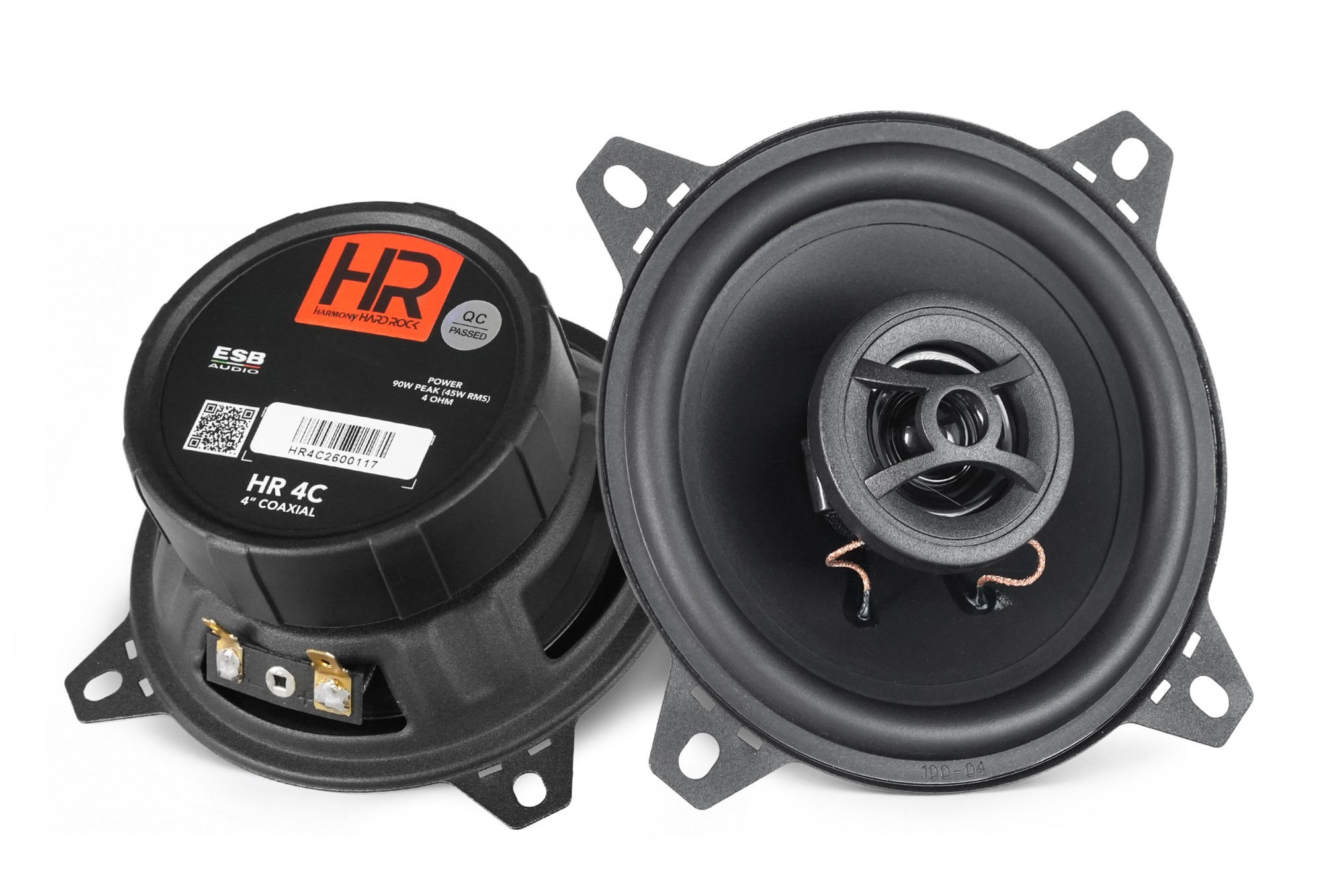
Coaxial Speakers ESB HR 4C
The ESB Harmony Hard Rock HR 4C coaxial speakers belong to the brand’s basic model range and are primarily intended as an affordable upgrade to factory sound systems. Thanks to relatively high sensitivity and low power demands, they can be powered by the factory head unit, an aftermarket car stereo or a small external amplifier. The mid-bass section uses a lightweight paper cone, while the tweeter integrated in the center of the cone uses a lightweight mylar dome. The coaxial design enables simple installation into a single factory location without the need for a separate tweeter or crossover.
Cone, surround and basket
The mid-bass section uses a paper cone, which offers a good balance of low mass, stiffness and damping of unwanted resonances. The rubber surround helps maintain stable and linear cone movement and limits undesirable displacement of the moving system. The steel basket features an open design that supports airflow behind the cone and improves ventilation of the voice coil. Its shape also provides sufficient mechanical rigidity for typical automotive use.
Magnetic system and voice coil
The magnetic system uses a ferrite magnet designed as a reasonable compromise between size, weight and magnetic flux. The voice coil with an aluminum former aids heat dissipation and allows the speaker to operate stably even at higher volumes. The mobile system construction focuses primarily on reliable operation and balanced sound in common installation conditions.
Harmony model range
The Italian Harmony brand was born in the 1980s alongside ESB Audio’s first domestic loudspeakers. In the 1990s its offering expanded to include car speakers, with the main idea of providing quality sound and construction at a more accessible price than the higher ESB model lines. That philosophy continues today in the Harmony Blue Note and Hard Rock series. The Blue Note name references the famous jazz era of the 1930s to 1950s, and products in that series focus on natural, balanced sound without pronounced coloration. The Hard Rock series, on the other hand, offers a different tuning with emphasis on stronger, deeper bass and higher power. Harmony thus gradually builds a comprehensive product range for a wide spectrum of listeners.
Main features
- Basic coaxial speakers from ESB's Harmony Hard Rock series.
- Suitable for upgrading factory sound systems.
- Paper cone for the mid-bass section.
- Rubber surround for stable cone movement.
- Integrated tweeter with a mylar dome.
- Open steel basket design.
- Ferrite magnetic system.
- Voice coil with aluminum former.
- Easy installation into a single mounting position.
- Suitable for use with head units as well as external amplifiers.
About ESB Audio
The history of ESB Audio goes back to 1972 when this Italian brand was officially founded. ESB Audio is one of the most renowned loudspeaker manufacturers of the second half of the 20th century and throughout its rich history launched many innovative technologies and numerous high-end products in the home audio sector that achieved great worldwide success. Based on these experiences, ESB engineers began researching sound optimization in the automotive environment in 1984 and started producing the first car speakers two years later. Due to great success, ESB increasingly focused on the automotive industry and its demanding challenges. Car audio became a phenomenon of that era, and in 2005 a school dedicated exclusively to vehicle audio was established in Aprilia, where ESB is based. At that time the decision was made to leave the home audio market and devote the company exclusively to car audio. Today ESB, together with the American manufacturer of audiophile amplifiers and DSP processors Zapco, is part of the Italian Apex Group. The range includes several model lines of speakers led by the high-end 3-way Novemila system, which represents some of the most acoustically and aesthetically advanced speakers on the market today. ESB's main mission remains to manufacture speakers of the highest quality aimed at faithful sound reproduction, enabling the user to hear music as the creator intended—exactly according to the company's slogan "Just like live".
| Catalog number | HR 4C |
| Brand | ESB Audio |
| Links | Official web presentation (English) |
| Speaker typeCoaxial speakers: Coaxial speakers are characterized by a so-called all-in-one design. The tweeter and mid-bass speaker are in one basket. The advantage is simpler assembly, but thanks to the connection or proximity of the bands in one speaker, the sound quality will usually be reduced. As a rule, in the middle of the mid-bass speaker, there is a tweeter whose voice coil works in the second air gap of the common magnetic circuit. The three-way coaxial speaker consists of a mid-bass speaker, a center speaker and a separate tweeter in the front on a special beam. Component Speakers: Component speakers are characterized by a division into individual frequency bands, treble + mid-bass + or. bass band. The individual speakers can be placed completely separately, which results in a better sound and acoustic performance. In the vast majority of cases of component speakers, an external crossover is also supplied, which divides the treble, middle / mid-bass, and into the three-band the bass band or allows setting the decibel level of the tweeter (e.g. +2 dB, 0 dB, -2 dB), steepness (e.g. 6dB/Oct. 12dB/Oct.) or active or bi-amp connection. | Coaxial |
| RMS powerRMS speaker power is the constant power of the entire system, not just one speaker or one side. This is also the performance of continuous use of the speakers. If the RMS power is exceeded for a long time, the speakers may be irreversibly damaged! | 45 W |
| Max. (maximum performancePeak performance , which the speaker can play for a moment (approx. 0.5 s), for example when hitting drums in a song. If the max power is exceeded, the speakers will usually be damaged! | 90 W |
| Sensitivity (SPL 2.83V/1m)Sensitivity, sensitivity or efficiency of the speaker. Speaker sensitivity is given in decibels (dB) and simply put, the higher the value, the lower the demands on the amplifier's power. This is a defacto rating of how a speaker converts watts to sound. Sensitivity ratings are in noise level measured at 1 meter from the speaker using 1 W (watt of power) or using 2.83 volts at the source at 1 meter. A higher decibel level means the speaker is louder with less power. For every 3 dB increase in sensitivity, the speaker requires half the power to reproduce the same volume. For example, if an 88 dB speaker needs 100 Watts to produce a certain volume, then a speaker with a sensitivity of 91 dB needs only 50 Watts to reach the same volume. | 87 dB |
| ImpedanceImpedance - measurement of electrical resistance. When buying speakers, it is important to make sure that the impedance matches the amplifier or car stereo you are using. Example: A 2 Ohm speaker cannot be connected to an amplifier that is only stable up to 4 Ohms! A 4 Ohm speaker can easily be used with an amplifier that is stable up to 2 Ohms. The most common speaker impedance today is 3 - 4 Ohm. | 4 Ω |
| Frequency rangeThe ability of the speakers to play a signal from the lowest frequency to the highest, or the speaker's ability to faithfully reproduce sound in a specific frequency band. Professionally: In the frequency range from 40 to 16,000 Hz, the vast majority of fundamental and overtones (harmonics) of all musical instruments are found. We are interested in the course of the radiated sound pressure in this range of frequencies when the loudspeaker system is supplied with constant power. We call this course the frequency characteristic, which tells us the level of radiated sound pressure in decibels (dB) depending on the frequency. The frequency characteristic of a speaker or speaker system can be expressed most succinctly with a graph. Mostly, however, the frequency characteristic is indicated by indicating the maximum tolerance of the sound pressure in the given frequency range, e.g. 50 to 15,000 Hz -+ 6 dB. Since the frequency characteristics of loudspeakers and systems in general are quite uneven, some manufacturers do not even specify this maximum tolerance of sound pressure in decibels in their catalogs for reasons of prestige. Data impoverished in this way is unfortunately worthless. What is valid is that the manufacturer offers a speaker system with a frequency range of 30 to 20,000 Hz, if he is worried about stating the maximum unevenness of the sound pressure in this range, because he can have a tolerance of, for example, +- 20 dB. The unevenness or undulation of the frequency curve in good speaker systems for high-quality music performance should not exceed +-3 dB in the 80 to 12,000 Hz band and +-6 dB in the 40 to 16,000 Hz band. Greater unevenness already depletes or emphasizes certain tonal areas, which can cause audible or even disturbing distortion. The proportion between fundamental tones and higher harmonics also changes, thereby changing the color of the sound, and individual musical instruments as well as the entire musical image sound unnatural. | 80 - 18000 Hz |
| The diameter of the mid-bass speakerWe state the diameter of the speaker as the diameter of the entire speaker, not including the mounts, when smaller speakers (87, 100, 130 mm) have extra mounts. Some speakers are oval and there the dimension is given in inches, always the shortest side to the longest side. One inch is approx. 2.5 cm. | 130 mm |
| Installation depth of the mid-bass speakerThe installation depth of the speaker is measured from the bottom edge of the magnet to the bottom edge of the tin, plastic or cast speaker basket, or speaker bearing surfaces. | 54 mm |
| Mid-woofer diaphragm materialThe material that was used for the speaker diaphragm. Don't be afraid of the paper, it surprisingly has a very natural and high-quality sound and, thanks to the surface treatment, it can withstand moisture without any problems. | Pressed paper |
| Voice coil diameter of the mid-bass speaker | 25 mm (1") |
| Magnet | 6.4 Oz Ferrite |
| Tweeter dome diameterThe net diameter of the dome (diaphragm) of the tweeter. | 13 mm |
| Tweeter dome materialThe shell material that was used in the manufacture of the tweeter. | Mylar |
| Cover grids included in the packageOriginal cover grilles in speaker packaging. | No |
| Price forIf the price is for a pair, the package always includes 2 pieces of everything, e.g. 2x mid-bass, 2x tweeter and 2x crossover. | Pair |
Evaluation
Recently viewed products
 -27 %Quick preview4-channel amplifier, 4 x 120 / 2 x 400 W RMS (4 Ω), 4 x 200 W RMS (2 Ω), Class D174,91 EUR
 -27 %Quick preview1-channel amplifier, 1 x 700 / 1200 / 2200 W RMS (4 / 2 / 1 Ω), Class D233,31 EUR
 -27 %Quick preview1-channel amplifier, 1 × 600 / 1000 / 1500 W RMS (4 / 2 / 1 Ω), Class D, remote control204,11 EUR