Amplifier with DSP processor Zapco ADSP-Z8 IV-6AT - used goods
More about the product
- You can return the goods to us within 14 days
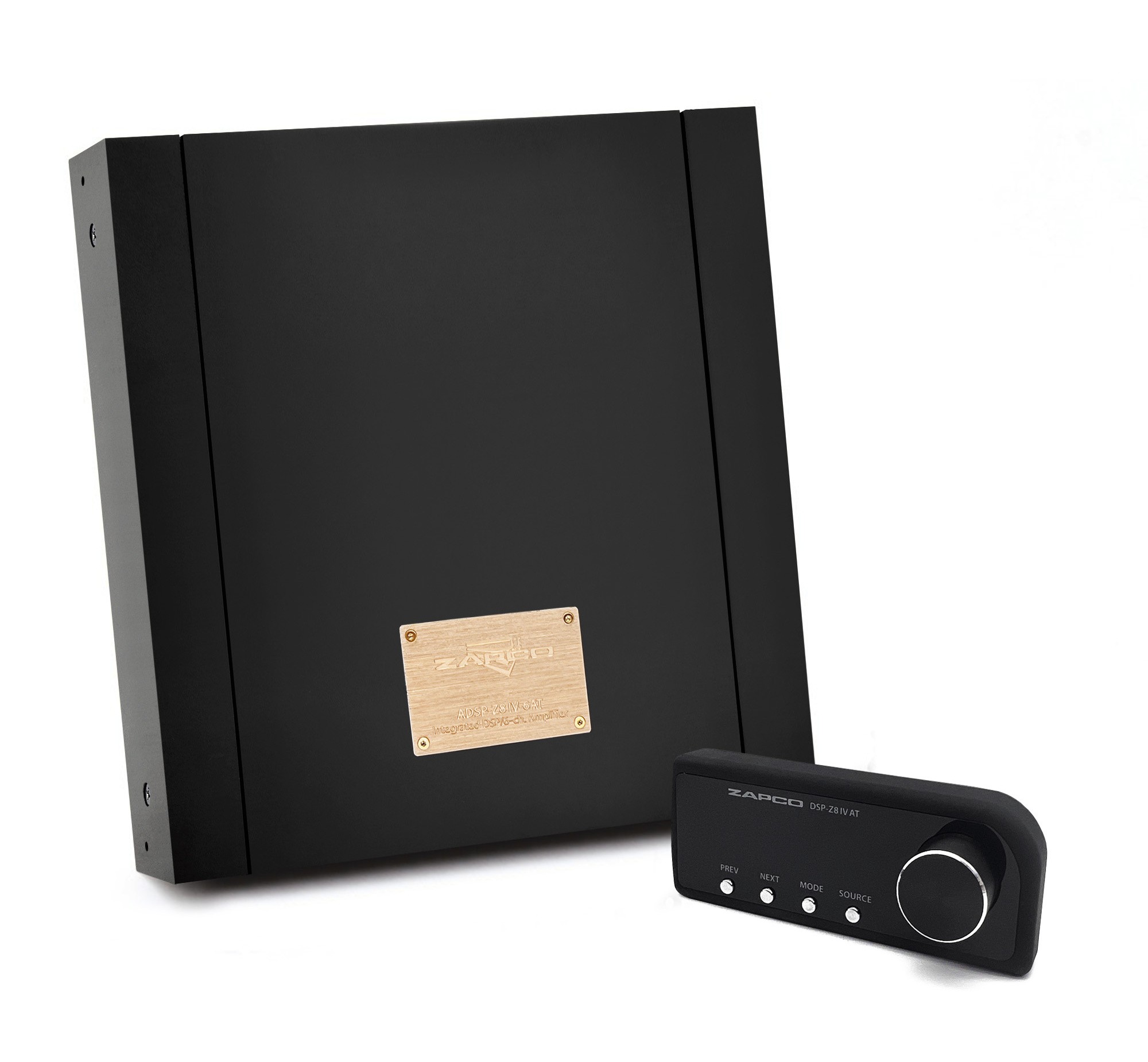
- The amplifier is 100% functional.
- Original box damaged.
- Top cover sealed.
- Returned by customer.
Zapco ADSP-Z8 IV-6AT amplifier with DSP processor
Many years ago Zapco introduced its DSP processor DSP-Z8 IV. It was designed to bring true audiophile sound quality into an affordable DSP. The Zapco DSP-Z8 IV outperformed much pricier units and delivered sound quality better than devices costing twice as much. But as Zapco has always said — and will always say — “We believe we can be even better.” In 2018 the updated DSP-Z8 IV II series was launched with numerous improvements, and in 2022 a completely new model range, the Zapco DSP-Z8 IV AT, arrived. It includes two new DSP processors, two DSP-equipped amplifiers and a digital monoblock. What’s new in the IV AT series? New features, new controls and, of course, even better sound. The unified Black and Copper aesthetic matching Zapco’s AP series audiophile amplifiers is just the beginning.
New features of the Zapco ADSP-Z8 IV-6AT
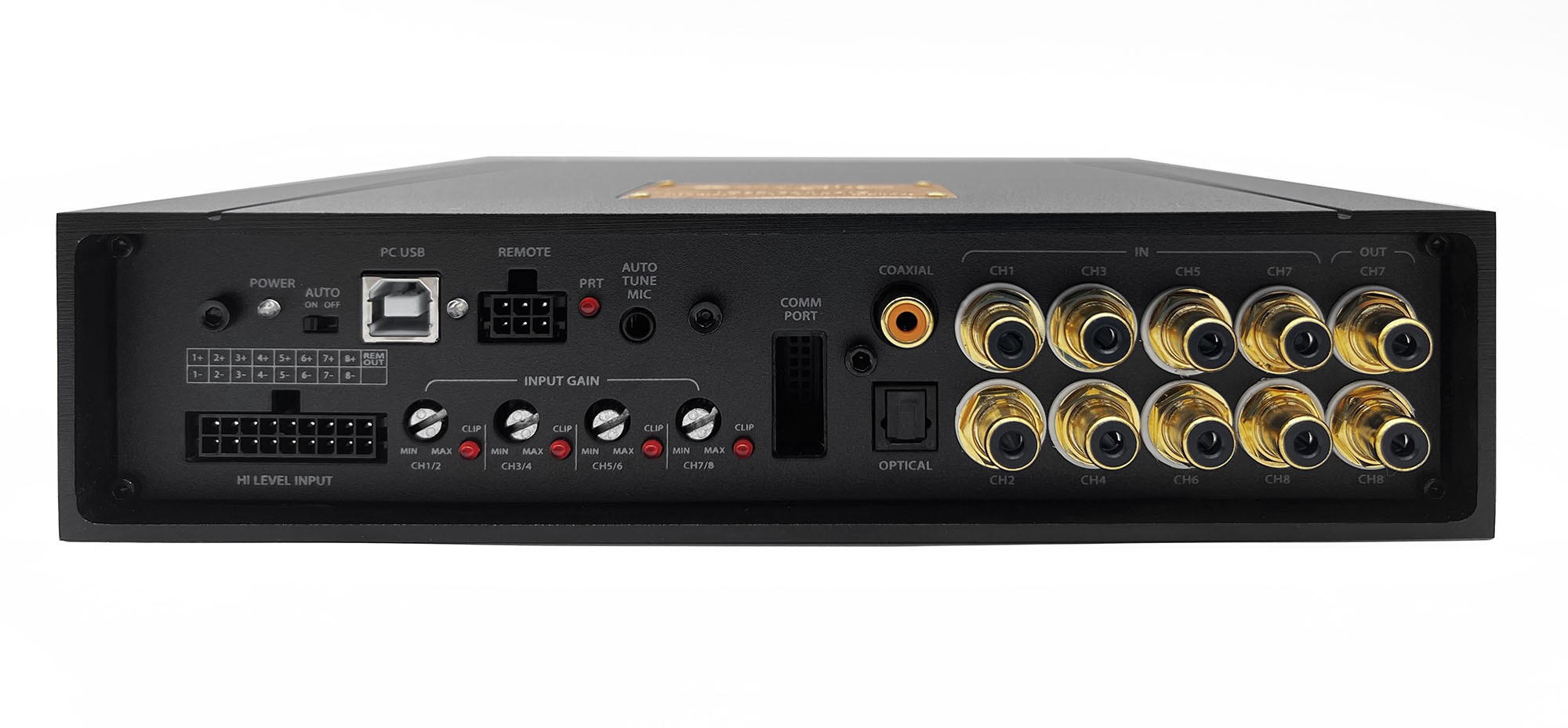
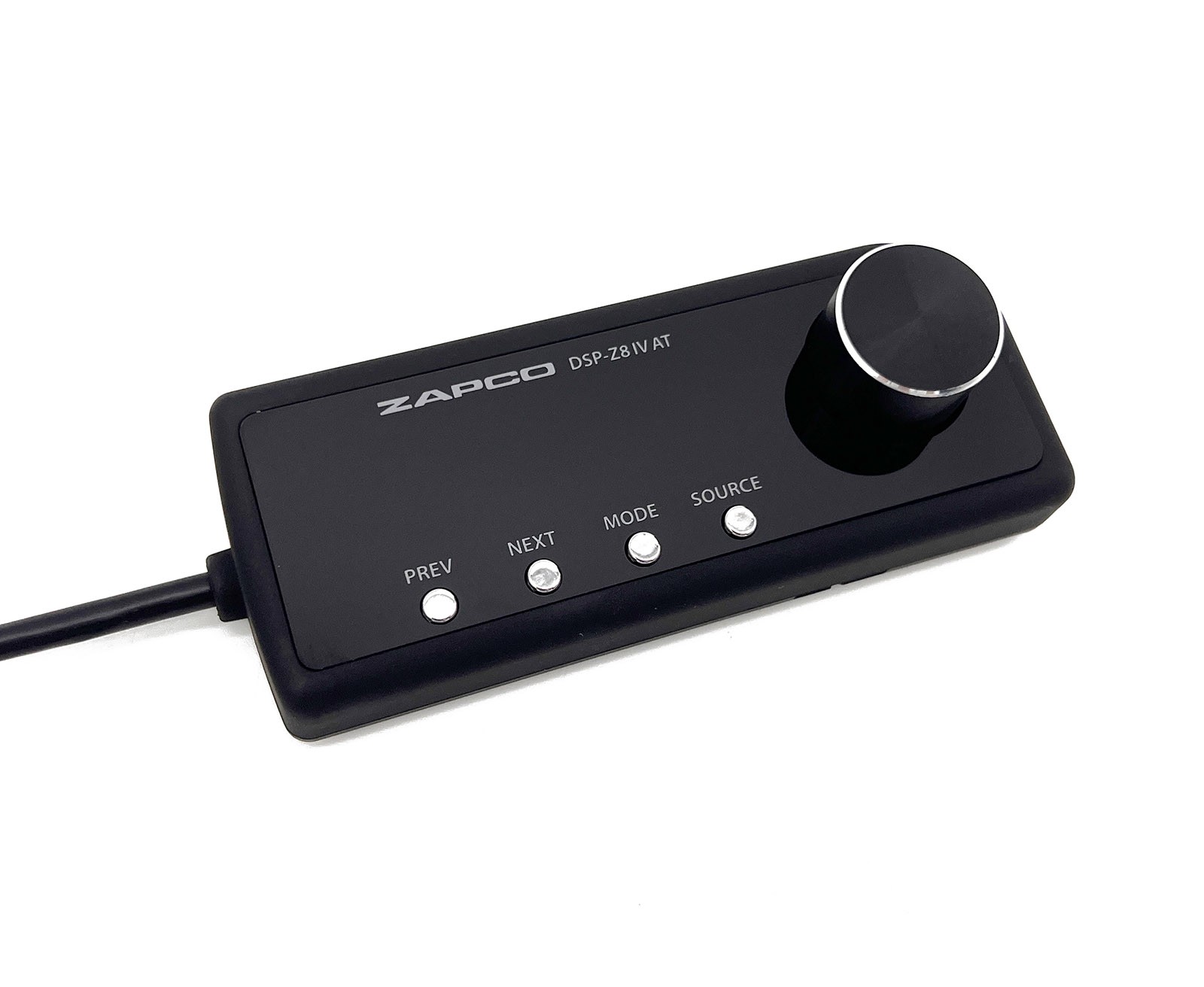
Compared to its predecessor, the Zapco ADSP-Z8 IV-6AT has two fewer channels and now offers six channels with 80 W RMS per channel at 4 ohms. The amplifier is stable down to 2 ohms and channels can be bridged. The unit now provides 8 high-level inputs, 8 low-level RCA inputs and, new for this model, 2 RCA outputs. New coaxial and optical inputs accept digital signal from a head unit or a portable HD player. There is also the ability to set the input signal level, improved PC software, optional automatic calibration using a dedicated microphone, and notably a Bluetooth module for Hi-Res music streaming available as an accessory. A new remote control lets you change the input source, adjust master volume or the amplifier output for a subwoofer, and even skip tracks when streaming music from a mobile app.
Main features of the Zapco ADSP-Z8 IV-6AT
- 6-channel Class D amplifier with integrated DSP processor.
- Power: 6 x 80 W RMS (4 Ω), 8 x 120 W RMS (2 Ω).
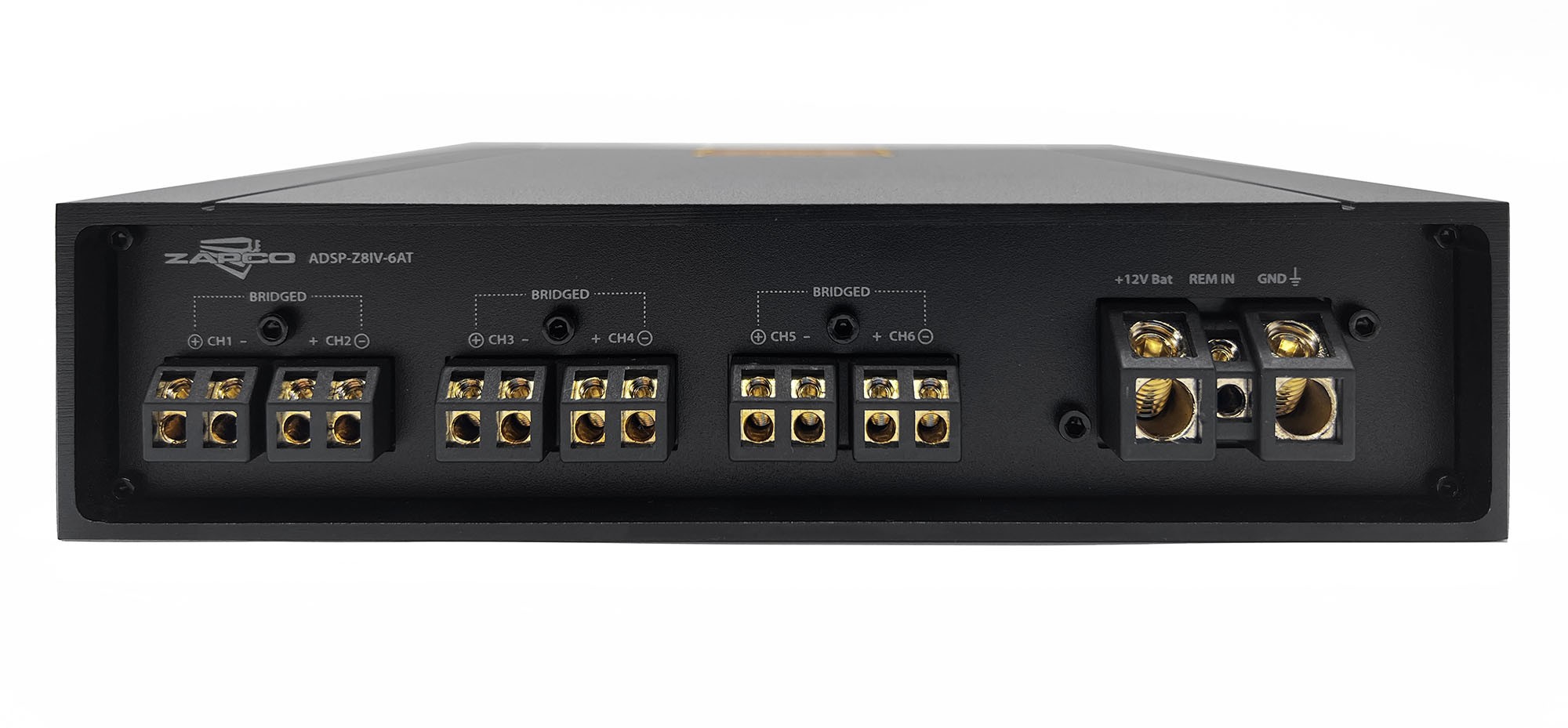
- Bridged power at 4 Ω: 3 x 240 W RMS.
- DSP Processor: Cirrus Logic CS47048.
- ADC: Cirrus Logic CS47048 32 bit/192 KHz.
- ADC Dynamic Range/THD: 108 dB / -98 dB.
- DAC: Cirrus Logic CS8422 24 bit/192 KHz.
- DAC Dynamic Range/THD: 140 dB / -120 dB.
- Inputs: 8 x RCA, 8 x high-level, 1 x optical, 1 x coaxial.
- Outputs: 2 x RCA.
- Automatic sound calibration function.
- Remote control included.
- High-resolution music streaming via optional Zapco HD-BT module.
Improved PC software
The new Zapco ADSP-Z8 IV-6AT gives you the great sound and features of the Series IV II and adds coaxial and optical digital inputs as well as Bluetooth streaming. The PC software has also received several enhancements. Dropdown menus now allow you to name each output channel to match your system configuration. The added Advanced menu includes new Mixing Set and AutoTune features. The new DSP-Z8 IV AT offers more input selection options — you can have up to 8 input channels and instantly set the configuration to 2-Ch, 4-Ch, 6-Ch or 8-Ch in the front-end input section. If you need to sum factory stereo channels to achieve full input range, simply click SUM and the system handles it automatically. For more complex setups you can enter the Advanced menu and use Mixing Set to manually assign how much of each input channel feeds every output channel, tailoring it precisely to your audio system.
Automatic sound calibration
The IV AT DSP processors now provide automatic calibration for EQ, phase and delay when using the optional calibrated Zapco microphone. You can choose which functions to have the system calibrate and which channels to include. In the graph area you can watch the system work and view the speaker EQ curves. Calibration of all channels and functions is completed automatically within 5 to 10 minutes, saving you hours of manual tuning. Of course the human ear remains the final judge, but automatic tuning brings you to a point where only final tweaks are needed before enjoying your music.
About Zapco
Zapco is the oldest high-end car audio brand in the world, specializing in premium amplifiers and DSP processors for vehicles. Founded in the USA in 1974, the company has since collected numerous awards from prestigious organizations recognizing product quality and innovation, as well as from global sound quality competitions. Zapco amplifiers deliver uncompromising audiophile quality, define the standard of excellence and set the benchmarks by which other products are judged. For more than 45 years Zapco has continuously sought innovative ways to bring better sound into the automotive environment, and this relentless pursuit of absolute sound quality yields new technologies and high-end products. Why? Because nothing else grips the soul and brings tears to the eyes like music. Through music you can dance for joy — of all the arts, music has the strongest and most immediate effect on body and mind. Reproducing music in all its beauty and subtlety deserves nothing less than the utmost effort from everyone at Zapco. Because music matters!
| Catalog number | ADSP-Z8 IV-6AT-P1 |
| Brand | Zapco |
| Links | Official web presentation (English) |
| Energy class of the amplifierAmplifiers are divided into two basic classes: analog and digital . Analog amplifiers (A/B) have higher consumption requirements, but usually have a more natural sound. Digital amplifiers (D) have significantly lower consumption and higher efficiency, but the sound may not be as faithful as with classic analog amplifiers. | D |
| Number of amplifier channelsAmplifiers are divided into: - Monoblocks - 2-channel - 3-channel - 4-channel - 5-channel - 6-channel - multi-channel Each channel is used to power one speaker for the coaxial type, or one side if they are component speakers. Monoblock type amplifiers are mainly used for subwoofers. 2-channel are suitable for both subwoofers and, for example, the front pair of speakers in a car. 3-channel is used for front or rear speakers + subwoofer. 4-channel are used for front + rear speakers or 1 pair of speakers + subwoofer. 6 or 5-channel are used for 2 pairs of speakers + subwoofer, most often. Bridging means connecting the amplifier to a bridge, using the + pole from one channel and the - pole from the other channel. In most cases this is shown as "BRIDGED" on the amplifier. | 6 |
| RMS power into 4 ΩRMS power when loading speakers or subwoofer at 4 Ω. RMS power is the constant power of the amplifier and is one of the most important parameters when choosing an amplifier. | 6 x 80 W / 3 x 240 W |
| RMS power into 2 ΩRMS power when loading speakers or subwoofer at 2 Ω. RMS power is the constant power of the amplifier and is one of the most important parameters when choosing an amplifier. | 6 x 120 W |
| Frequency rangeThe ability of the amplifier to reproduce the signal from the lowest frequency to the highest = faithfully reproduce the sound in a specific frequency band. Professionally: In the frequency range from 40 to 16,000 Hz, the vast majority of fundamental and overtones (harmonics) of all musical instruments are found. We are interested in the course of the radiated sound pressure in this range of frequencies when the loudspeaker system is supplied with constant power. We call this course the frequency characteristic, which tells us the level of radiated sound pressure in decibels (dB) depending on the frequency. The frequency characteristic of a speaker or speaker system can be expressed most succinctly with a graph. Mostly, however, the frequency characteristic is indicated by indicating the maximum tolerance of the sound pressure in the given frequency range, e.g. 50 to 15,000 Hz -+ 6 dB. Since the frequency characteristics of loudspeakers and systems in general are quite uneven, some manufacturers do not even specify this maximum tolerance of sound pressure in decibels in their catalogs for reasons of prestige. Data impoverished in this way is unfortunately worthless. What is valid is that the manufacturer offers a speaker system with a frequency range of 30 to 20,000 Hz, if he is worried about stating the maximum unevenness of the sound pressure in this range, because he can have a tolerance of, for example, +- 20 dB. The unevenness or undulation of the frequency curve in good speaker systems for high-quality music performance should not exceed +-3 dB in the 80 to 12,000 Hz band and +-6 dB in the 40 to 16,000 Hz band. Greater unevenness already depletes or emphasizes certain tonal areas, which can cause audible or even disturbing distortion. The proportion between fundamental tones and higher harmonics also changes, thereby changing the color of the sound, and individual musical instruments as well as the entire musical image sound unnatural. | 10 - 22500 Hz |
| Harmonic Distortion (THD)Total harmonic distortion indicates how much the input signal is distorted in the amplifier. Distortions appear as overtones contained in the output signal. The proportion of originally absent parts of the signal is given as a percentage, typical values are between 0.001% and 0.5%. Distortion is measured in their power band. If it exceeds the limit of 0.7% from a certain power, it is the value of the output power of the given amplifier, from which it no longer plays without distortion and from which the distortion usually increases steeply, so that no further increase in power can be counted on. The lower the value, the better. | 0.002 % |
| Signal-to-noise ratioThe signal-to-noise ratio means that the output signal always contains noise. The signal-to-noise ratio expresses how much of this noise is compared to the useful signal. The so-called A value is given, which does not take deep and very high frequencies into account. This corresponds to the characteristic of human hearing, which is not so sensitive to deep frequencies, especially below 1 kHz. The higher the value, the better the amplifier is. | 110 dB |
| High level inputsThe high-level input on the amplifier allows connection directly to the existing speakers in the car without additional purchase of an external high/low adapter. Important equipment in the case of installing an amplifier on an original car radio. | Yes |
| Automatic on and offThis function allows you to automatically switch on the amplifier. | Yes |
| Socket input terminalsFerrule terminals allow better wiring contact to the amplifier. It is also a more secure form of terminals. If you are tightening the sleeve terminals, we recommend retightening them after 1 day, as the connected cable gradually compresses. | Yes |
| Remote control included in the packageSome models of amplifiers also come with wired remote controls in the package, which on one side plug into the amplifier and on the other side you have a potentiometer that you can place anywhere in the cabin. A common place to place the remote control is under the steering wheel. The advantage is the regulation of power, and therefore volume, depending on driving conditions and the mood of the crew in the car. | Yes |
| Dimensions of the amplifier | 222 x 230 x 52 mm |