
Amplifier with DSP processor Nakamichi NDSE300A
More about the product
- You can return the goods to us within 14 days
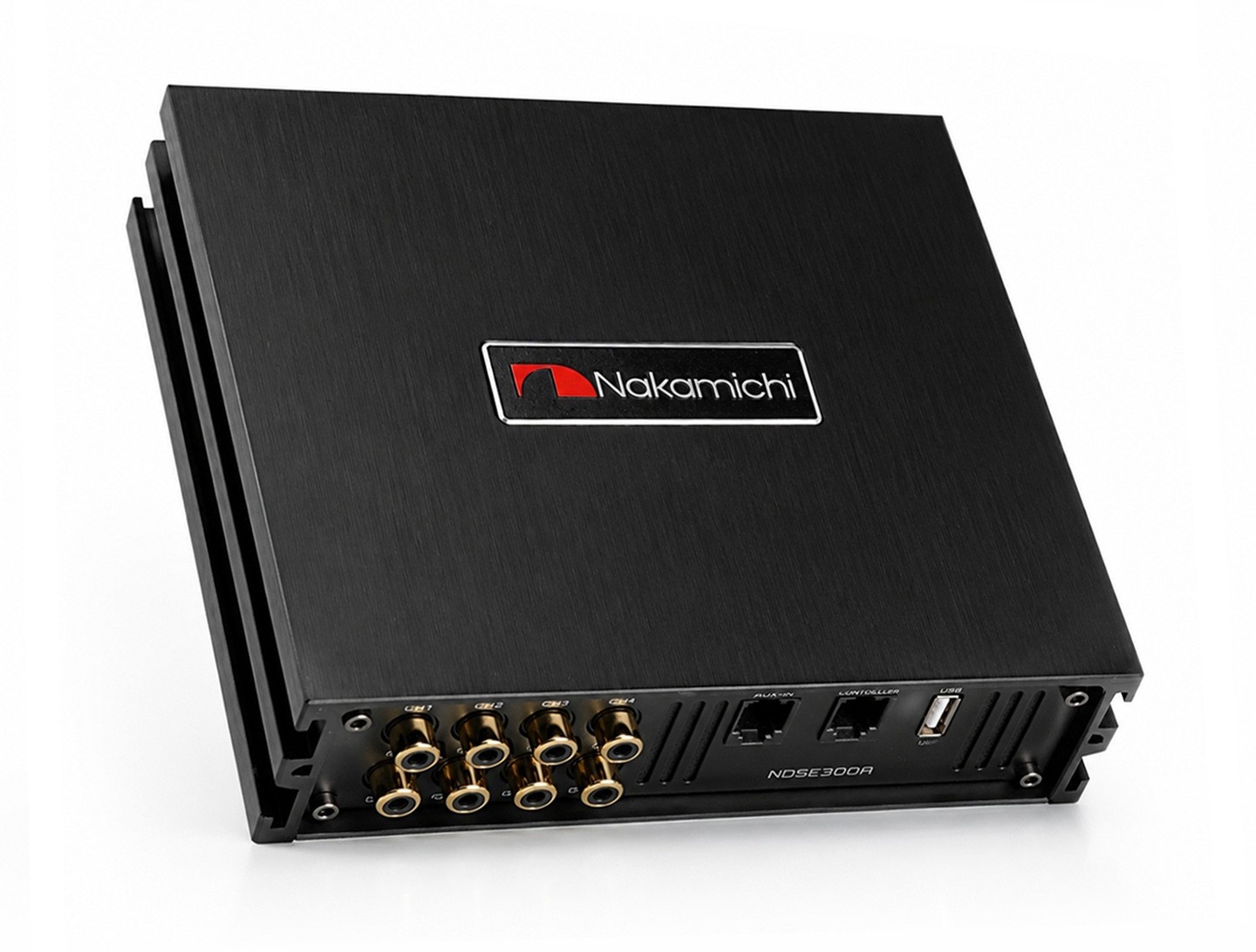
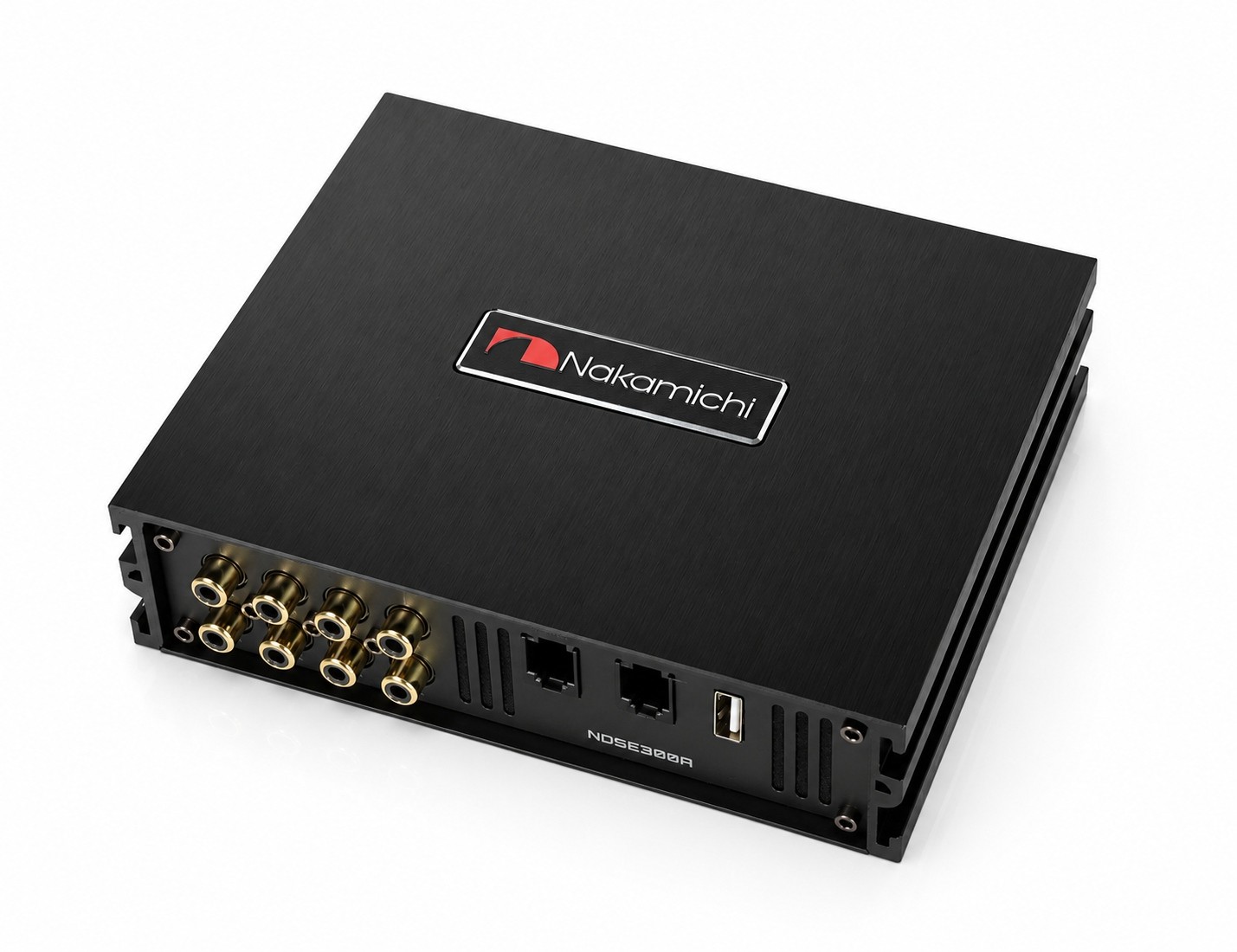
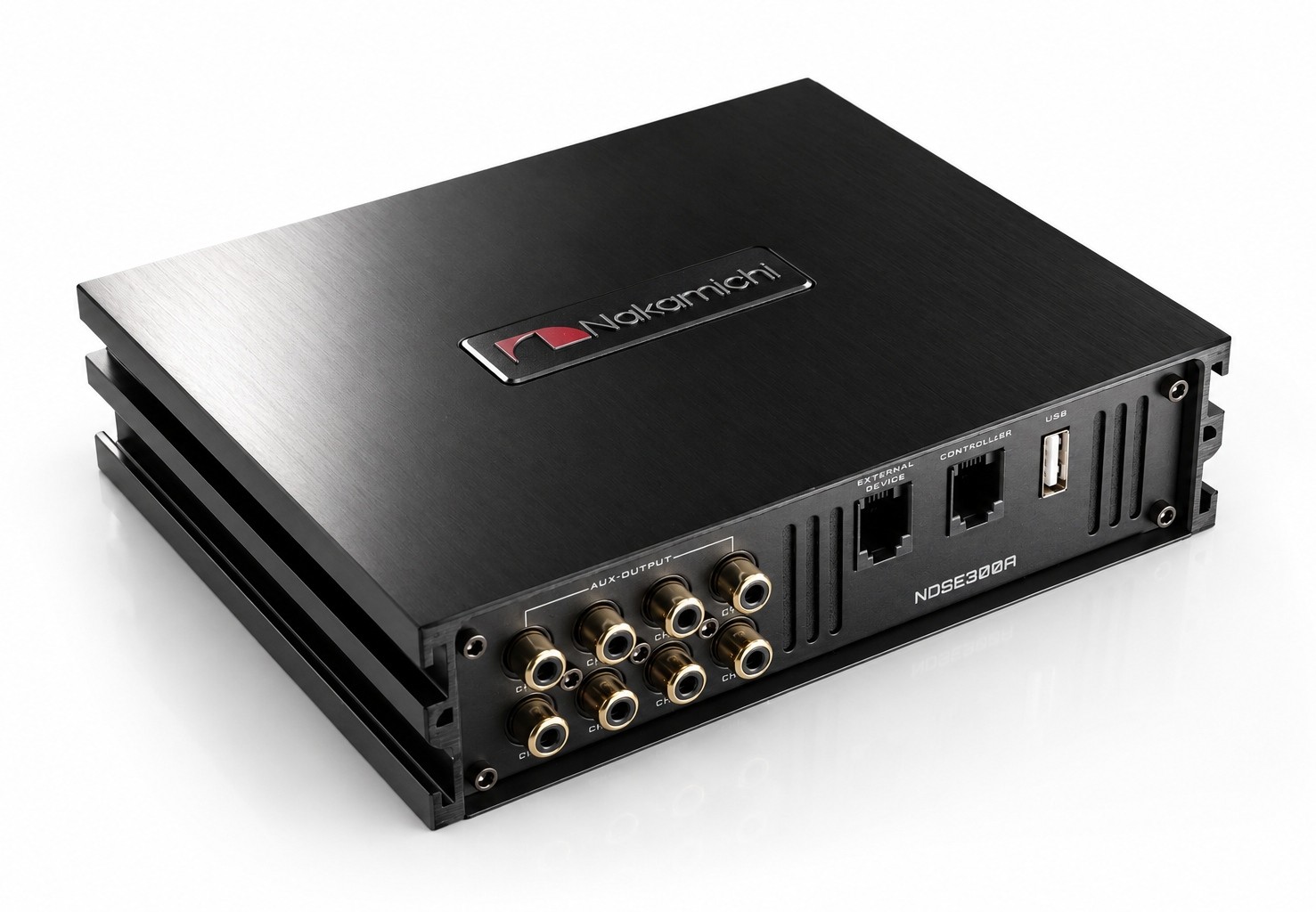
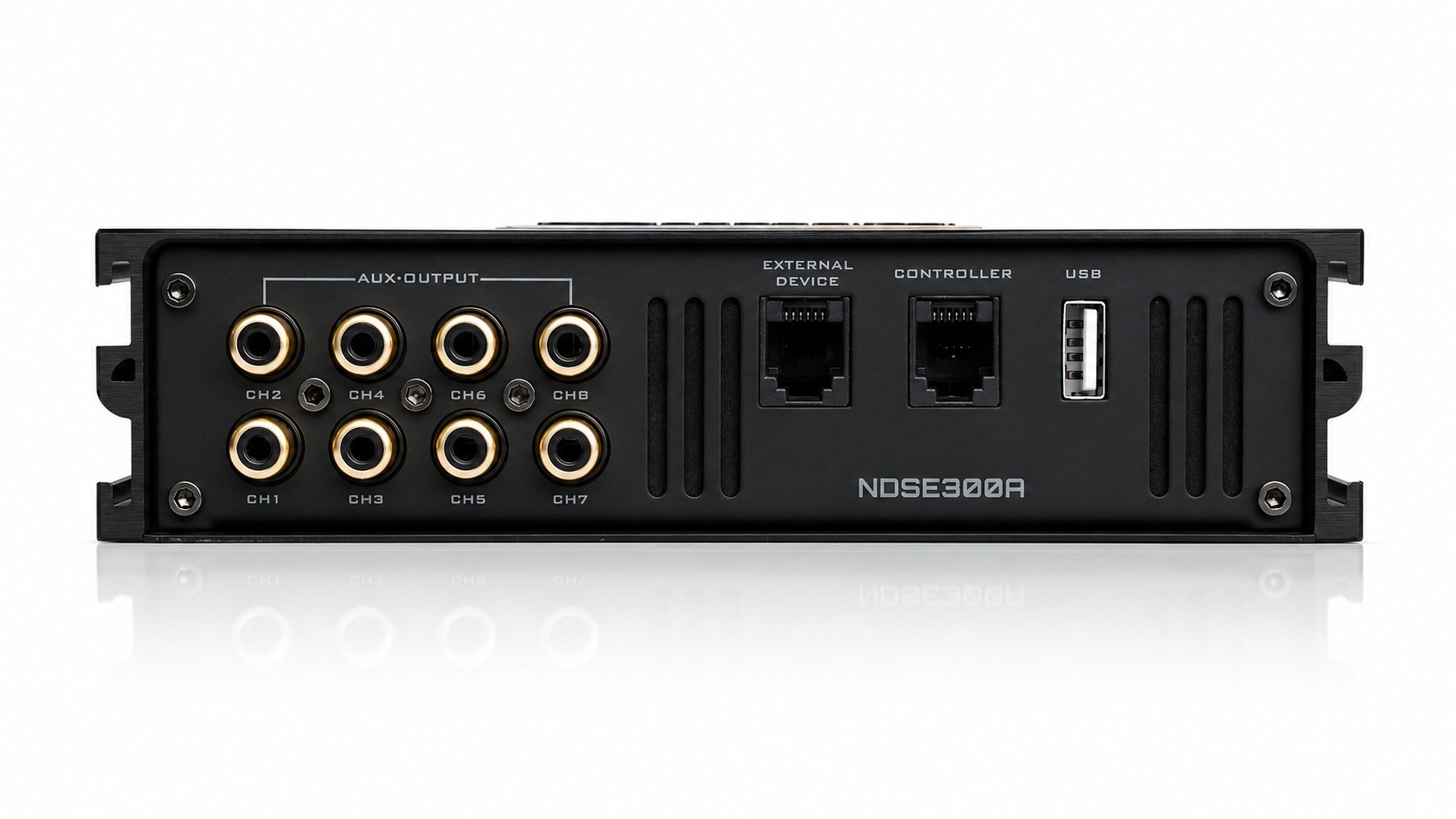
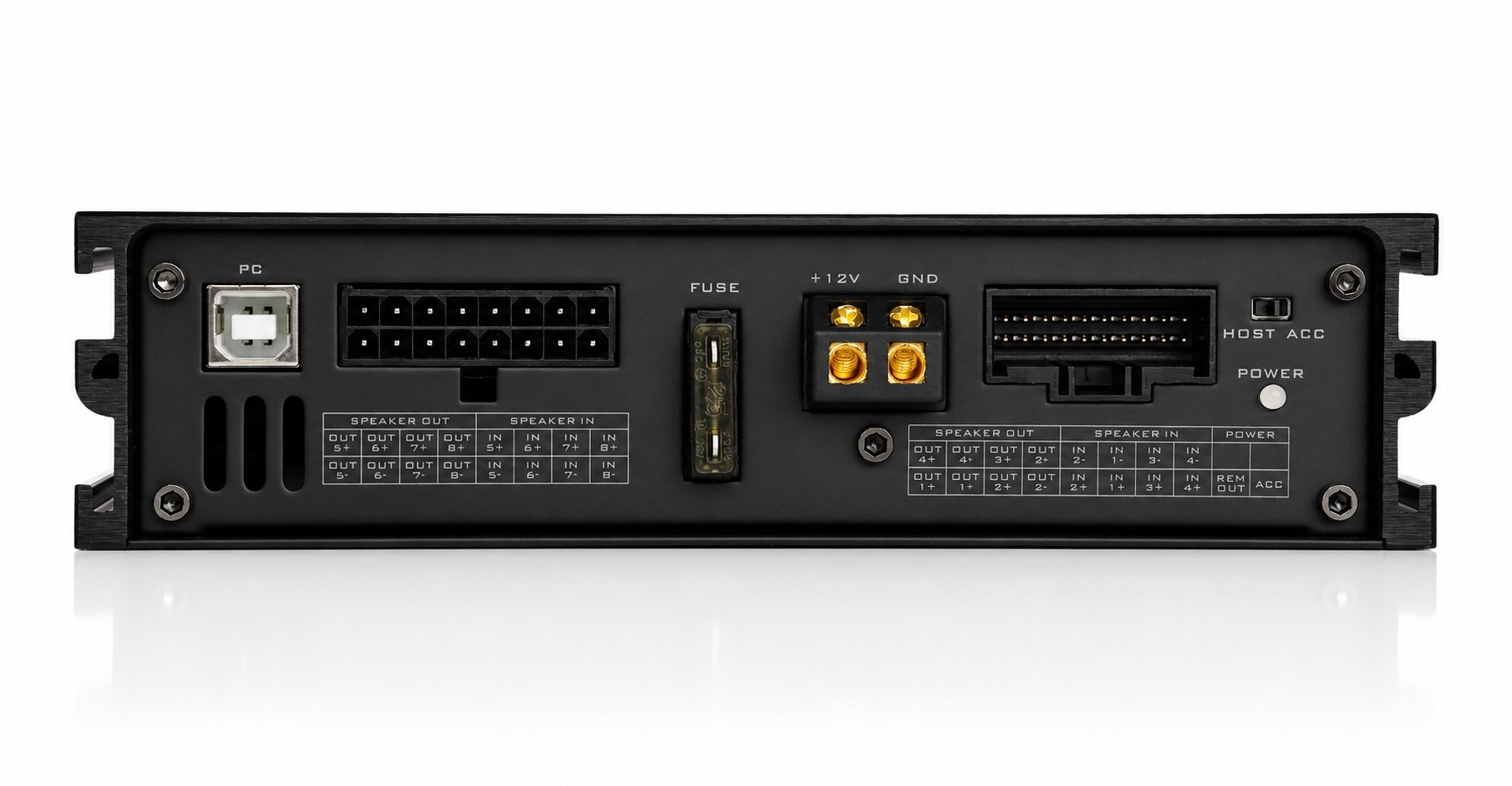
Amplifier with DSP processor Nakamichi NDSE300A
The Nakamichi NDSE300A is a compact eight-channel DSP processor with an integrated amplifier that allows significant improvement of factory or aftermarket audio systems without the need for multiple separate devices. Eight high-level inputs simplify connection to an original car radio or factory amplifier, while eight amplified outputs with a nominal power of 8 × 25 W enable direct powering of speakers. The NDSE300A can be used both as a complete DSP amplifier and as a standalone DSP processor in conjunction with external power amplifiers via the eight RCA outputs. Both solutions can also be combined freely—for example, using the built-in amplifier to power tweeters and an external amplifier for more power-hungry midrange drivers or a subwoofer.
The integrated DSP offers independent adjustment of each output channel via a 31-band equalizer, active crossovers, time corrections, signal level and polarity. High-pass and low-pass filters can be set in the range from 20 Hz to 20 kHz with slopes from 6 to 48 dB/oct. and selectable Butterworth, Bessel or Linkwitz-Riley filters. Time corrections offer a range of up to 25 ms, or 850 cm, allowing precise creation of the soundstage at the driver’s position. Six separate sound presets can be saved to the device memory.
The NDSE300A supports wireless music playback via Bluetooth and playback of MP3, WMA, FLAC and WAV files from a USB drive. All functions can be configured via PC software or the Nakamichi-E mobile app. A connector for an optional wired remote control is also available. Automatic power-on can be controlled by the high-level input signal or the ACC wire, and the REM output allows simultaneous switching of connected external amplifiers. With dimensions of 173 × 142 × 43 mm, the processor can be easily installed even in limited spaces.
Main features
- 8-channel digital audio processor with integrated amplifier.
- Configuration of 8 input and 8 output channels.
- Nominal amplifier power 8 × 25 W.
- Eight high-level inputs for connecting factory audio systems.
- Eight amplified high-level outputs for direct speaker powering.
- Eight low-level RCA outputs for external amplifiers.
- 31-band equalizer for precise sound tuning.
- EQ gain adjustment range −12 to +12 dB.
- Adjustable Q value in the range 0.3 to 50.
- High-pass and low-pass filters for each output channel.
- Butterworth, Bessel and Linkwitz-Riley filters.
- Adjustable filter slopes from 6 to 48 dB/oct.
- Time corrections up to 25 ms or 850 cm.
- Independent polarity setting for each channel.
- Output level adjustment from mute to −60 to +6 dB.
- Ability to save six sound presets.
- Built-in Bluetooth for wireless music playback.
- Playback from USB storage.
- Support for MP3, WMA, FLAC and WAV formats.
- Control via the Nakamichi-E mobile app.
- Support for an optional wired remote control.
- Automatic power-on via high-level signal or ACC.
- REM +12 V output for switching external amplifiers.
About the brand
The history of the Nakamichi brand dates back to 1948, when it was founded in Japan by Etsuro Nakamichi. His journey began with the establishment of the Nakamichi Research Corporation in Tokyo, focused on research of sonars, magnets and development solutions for leading brands, government institutions and universities. From the beginning, the brand was built on a scientific approach, deep understanding of sound and emphasis on technical precision. A major expansion period came in 1972, when Takeshi Nakamichi joined the company and significantly contributed to the development of legendary audio products sold worldwide. Under his leadership, models such as the Nakamichi 1000—the world’s first cassette deck—were developed. Thanks to the combination of top-tier sound and timeless design, to which chief engineer Kozo Kobayashi also contributed, Nakamichi products became icons of their era. The Nakamichi brand remains successful today, offering a portfolio of high-quality products for home and car audio that stand out for thoughtful construction, quality workmanship and excellent sound within their price category.
| Catalog number | NDSE300A |
| Brand | Nakamichi |
| Links | Official web presentation |
| Energy class of the amplifierAmplifiers are divided into two basic classes: analog and digital . Analog amplifiers (A/B) have higher consumption requirements, but usually have a more natural sound. Digital amplifiers (D) have significantly lower consumption and higher efficiency, but the sound may not be as faithful as with classic analog amplifiers. | D |
| Number of amplifier channelsAmplifiers are divided into: - Monoblocks - 2-channel - 3-channel - 4-channel - 5-channel - 6-channel - multi-channel Each channel is used to power one speaker for the coaxial type, or one side if they are component speakers. Monoblock type amplifiers are mainly used for subwoofers. 2-channel are suitable for both subwoofers and, for example, the front pair of speakers in a car. 3-channel is used for front or rear speakers + subwoofer. 4-channel are used for front + rear speakers or 1 pair of speakers + subwoofer. 6 or 5-channel are used for 2 pairs of speakers + subwoofer, most often. Bridging means connecting the amplifier to a bridge, using the + pole from one channel and the - pole from the other channel. In most cases this is shown as "BRIDGED" on the amplifier. | 8 |
| RMS power into 4 ΩRMS power when loading speakers or subwoofer at 4 Ω. RMS power is the constant power of the amplifier and is one of the most important parameters when choosing an amplifier. | 8 x 25 W |
| Max. (maximum) power at 4 ΩPeak performance "Max." , which the amplifier can develop for a very short time. A relatively unimportant parameter. It is mainly a marketing move to attract customers to high numbers. | 8 x 50 W |
| Frequency rangeThe ability of the amplifier to reproduce the signal from the lowest frequency to the highest = faithfully reproduce the sound in a specific frequency band. Professionally: In the frequency range from 40 to 16,000 Hz, the vast majority of fundamental and overtones (harmonics) of all musical instruments are found. We are interested in the course of the radiated sound pressure in this range of frequencies when the loudspeaker system is supplied with constant power. We call this course the frequency characteristic, which tells us the level of radiated sound pressure in decibels (dB) depending on the frequency. The frequency characteristic of a speaker or speaker system can be expressed most succinctly with a graph. Mostly, however, the frequency characteristic is indicated by indicating the maximum tolerance of the sound pressure in the given frequency range, e.g. 50 to 15,000 Hz -+ 6 dB. Since the frequency characteristics of loudspeakers and systems in general are quite uneven, some manufacturers do not even specify this maximum tolerance of sound pressure in decibels in their catalogs for reasons of prestige. Data impoverished in this way is unfortunately worthless. What is valid is that the manufacturer offers a speaker system with a frequency range of 30 to 20,000 Hz, if he is worried about stating the maximum unevenness of the sound pressure in this range, because he can have a tolerance of, for example, +- 20 dB. The unevenness or undulation of the frequency curve in good speaker systems for high-quality music performance should not exceed +-3 dB in the 80 to 12,000 Hz band and +-6 dB in the 40 to 16,000 Hz band. Greater unevenness already depletes or emphasizes certain tonal areas, which can cause audible or even disturbing distortion. The proportion between fundamental tones and higher harmonics also changes, thereby changing the color of the sound, and individual musical instruments as well as the entire musical image sound unnatural. | 20 - 20000 Hz |
| Harmonic Distortion (THD)Total harmonic distortion indicates how much the input signal is distorted in the amplifier. Distortions appear as overtones contained in the output signal. The proportion of originally absent parts of the signal is given as a percentage, typical values are between 0.001% and 0.5%. Distortion is measured in their power band. If it exceeds the limit of 0.7% from a certain power, it is the value of the output power of the given amplifier, from which it no longer plays without distortion and from which the distortion usually increases steeply, so that no further increase in power can be counted on. The lower the value, the better. | < 0.05 % |
| Signal-to-noise ratioThe signal-to-noise ratio means that the output signal always contains noise. The signal-to-noise ratio expresses how much of this noise is compared to the useful signal. The so-called A value is given, which does not take deep and very high frequencies into account. This corresponds to the characteristic of human hearing, which is not so sensitive to deep frequencies, especially below 1 kHz. The higher the value, the better the amplifier is. | > 98 dB |
| Standby power consumption | 0.1 W |
| On-board voltage rangeThe ability of the amplifier to operate at a specified voltage. As the voltage decreases, so does the power of the amplifier. The ideal voltage in a car is between 13.8 and 14.4 V. | 9 – 18 V |
| High level inputsThe high-level input on the amplifier allows connection directly to the existing speakers in the car without additional purchase of an external high/low adapter. Important equipment in the case of installing an amplifier on an original car radio. | Yes |
| Automatic on and offThis function allows you to automatically switch on the amplifier. | Yes |
| Integrated DSP processor | Yes |
| Number of DSP processor channels | 8 |
| Output equalizer | 31 bands |
| Filters | HPF, LPF |
| Filter types and slope | Butterworth, Bessel and Linkwitz-Riley (from 6 to 48 dB/oct) |
| Input for wired remote controlIf the amplifier has a remote control input. | Yes |
| Dimensions of the amplifier | 173 x 142 x 43 mm |
| Mass | 0.9 Kg |
Evaluation
You might also be interested
 Quick preview6-channel DSP processor / 4-channel amplifier, 4 x 25 W RMS, inputs: 4 x hi-level, outputs: 6 x RCA, Bluetooth, USB, Hi-Res streaming151,60 EURTemporarily unavailableNakamichi NDSK520A Free transport
 -39 %Last piecesQuick preview10-channel DSP processor / 8-channel amplifier, 8 x 25 W RMS, inputs: 4x Hi-level, 2x RCA, outputs: 10 x RCA, Bluetooth, Wi-Fi, USB 299,96 EUR
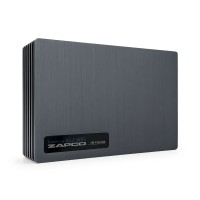 Quick preview8-channel amplifier with DSP processor, 8 x 23 W RMS, player, BT streaming, 4 x high-level input, 2 x RCA input, 10 x RCA output, Class AB399,00 EURIn stockZapco HB 46 II 4A Free transport
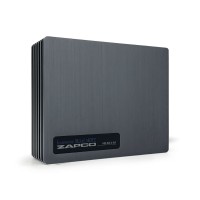 Quick preview4-channel amplifier with DSP processor, 4 x 23 W RMS, player, BT streaming, 4 x high-level input, 2 x RCA input, 6 x RCA output, Class AB239,00 EURIn stockZapco HB 48 II 4A Free transport
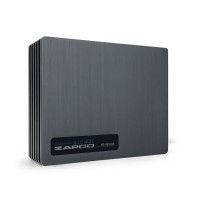 Quick preview4-channel amplifier with DSP processor, 4 x 23 W RMS, player, BT streaming, 4 x high-level input, 2 x RCA input, 8 x RCA output, Class AB279,00 EURIn stockZapco HB 68 II Free transport
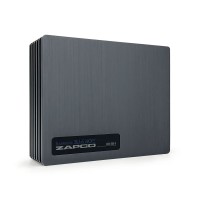 TipQuick preview8-channel DSP processor, BT 5.1 streaming, built-in player, 2 × RCA input and 8 × RCA output, AUX279,00 EURIn stockZapco HB 810 II 8AD Free transport
 TipQuick preview8-channel amplifier with DSP processor, 4 x 35 + 4 x 100 W RMS / 4 x 35 + 2 x 300 W RMS, player, BT streaming, 8 x Hi-level input, 2 x RCA inputs, 10 x RCA outputs, class AB + D599,00 EURIn stock