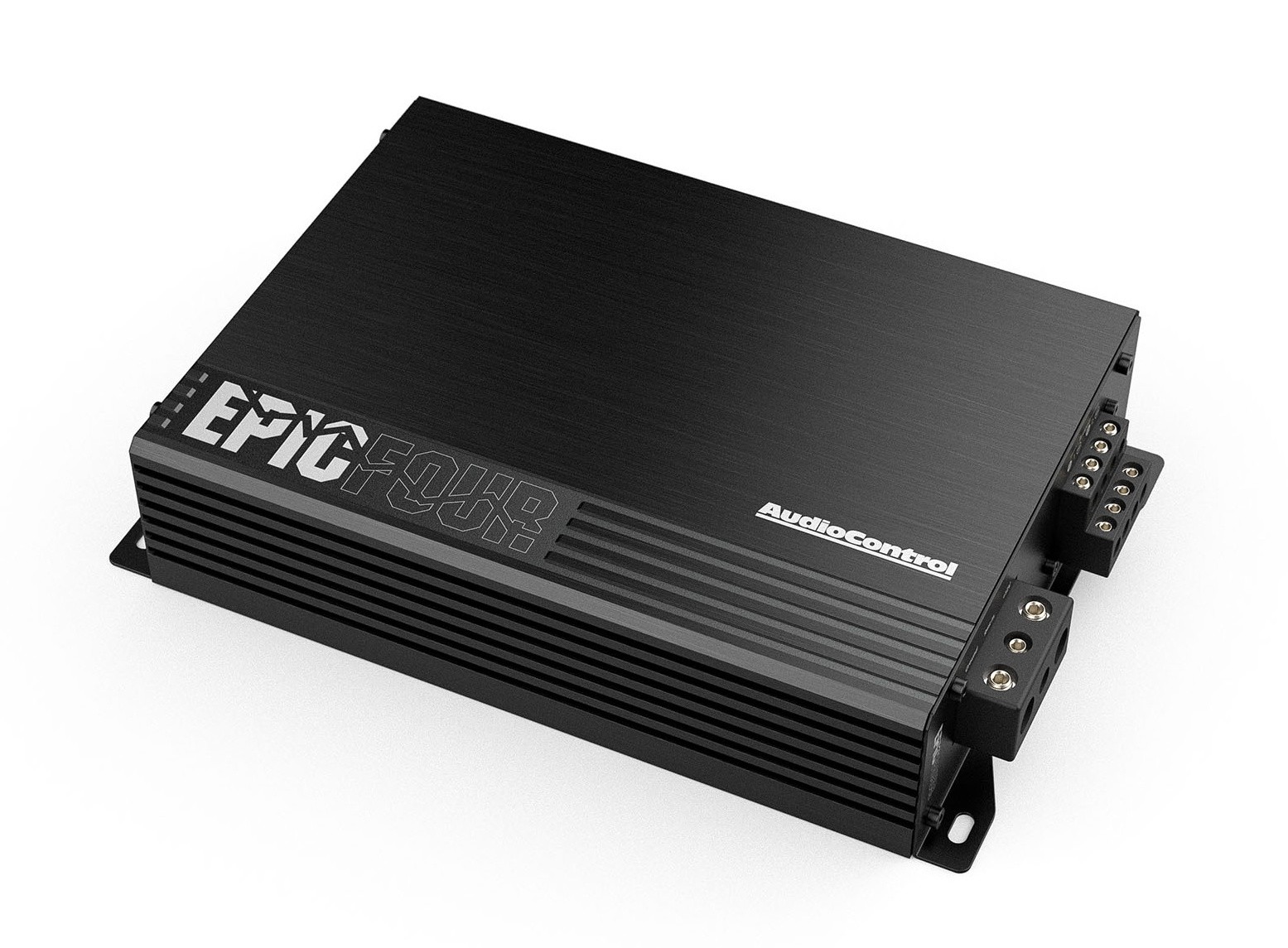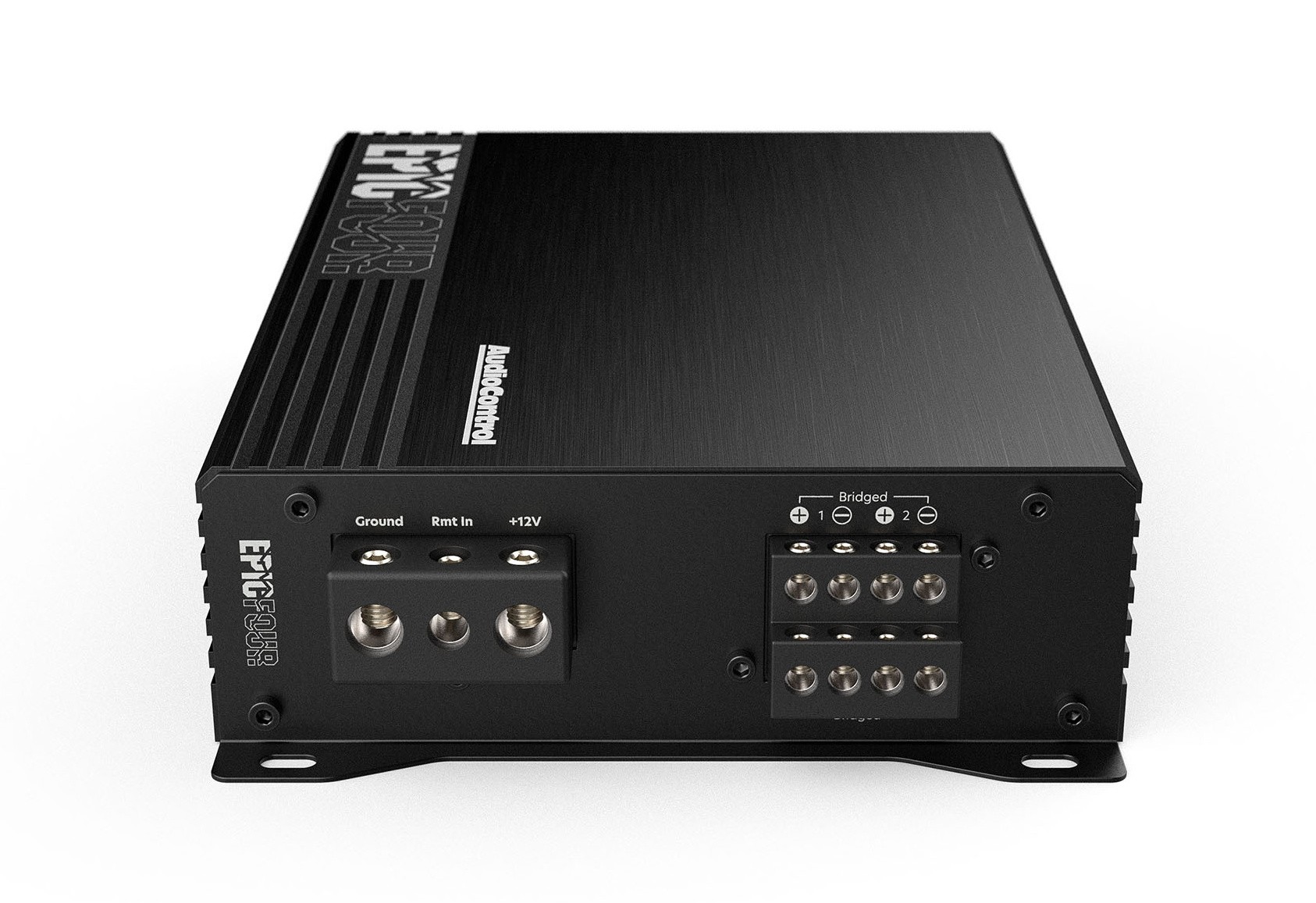
AudioControl EPICFOUR amplifier
More about the product
- You can return the goods to us within 14 days
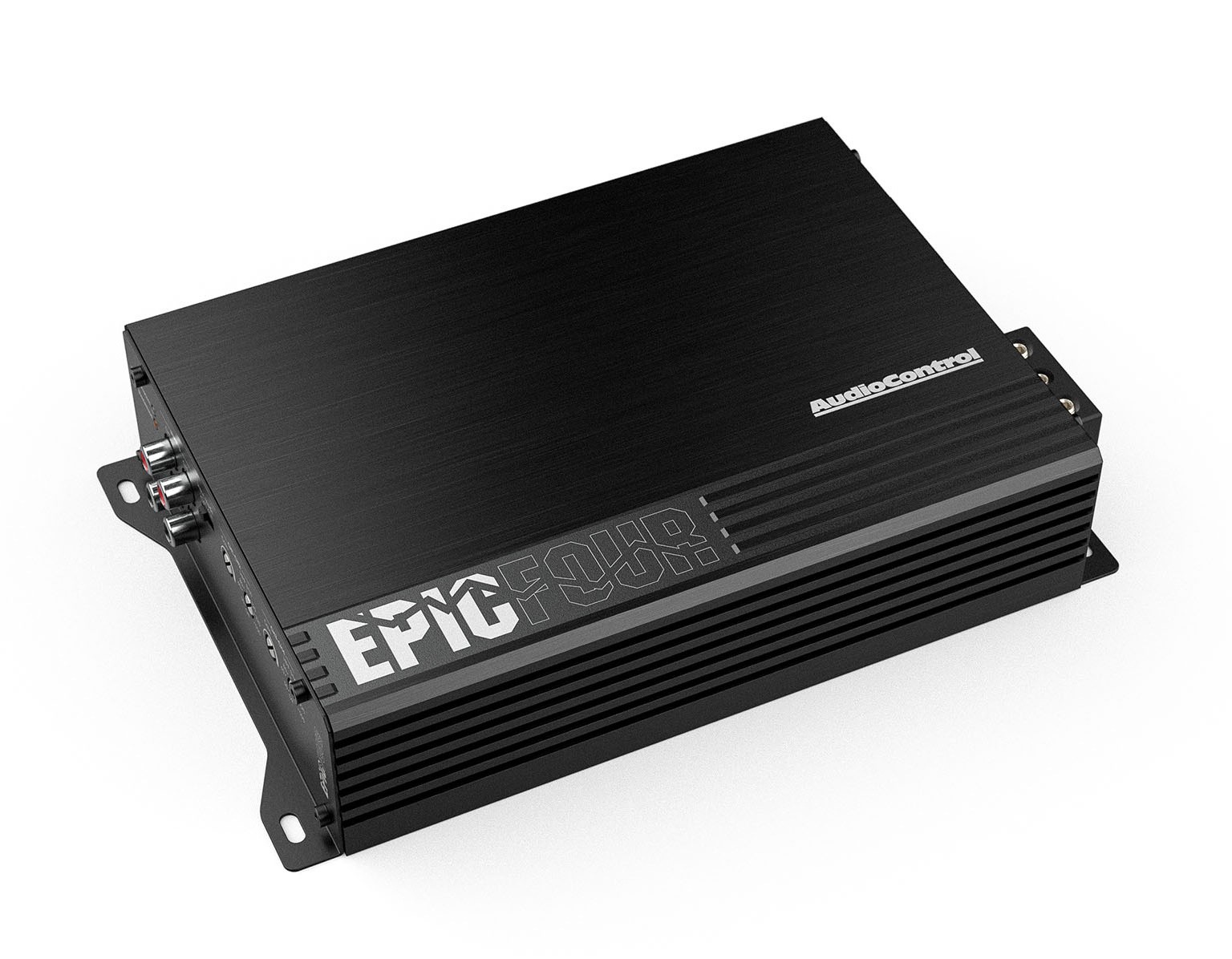
AudioControl EPICFOUR Amplifier
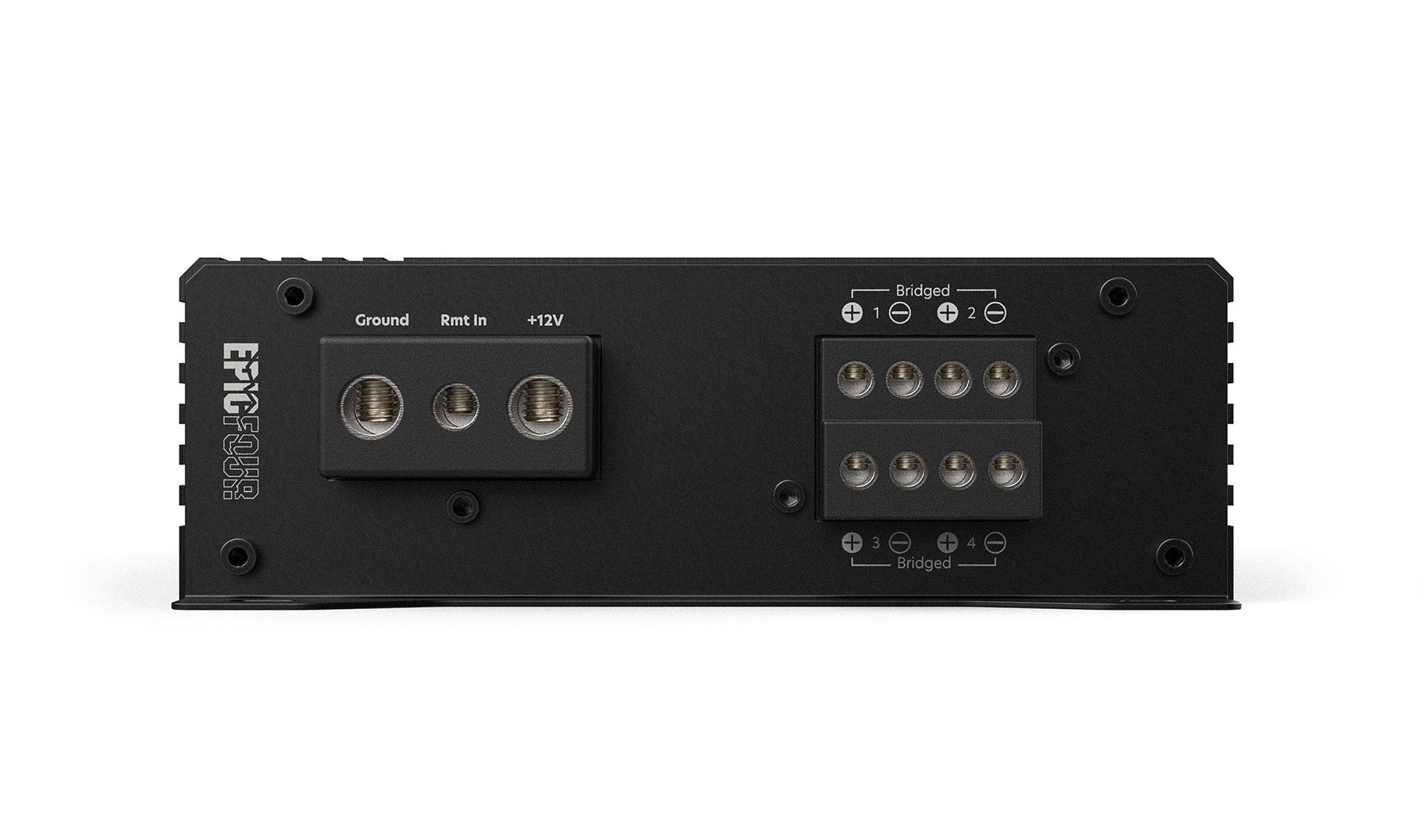
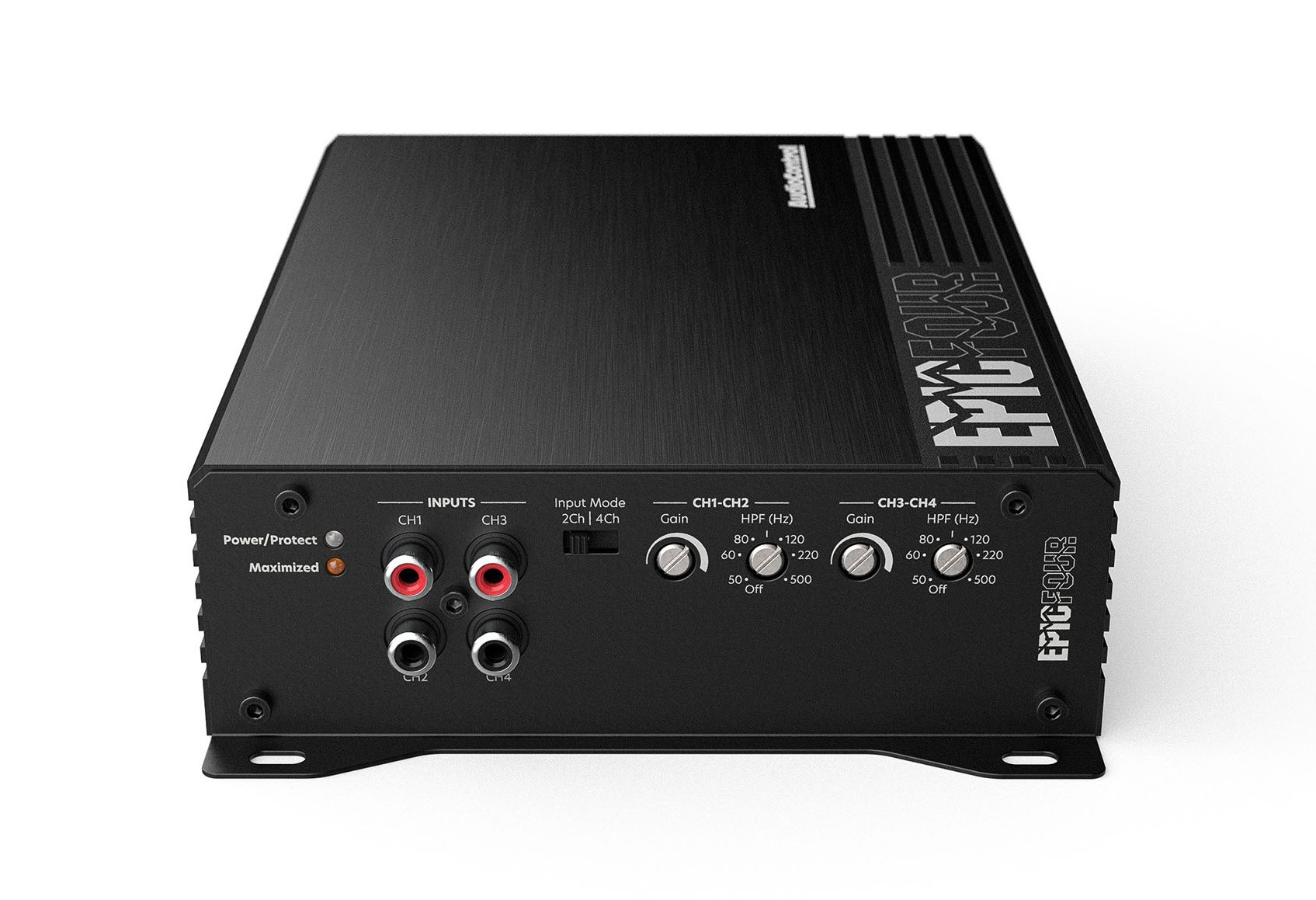
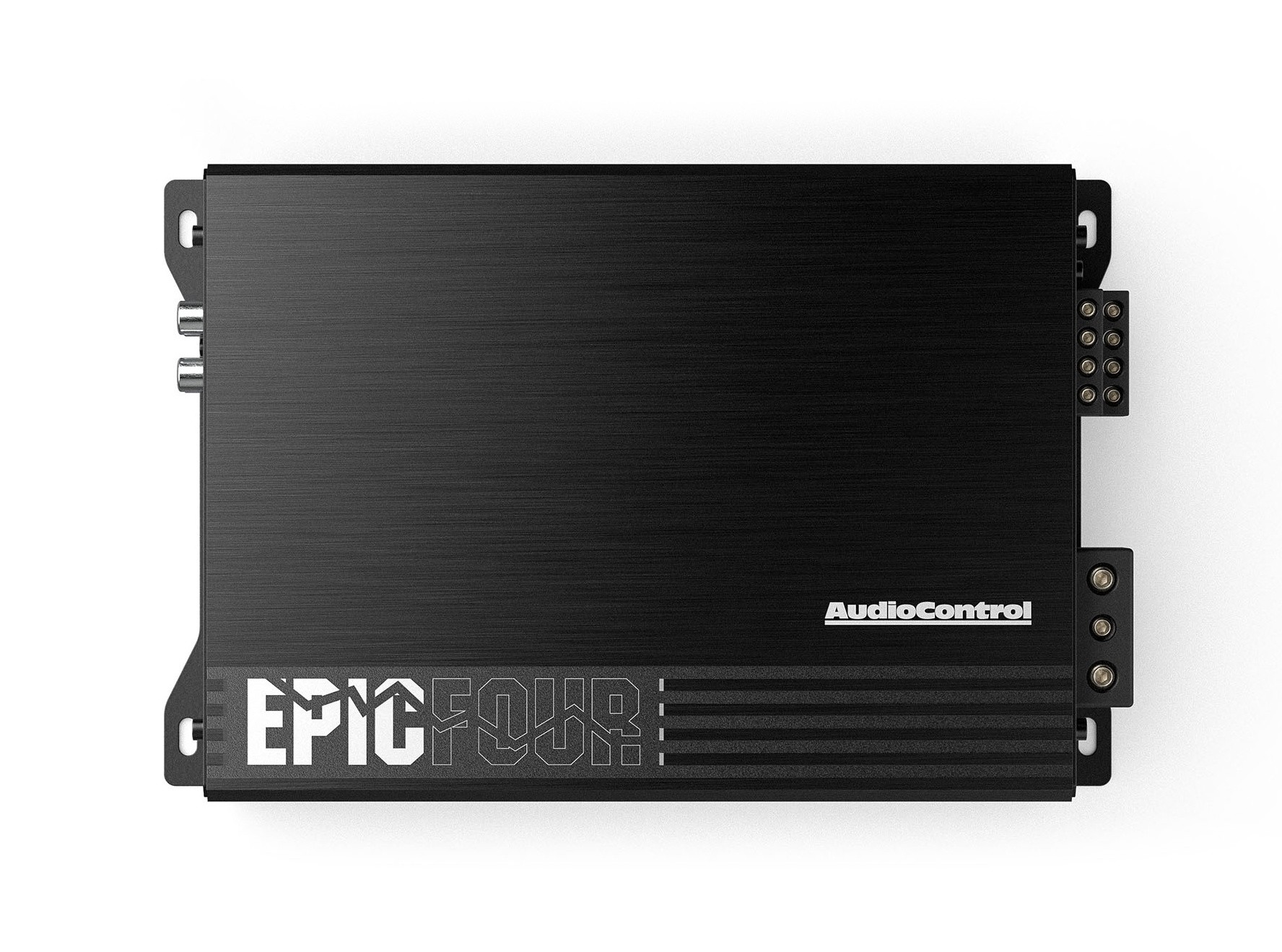
Zesilovače AudioControl řady EPIC kombinují vysoký výkon, kompaktní rozměry a stabilní provoz při nízké impedanci. Jsou navrženy pro pohon subwooferů a výkonných reproduktorů a díky digitální technologii Class-D poskytují účinný přenos energie i při náročném zatížení. Model EPICFOUR je čtyřkanálový zesilovač, který zvládá stabilní zapojení do 2 Ω a poskytuje variabilní možnosti použití – od napájení čtyř samostatných reproduktorů až po zapojení do můstku pro vyšší výkon na dva kanály. Díky účinnému chlazení, ochraně s automatickým resetem a masivním napájecím i reproduktorovým terminálům je vhodný i pro náročnější instalace, kde je požadavek na výkon i kompaktní rozměry. K dispozici jsou variabilní vysokopropustné filtry Linkwitz-Riley, které umožňují přesné nastavení pro jednotlivé kanály. Zesilovač je vybaven inteligentními ochrannými obvody proti přepětí, podpětí, přetížení i přehřátí, což zajišťuje dlouhou životnost a bezpečný provoz.
Main Features
- Compact 4-channel Class D amplifier.
- Stable operation down to 2 Ω.
- Variable Linkwitz-Riley high-pass filter 12 dB/octave (50–500 Hz).
- Signal-to-noise ratio 90 dB+ per CEA standard.
- Intelligent protection circuits with automatic reset (OCP, OVP, UVP, DCP, OTP).
- Heavy-duty screw terminals.
- Low quiescent current (< 1 A).
About AudioControl
As the name suggests, AudioControl has been all about controlling sound for more than 40 years. Especially in the United States, AudioControl is a respected and popular manufacturer of not only car audio but also home audio equipment. The company's headquarters, including research, development, manufacturing and training facilities, flourishes in Mountlake Terrace, Washington, in the heart of the Pacific Northwest rainforest. All products are still designed and proudly made in the USA, ensuring high quality and reliability. This is backed by the five-year warranty AudioControl offers on its products. AudioControl engineers are responsible for several patented technologies that created new ways to improve automotive audio, and that is the company's focus. The product range is relatively narrow, specializing in premium digital amplifiers, DSP processors, equalizers, preamplifiers and, above all, products for integrating new sound systems into existing factory units. Professional measurement tools are also available to help achieve AudioControl’s main goal, perfectly captured by their slogan "Making good sound great".
| Catalog number | EPICFOUR |
| Brand | Audio control |
| Links | Official web presentation (English) |
| Energy class of the amplifierAmplifiers are divided into two basic classes: analog and digital . Analog amplifiers (A/B) have higher consumption requirements, but usually have a more natural sound. Digital amplifiers (D) have significantly lower consumption and higher efficiency, but the sound may not be as faithful as with classic analog amplifiers. | D |
| Number of amplifier channelsAmplifiers are divided into: - Monoblocks - 2-channel - 3-channel - 4-channel - 5-channel - 6-channel - multi-channel Each channel is used to power one speaker for the coaxial type, or one side if they are component speakers. Monoblock type amplifiers are mainly used for subwoofers. 2-channel are suitable for both subwoofers and, for example, the front pair of speakers in a car. 3-channel is used for front or rear speakers + subwoofer. 4-channel are used for front + rear speakers or 1 pair of speakers + subwoofer. 6 or 5-channel are used for 2 pairs of speakers + subwoofer, most often. Bridging means connecting the amplifier to a bridge, using the + pole from one channel and the - pole from the other channel. In most cases this is shown as "BRIDGED" on the amplifier. | 4 |
| RMS power into 4 ΩRMS power when loading speakers or subwoofer at 4 Ω. RMS power is the constant power of the amplifier and is one of the most important parameters when choosing an amplifier. | 4 x 100 / 2 x 400 W |
| RMS power into 2 ΩRMS power when loading speakers or subwoofer at 2 Ω. RMS power is the constant power of the amplifier and is one of the most important parameters when choosing an amplifier. | 4 x 200 W |
| Frequency rangeThe ability of the amplifier to reproduce the signal from the lowest frequency to the highest = faithfully reproduce the sound in a specific frequency band. Professionally: In the frequency range from 40 to 16,000 Hz, the vast majority of fundamental and overtones (harmonics) of all musical instruments are found. We are interested in the course of the radiated sound pressure in this range of frequencies when the loudspeaker system is supplied with constant power. We call this course the frequency characteristic, which tells us the level of radiated sound pressure in decibels (dB) depending on the frequency. The frequency characteristic of a speaker or speaker system can be expressed most succinctly with a graph. Mostly, however, the frequency characteristic is indicated by indicating the maximum tolerance of the sound pressure in the given frequency range, e.g. 50 to 15,000 Hz -+ 6 dB. Since the frequency characteristics of loudspeakers and systems in general are quite uneven, some manufacturers do not even specify this maximum tolerance of sound pressure in decibels in their catalogs for reasons of prestige. Data impoverished in this way is unfortunately worthless. What is valid is that the manufacturer offers a speaker system with a frequency range of 30 to 20,000 Hz, if he is worried about stating the maximum unevenness of the sound pressure in this range, because he can have a tolerance of, for example, +- 20 dB. The unevenness or undulation of the frequency curve in good speaker systems for high-quality music performance should not exceed +-3 dB in the 80 to 12,000 Hz band and +-6 dB in the 40 to 16,000 Hz band. Greater unevenness already depletes or emphasizes certain tonal areas, which can cause audible or even disturbing distortion. The proportion between fundamental tones and higher harmonics also changes, thereby changing the color of the sound, and individual musical instruments as well as the entire musical image sound unnatural. | 10 - 22,000 Hz |
| Signal-to-noise ratioThe signal-to-noise ratio means that the output signal always contains noise. The signal-to-noise ratio expresses how much of this noise is compared to the useful signal. The so-called A value is given, which does not take deep and very high frequencies into account. This corresponds to the characteristic of human hearing, which is not so sensitive to deep frequencies, especially below 1 kHz. The higher the value, the better the amplifier is. | 90.1 dB |
| High pass filter (HPF)HPF / HP or The "hi pass filter" offers the option of setting the amplifier using a potentiometer so that medium, possibly mid-bass and treble frequencies play upwards from a certain frequency. Example: Amplifiers most often have an HPF from 40 to 300 Hz. If we set the potentiometer to a value of approx. 150 Hz, the sound will be clipped so that it plays frequencies from 150 Hz up to the maximum upper limit of the entire frequency range of the amplifier, perhaps up to 20,000 Hz. We recommend setting this potentiometer in the range of 80-160 Hz. Thanks to this setting option, the speakers can handle a higher performance, as you will not overload them with bass in the lower frequency range. | 50 - 500 Hz |
| Standby power consumption | < 1 A |
| High level inputsThe high-level input on the amplifier allows connection directly to the existing speakers in the car without additional purchase of an external high/low adapter. Important equipment in the case of installing an amplifier on an original car radio. | No |
| Automatic on and offThis function allows you to automatically switch on the amplifier. | Yes |
| Socket input terminalsFerrule terminals allow better wiring contact to the amplifier. It is also a more secure form of terminals. If you are tightening the sleeve terminals, we recommend retightening them after 1 day, as the connected cable gradually compresses. | Yes |
| Dimensions of the amplifier | 155 × 239 × 51 mm |
Evaluation
You might also be interested
 Quick preview1-channel amplifier, 1 x 400 / 700 / 1000 W RMS (4 / 2 / 1 Ω), class D, remote control289,00 EURIn stockAudioControl EPIC1500 Free transport
 Quick preview1-channel amplifier, 1 x 600 / 1000 / 1500 W RMS (4 / 2 / 1 Ω), class D, remote control349,00 EURIn stockAudioControl EPIC2000 Free transport
 Quick preview1-channel amplifier, 1 x 600 / 1000 / 1500 W RMS (4 / 2 / 1 Ω), class D, remote control479,00 EUR1 to 4 weeksAudioControl EPIC500 Free transport
 Quick preview1-channel amplifier, 1 x 250 / 350 / 500 W RMS (4 / 2 / 1 Ω), class D, remote control179,00 EUR1 to 4 weeksAudioControl EPIC750 Free transport
 TipQuick preview1-channel amplifier, 1 x 300 / 500 / 750 W RMS (4 / 2 / 1 Ω), class D, remote control229,00 EURIn stock