
Subwoofer Quartorigo Arabesque Neo Sub
More about the product
- You can return the goods to us within 14 days
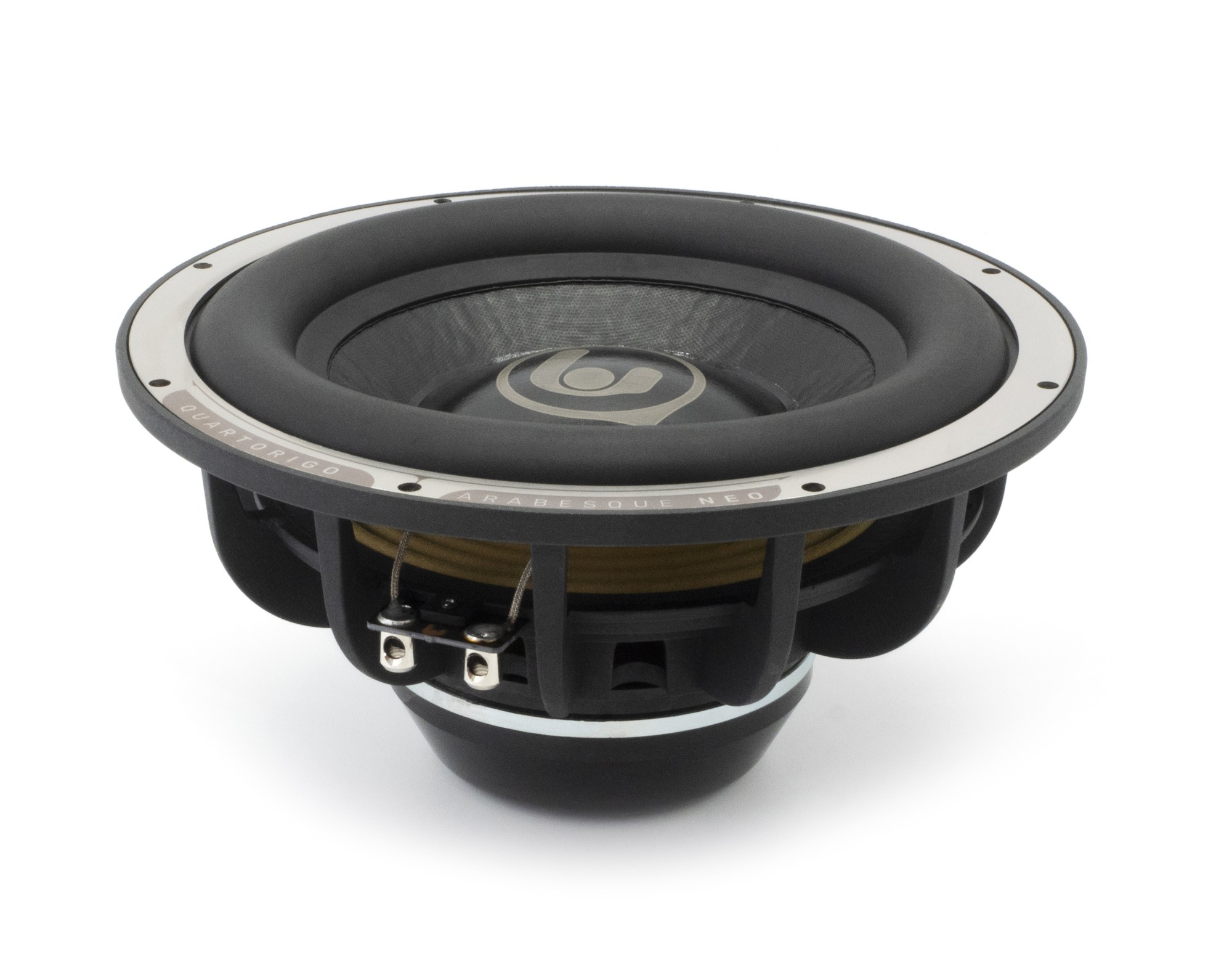
Quartorigo Arabesque Neo Subwoofer
The Quartorigo Arabesque Neo Sub raises the performance bar among high-end subwoofers. Together with its more robust sibling, the Heritage Sub, these top-tier subwoofers are designed to deliver audiophile sound and play very low with exceptionally precise response and minimal distortion. Their remarkable ability to blend seamlessly with all other speakers in an audio system is truly astonishing and allows you to enjoy music in all its richness. Both subwoofers powerfully complement any premium sound system with massive output and explosive dynamics. When it comes to subwoofer performance, don’t be misled by seemingly modest paper specifications. The oversized 75 mm voice coil combined with a very large magnetic force offers nearly limitless power handling. This applies to all Quartorigo products, which rely not on marketing-friendly numbers but on real performance. The main difference between the Heritage and Arabesque subwoofers is the magnetic system. Arabesque subwoofers use a high-performance neodymium magnet, which allows for a reduced mounting depth and smaller enclosure volume requirements. Arabesque therefore plays optimally even in sealed enclosures with a volume of just 15 liters. And, like all other Quartorigo products, these subwoofers carry the certification 100% Made in Italy..jpg)
Main features of the Quartorigo Arabesque Neo Subwoofer
- 10" subwoofer with a 4 Ω voice coil.
- Audiophile sound suitable for high-end installations.
- Flat frequency response and very low distortion.
- Paper cone with a durable rubber surround.
- Recommended amplifier power: 200 to 700 W RMS (4 Ω).
- Exceptionally rigid cast basket with excellent vibration damping.
- High-performance neodymium magnet for excellent power control.
- Minimal sealed enclosure requirements (from 15 l).
- Oversized 75 mm (3") voice coil.
- Certification 100% Made in Italy.
About Quartorigo
For music Lovers. The motto of this Italian manufacturer, depicted by a conductor in its logo, also expresses Quartorigo’s core principles. On a highly competitive market where brands and products quickly lose their identity, Quartorigo offers a clear and firm origin. Quartorigo is proud of its heritage and combines the essence of Italian design, honest craftsmanship and a passion for music in every product, through which it expresses its way of being, thinking and perceiving. With Quartorigo products you can instantly move from a concert hall to the seats in your car, experiencing the same emotions without losing a single tone. In line with this concept, Quartorigo embodies a true conductor sitting in front of you to provide a unique musical experience faithful to its roots. For more than 25 years you can rely on handcrafted products born from a long tradition, perfected over time and lasting a lifetime.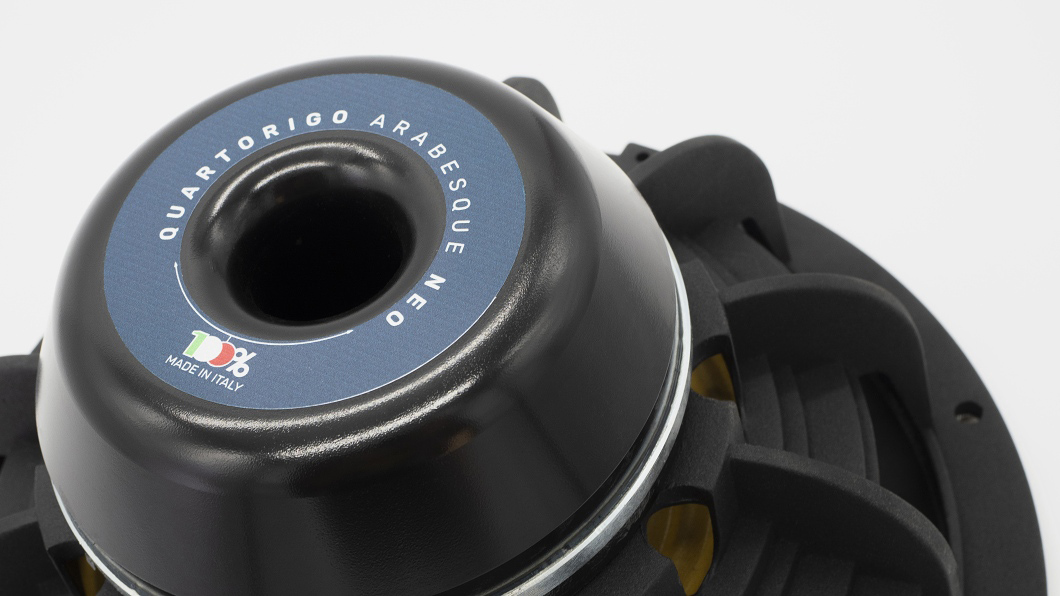
| Catalog number | ARABESQUE NEO SUB |
| Brand | Quartorigo |
| Links | Official web presentation |
| Subwoofer diameterThe diameter of the subwoofer is indicated on the screw holes. The overall outer diameter of the subwoofer is usually 1-2 cm wider, depending on the size category of the subwoofer. For a 30 cm subwoofer, the outer diameter incl. protective rubber 31.8 cm and in the 25 cm subwoofer it is 26.5 cm incl. protective rubbers. | 250 mm (10\") |
| RMS powerThe RMS power of the subwoofer is the constant power of continuous use of the subwoofer. If the power is exceeded for a longer period of time, irreversible damage may occur, or to burn out the voice coil of the subwoofer. | 200 W |
| Sensitivity (SPL 2.83V/1m)Subwoofer sensitivity or efficiency. The sensitivity of the subwoofer is given in decibels (dB) and, in simple terms, means that the higher the value, the lower the demands on the power of the amplifier. This is a de facto rating of how a subwoofer converts watts to sound. Sensitivity ratings are in noise level measured at 1 meter from the subwoofer using 1 W (watt of power) or using 2.83 volts at the source at 1 meter. A higher decibel level means the subwoofer is louder with less power. For every 3 dB increase in sensitivity, the subwoofer requires half the power to reproduce the same volume. For example, if an 88 dB subwoofer needs 300 Watts to produce a certain volume, then a subwoofer with 91 dB sensitivity needs only 150 Watts to reach the same efficiency. | 92 dB |
| Sensitivity (SPL 1W/1m)Subwoofer sensitivity or efficiency. The sensitivity of the subwoofer is given in decibels (dB) and, in simple terms, means that the higher the value, the lower the demands on the power of the amplifier. This is a de facto rating of how a subwoofer converts watts to sound. Sensitivity ratings are in noise level measured at 1 meter from the subwoofer using 1 W (watt of power) or using 2.83 volts at the source at 1 meter. A higher decibel level means the subwoofer is louder with less power. For every 3 dB increase in sensitivity, the subwoofer requires half the power to reproduce the same volume. For example, if an 88 dB subwoofer needs 300 watts to produce a certain volume, then a 91 dB subwoofer needs only 150 watts to reach the same efficiency. | 89 dB |
| ImpedanceImpedance - measurement of electrical resistance. When buying a subwoofer, it is very important that everyone make sure that the impedance matches the amplifier that you are connecting to it. For subwoofers with a double voice coil, we recommend following the information in the advice center! Example: A 2 Ohm subwoofer cannot be connected to an amplifier that is only stable up to 4 Ohms. A 4 Ohm subwoofer can easily be used on an amplifier that is stable up to 2 Ohms. Connecting a 4 Ohm subwoofer to an amplifier that is stable up to 4 Ohms also without problems. The most common subwoofer impedance is 4 Ohm. | 4 Ω |
| Frequency rangeThe ability of the subwoofer to play a signal from the lowest frequency to the highest, or the ability of a subwoofer to faithfully reproduce sound in a specific frequency band. Subwoofers ideally play from 20 - 150 Hz. Professionally: In the frequency range from 40 to 16,000 Hz, the vast majority of fundamental and overtones (harmonics) of all musical instruments are found. We are interested in the course of the radiated sound pressure in this range of frequencies when the loudspeaker system is supplied with constant power. We call this course the frequency characteristic, which tells us the level of radiated sound pressure in decibels (dB) depending on the frequency. The frequency characteristic of a speaker or speaker system can be expressed most succinctly with a graph. Mostly, however, the frequency characteristic is indicated by indicating the maximum tolerance of the sound pressure in the given frequency range, e.g. 50 to 15,000 Hz -+ 6 dB. Since the frequency characteristics of loudspeakers and systems in general are quite uneven, some manufacturers do not even indicate this maximum tolerance of sound pressure in decibels in their catalogs for tactical reasons. Data impoverished in this way is unfortunately worthless. What is valid is that the manufacturer offers a speaker system with a frequency range of 30 to 20,000 Hz, if he is worried about stating the maximum unevenness of the sound pressure in this range, because he can have a tolerance of, for example, +- 20 dB. The unevenness or undulation of the frequency curve in good speaker systems for high-quality music performance should not exceed +-3 dB in the 80 to 12,000 Hz band and +-6 dB in the 40 to 16,000 Hz band. Greater unevenness already depletes or emphasizes certain tonal areas, which can cause audible or even disturbing distortion. The proportion between fundamental tones and higher harmonics also changes, thereby changing the color of the sound, and individual musical instruments as well as the entire musical image sound unnatural. | 30 - 500 Hz |
| Subwoofer diaphragm materialThe specific material from which the subwoofer membrane is made. | Pressed paper |
| Recommended enclosure volumeThe closed enclosure is characterized by a simple construction. Closed enclosures are usually smaller than bass-reflex enclosures, and a special damping fleece is used for their damping. A closed baffle has the advantage of preventing an acoustic short between the front and back radiation of the subwoofer diaphragm. The disadvantage is that the closed enclosure raises the natural resonance frequency of the used subwoofer and thereby also increases the lower limit frequency. This is because the back side of the diaphragm is forced to compress and dilute the air inside the enclosure when the subwoofer is radiating in a closed enclosure. This adds to the inherent stiffness of the subwoofer's oscillation system the stiffness of the air in the closed enclosure. This causes an increase in the stiffness of the oscillating system and thus an increase in the resonant frequency of the entire system: subwoofer -> loudspeaker. The increase in resonant frequency for a given subwoofer is greater, the smaller the volume of air in the closed enclosure. The relatively small volume of air in the closed enclosure acts on the subwoofer as an acoustic spring when radiating the back side of the membrane into the enclosed enclosure. USE: Mainly for quality bass listening in the entire band with an emphasis on detail and accurate reproduction in the lower band. Pros and cons: + pure reproduction + small closets + easier tuning - low level of efficiency in deep bass - loudness only at the cost of enormous deflection of the membrane - a significant acoustic pressure cannot be expected | From 15 l (optimally 17 l) |
| Subwoofer voice coil diameterThe larger the diameter of the voice coil, the more load capacity the subwoofer has, in layman's terms. | 75 mm (3\") |
| Fs - resonant frequencyFs - is the lower resonant frequency. This parameter is the de facto free air resonant frequency of the subwoofer. Simply put, it is the point at which the weight of the subwoofer's moving parts equals the force of the subwoofer's suspension while it is in motion. If you've ever seen a piece of string start to hum uncontrollably in the wind, you've seen the effect of reaching a resonant frequency. The weight of the moving parts and the stiffness of the suspension (surround and spider) are key elements that affect the resonant frequency. As a general rule, a lower Fs indicates a subwoofer that would be better at reproducing low frequencies than a subwoofer with a higher Fs. However, this is not always the case, as other important parameters of the subwoofer also enter the resulting sound. | 25.89 Hz |