
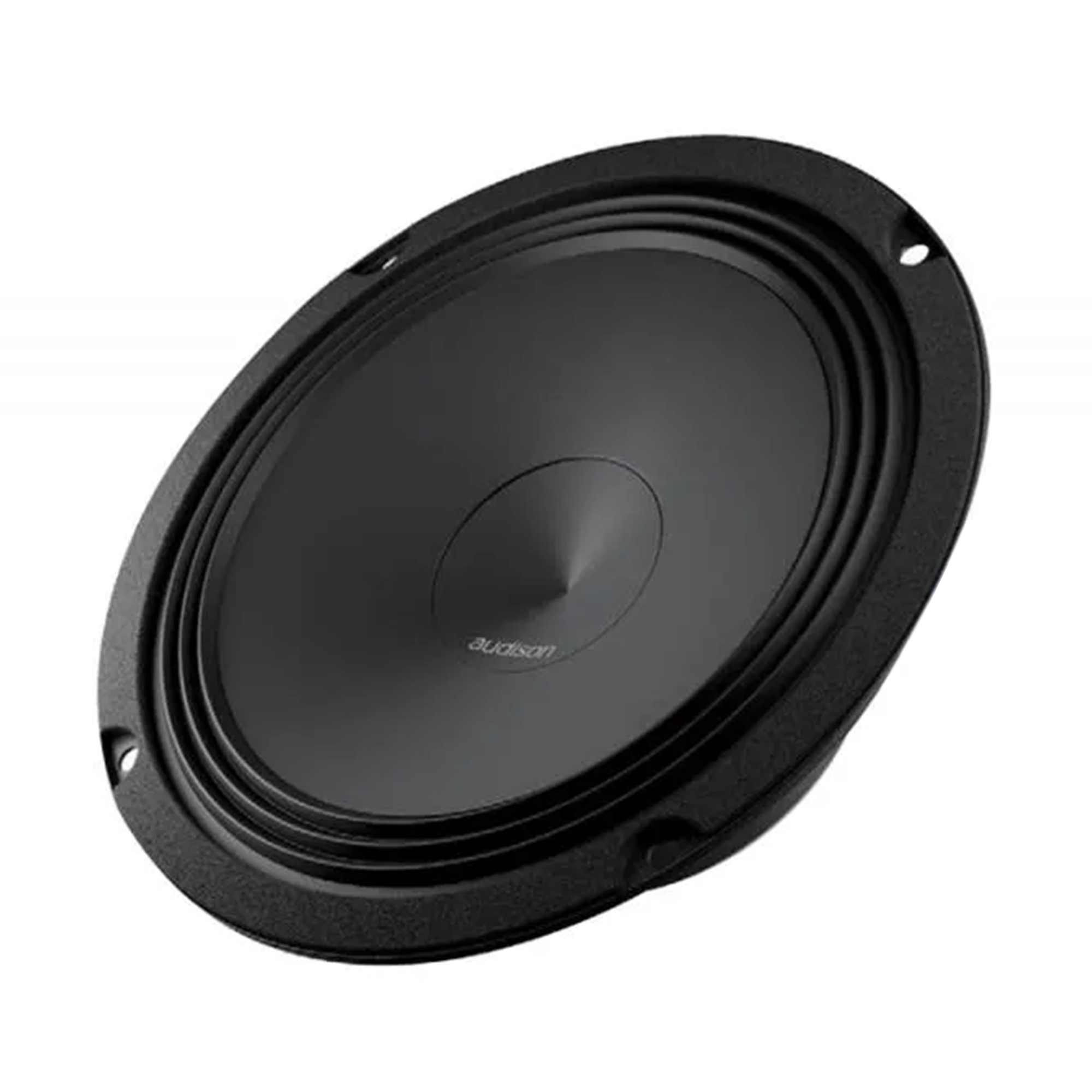
Speakers Audison AP 6.5 Ω2
mid-bass speakers, Ø 165 mm, 70 W RMS, 2 Ω, 95 dB (2.83V/1m), mounting depth 58.5 mm
More about the product
More about the product
We will help you with your purchase
- You can return the goods to us within 14 days
TipUpdated
Audison AP 6.5 Ω2
The Audison AP 6.5 Ω2 mid-bass speakers were developed with a nominal impedance of 2 Ω to make full use of the power from the input source (amplifier, car radio) and maximize speaker efficiency, achieving a sensitivity of 95 dB. A 25 mm diameter voice coil was used in production, providing high power-handling potential with minimal distortion. To extend the mid-bass frequency range down to 50 Hz, a resonance frequency of 75 Hz was chosen, delivering excellent low-frequency output even without a subwoofer. The paper cone with a water-repellent coating was developed using FEM (Finite Element Method) simulation technology. The reduced mounting depth allows for easy installation. The compact speaker basket is protected by a scratch-resistant coating. Thanks to the quick-connect terminal, wiring installation is time-efficient and highly flexible. The terminal is equipped with a heat-resistant plastic cover that protects it against short circuits.Main features
- 165 mm mid-bass speakers from the Audison Prima series.
- Low 2 Ω impedance for efficient power use with compatible amplifiers.
- Continuous power 70 W RMS and peak power 210 W.
- High 95 dB sensitivity for dynamic sound even at lower amplifier power.
- Frequency range 60 to 5,000 Hz.
- Specially designed 25 mm voice coil with a 10 mm winding height.
- Linear cone excursion ±2.8 mm for effective low-frequency reproduction.
- Water-repellent treated paper cone optimized using Klippel technology.
- Innovative Triple Wave TPU surround for high linearity of cone movement.
- Resonance frequency 75 Hz for quality bass reproduction.
- Robust steel basket with a scratch-resistant finish.
- High-quality connection terminals with double contacts and short-circuit protection.
- Mounting depth only 58.5 mm and mounting diameter 141 mm.
- Suitable for installation in the vehicle's original locations.
- Optimized to work with Audison amplifiers with DSP supporting 2 Ω impedance.
About the brand
Audison is an Italian brand with a tradition dating back to 1987. Its goal is to produce the best mobile electronics in the world and to continue innovating. Sound reproduction has always been a fascinating world where emotion and technology meet. The best results are achieved when these two values are at their peak. Thanks to this combination, every project Audison develops — born from a natural attitude that stems from a love of music and an inner need — challenges existing standards. Since the introduction of the first HR 100 amplifier, Audison has gone on to create products that have truly marked the history of car hi-fi. Audison is unwaveringly committed to research that leads to perfection in in-car sound reproduction. Audison is a pioneer of innovation and settles for nothing less than perfection in every product it brings to life. Innovation is something that disrupts the standard process and requires a demanding approach that goes beyond the common solutions adopted by everyone else. This is where the essence of the Audison brand is revealed. Innovation shapes the entire design process, starting with conceiving audio products for cars that provide unique value and enhance the in-car listening experience. Audison constantly pushes technological boundaries and files dozens of patents. Acoustic quality cannot accept compromises!| Catalog number | AP 6.5 2 |
| Brand | Audison |
| Links | Official web presentation (English) |
| Speaker typeCoaxial speakers: Coaxial speakers are characterized by a so-called all-in-one design. The tweeter and mid-bass speaker are in one basket. The advantage is simpler assembly, but thanks to the connection or proximity of the bands in one speaker, the sound quality will usually be reduced. As a rule, in the middle of the mid-bass speaker, there is a tweeter whose voice coil works in the second air gap of the common magnetic circuit. The three-way coaxial speaker consists of a mid-bass speaker, a center speaker and a separate tweeter in the front on a special beam. Component Speakers: Component speakers are characterized by a division into individual frequency bands, treble + mid-bass + or. bass band. The individual speakers can be placed completely separately, which results in a better sound and acoustic performance. In the vast majority of cases of component speakers, an external crossover is also supplied, which divides the treble, middle / mid-bass, and into the three-band the bass band or allows setting the decibel level of the tweeter (e.g. +2 dB, 0 dB, -2 dB), steepness (e.g. 6dB/Oct. 12dB/Oct.) or active or bi-amp connection. | Mid-bass |
| RMS powerRMS speaker power is the constant power of the entire system, not just one speaker or one side. This is also the performance of continuous use of the speakers. If the RMS power is exceeded for a long time, the speakers may be irreversibly damaged! | 70 W |
| Max. (maximum performancePeak performance , which the speaker can play for a moment (approx. 0.5 s), for example when hitting drums in a song. If the max power is exceeded, the speakers will usually be damaged! | 210 W |
| Sensitivity (SPL 2.83V/1m)Sensitivity, sensitivity or efficiency of the speaker. Speaker sensitivity is given in decibels (dB) and simply put, the higher the value, the lower the demands on the amplifier's power. This is a defacto rating of how a speaker converts watts to sound. Sensitivity ratings are in noise level measured at 1 meter from the speaker using 1 W (watt of power) or using 2.83 volts at the source at 1 meter. A higher decibel level means the speaker is louder with less power. For every 3 dB increase in sensitivity, the speaker requires half the power to reproduce the same volume. For example, if an 88 dB speaker needs 100 Watts to produce a certain volume, then a speaker with a sensitivity of 91 dB needs only 50 Watts to reach the same volume. | 95 dB |
| ImpedanceImpedance - measurement of electrical resistance. When buying speakers, it is important to make sure that the impedance matches the amplifier or car stereo you are using. Example: A 2 Ohm speaker cannot be connected to an amplifier that is only stable up to 4 Ohms! A 4 Ohm speaker can easily be used with an amplifier that is stable up to 2 Ohms. The most common speaker impedance today is 3 - 4 Ohm. | 2 Ω |
| Frequency rangeThe ability of the speakers to play a signal from the lowest frequency to the highest, or the speaker's ability to faithfully reproduce sound in a specific frequency band. Professionally: In the frequency range from 40 to 16,000 Hz, the vast majority of fundamental and overtones (harmonics) of all musical instruments are found. We are interested in the course of the radiated sound pressure in this range of frequencies when the loudspeaker system is supplied with constant power. We call this course the frequency characteristic, which tells us the level of radiated sound pressure in decibels (dB) depending on the frequency. The frequency characteristic of a speaker or speaker system can be expressed most succinctly with a graph. Mostly, however, the frequency characteristic is indicated by indicating the maximum tolerance of the sound pressure in the given frequency range, e.g. 50 to 15,000 Hz -+ 6 dB. Since the frequency characteristics of loudspeakers and systems in general are quite uneven, some manufacturers do not even specify this maximum tolerance of sound pressure in decibels in their catalogs for reasons of prestige. Data impoverished in this way is unfortunately worthless. What is valid is that the manufacturer offers a speaker system with a frequency range of 30 to 20,000 Hz, if he is worried about stating the maximum unevenness of the sound pressure in this range, because he can have a tolerance of, for example, +- 20 dB. The unevenness or undulation of the frequency curve in good speaker systems for high-quality music performance should not exceed +-3 dB in the 80 to 12,000 Hz band and +-6 dB in the 40 to 16,000 Hz band. Greater unevenness already depletes or emphasizes certain tonal areas, which can cause audible or even disturbing distortion. The proportion between fundamental tones and higher harmonics also changes, thereby changing the color of the sound, and individual musical instruments as well as the entire musical image sound unnatural. | 60 - 5000 Hz |
| The diameter of the mid-bass speakerWe state the diameter of the speaker as the diameter of the entire speaker, not including the mounts, when smaller speakers (87, 100, 130 mm) have extra mounts. Some speakers are oval and there the dimension is given in inches, always the shortest side to the longest side. One inch is approx. 2.5 cm. | 165 mm |
| Installation depth of the mid-bass speakerThe installation depth of the speaker is measured from the bottom edge of the magnet to the bottom edge of the tin, plastic or cast speaker basket, or speaker bearing surfaces. | 58.5 mm |
| Mid-woofer diaphragm materialThe material that was used for the speaker diaphragm. Don't be afraid of the paper, it surprisingly has a very natural and high-quality sound and, thanks to the surface treatment, it can withstand moisture without any problems. | Paper |
| Frequency crossover included in the packageThe crossover is an important part of defacto all loudspeakers. A crossover usually contains different resistor values, coil sizes, and capacitor types that fundamentally modify the sound. We describe below what the turnouts are for. Component Speakers: A crossover is part of every quality component speaker system. Its task is to ensure the distribution of frequencies that the amplifier produces in the entire acoustic spectrum of frequencies so that each of the speakers receives only that part of the band that it can optimally play in terms of efficiency and minimal distortion. Coaxial speakers: In most cases, coaxial loudspeakers have a simple crossover (6dB/Oct.) formed by a capacitor at the tweeter. | No |
| Cover grids included in the packageOriginal cover grilles in speaker packaging. | No |
| Price forIf the price is for a pair, the package always includes 2 pieces of everything, e.g. 2x mid-bass, 2x tweeter and 2x crossover. | Few |
Evaluation
You might also be interested
Audison AP 1 TipUpdatedQuick previewtweeters, Ø 26 mm domes, 150 W, 93 dB (2.83V/1m), 4 Ω89,00 EURIn stockAudison AP4
 UpdatedQuick previewØ 100 mm, 40/120 W, 4 Ω, 91 dB (2.83V/1m), installation depth 41 mm89,00 EURIn stockAudison AP5
 UpdatedQuick previewØ 130 mm, 50/150 W, 4 Ω, 93 dB (2.83V/1m), installation depth 48.5 mm99,00 EURIn stockAudison AP 6.5
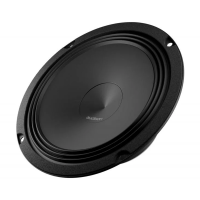 TipUpdatedQuick previewØ 165 mm, 70/210 W, 4 Ω, 93.5 dB (2.83V/1m), installation depth 56 mm99,00 EURIn stockAudison APG 6.5
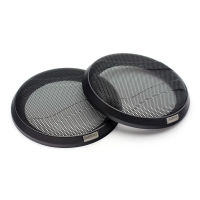 UpdatedQuick previewspeaker grills for speakers with Ø 16.5 cm, price for 2 pieces19,90 EURIn stock
TipUpdatedQuick previewtweeters, Ø 26 mm domes, 150 W, 93 dB (2.83V/1m), 4 Ω89,00 EURIn stockAudison AP4UpdatedQuick previewØ 100 mm, 40/120 W, 4 Ω, 91 dB (2.83V/1m), installation depth 41 mm89,00 EURIn stockAudison AP5UpdatedQuick previewØ 130 mm, 50/150 W, 4 Ω, 93 dB (2.83V/1m), installation depth 48.5 mm99,00 EURIn stockAudison AP 6.5TipUpdatedQuick previewØ 165 mm, 70/210 W, 4 Ω, 93.5 dB (2.83V/1m), installation depth 56 mm99,00 EURIn stockAudison APG 6.5UpdatedQuick previewspeaker grills for speakers with Ø 16.5 cm, price for 2 pieces19,90 EURIn stockask us