
Musway P2 amplifier
More about the product
- You can return the goods to us within 14 days
Musway P2 amplifier
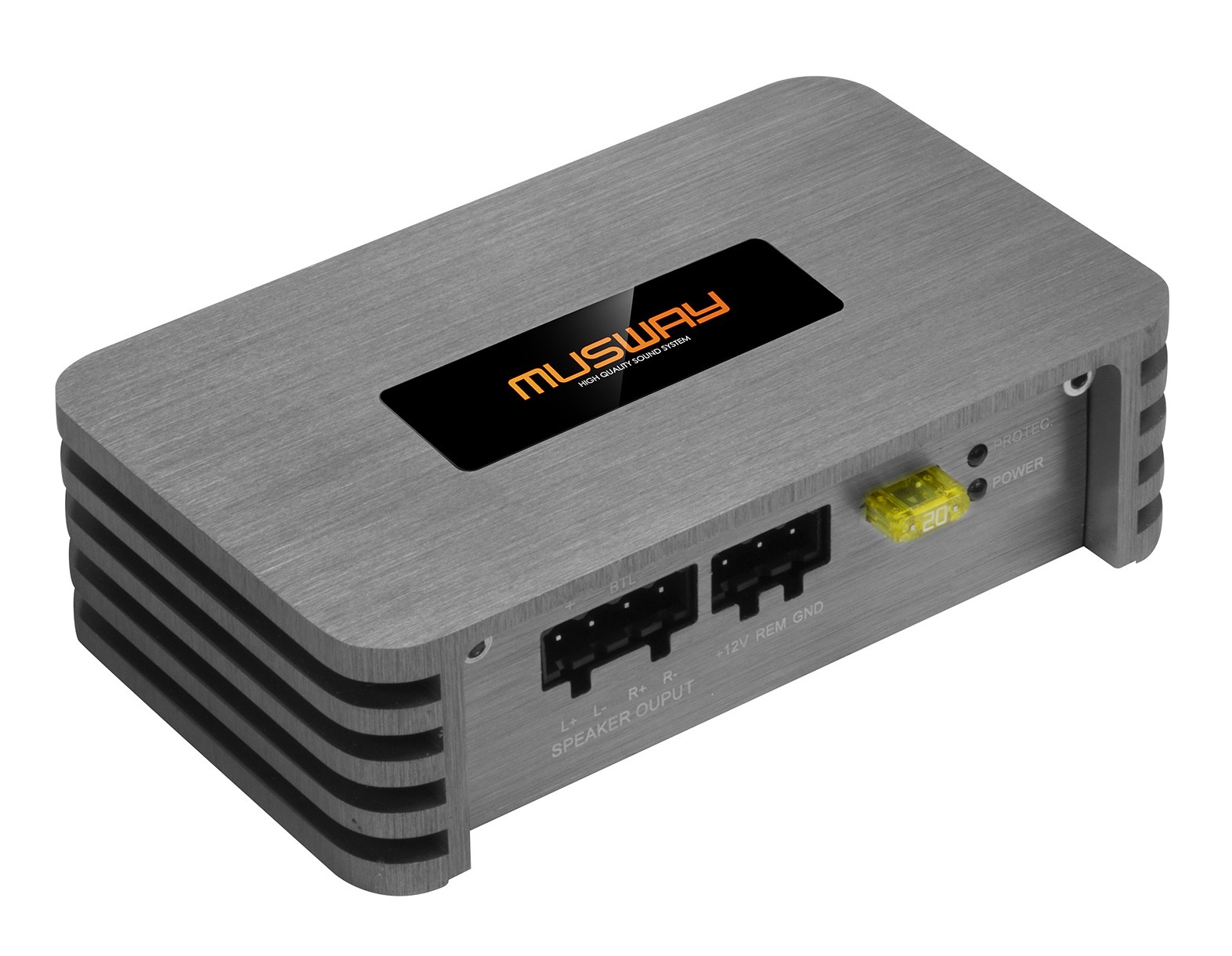
Musway P2 is an ultra-compact 2-channel Class D amplifier designed as a pure power module for modern audio systems, especially when used together with Musway DSP processors or DSP amplifiers. The “Pure Amplification” concept means the amplifier contains no filtering section and focuses exclusively on the cleanest possible amplification of the signal. Only input sensitivity adjustment is available, making it an ideal solution for active systems driven by an external processor.
Minimalist design, surprising power
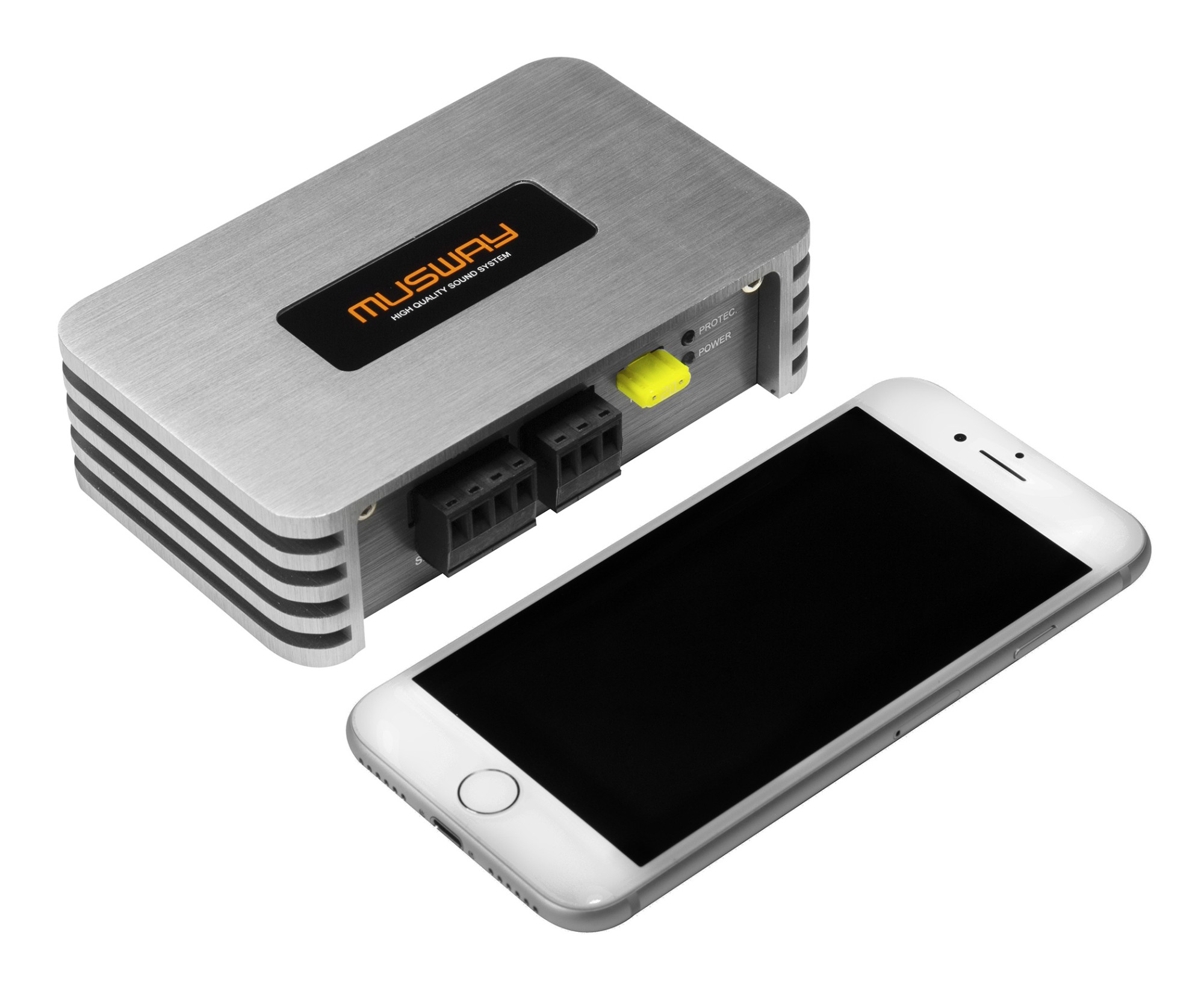
Extremely compact dimensions allow installation virtually anywhere in the vehicle – typically behind the dashboard, in a glovebox or in tight spaces where a conventional amplifier cannot be used. This makes the P2 ideal as an additional power stage, for example to Musway DSP amplifiers M6 or D8, where it uses their processed outputs. The amplifier is designed as a simple and effective solution wherever extra power is needed without complicated installation. Despite its size, the amplifier delivers approximately 2 × 70 W RMS at 4 Ω and over 100 W RMS at 2 Ω per channel, or up to 210 W RMS in bridged mode. This allows it to power a quality front system or a small subwoofer. The high efficiency of the digital technology also minimizes heating and ensures stable operation even under long-term load.
Technology and construction
Inside the compact brushed-aluminium chassis with the Musway logo is a full-fledged power solution with a transformer and filter capacitors that provide stable energy delivery even under higher loads. The modern amplifier chip offers a wide frequency range up to around 60 kHz and very low distortion, which positively affects the clarity and detail of reproduction. Although it is a minimalist amplifier, the quality of the design and components corresponds to a higher class.
Simple installation and integration
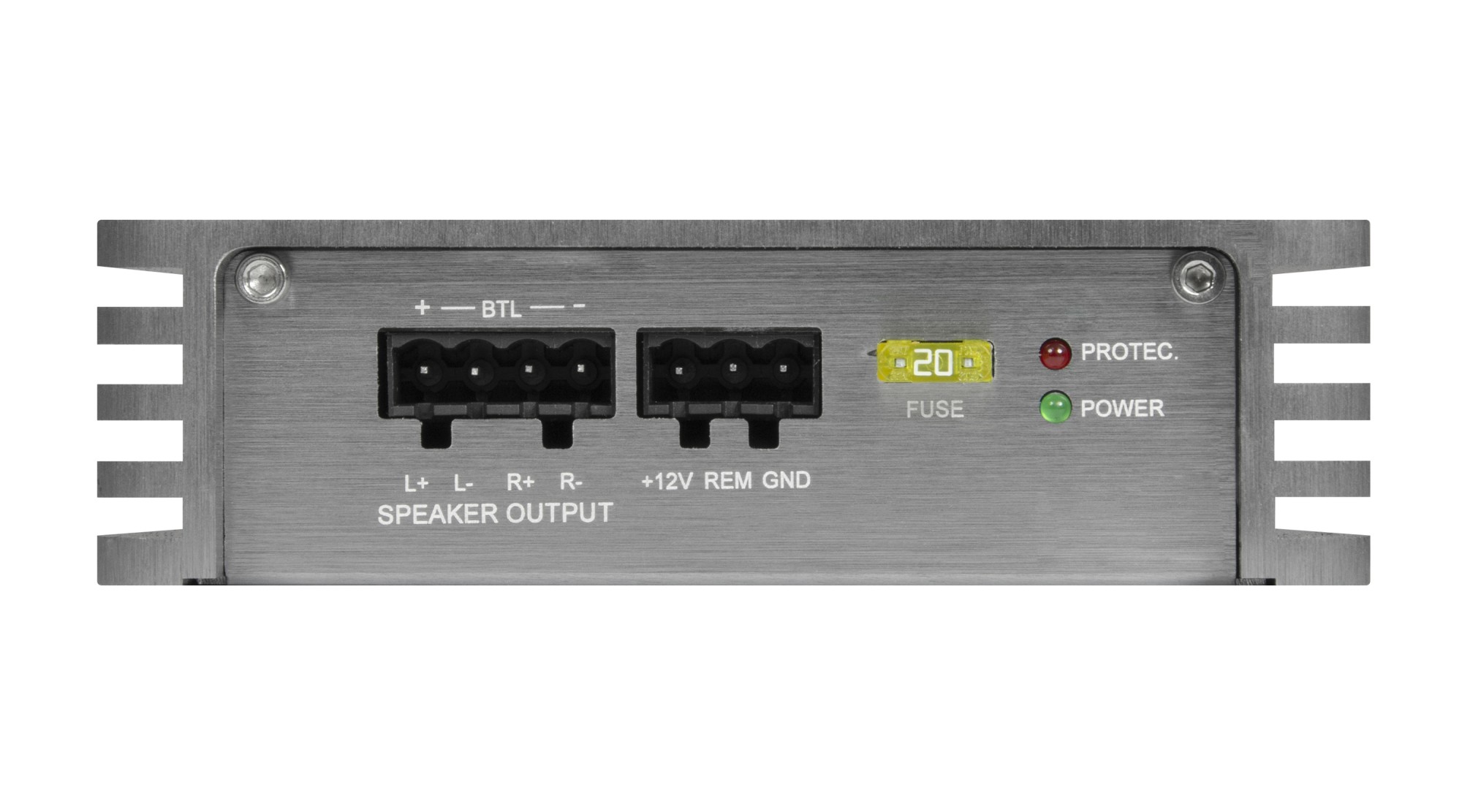
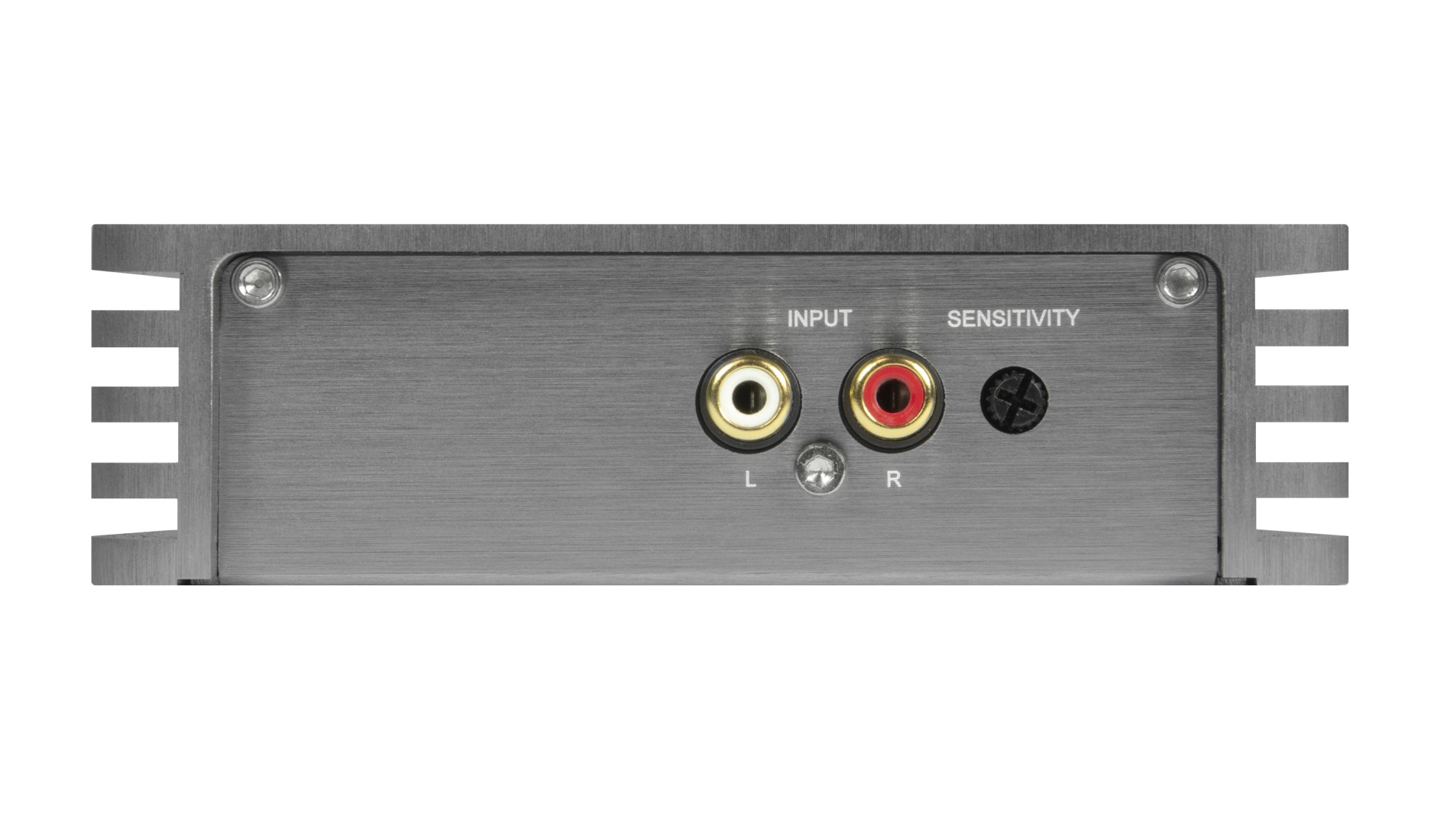
The amplifier is equipped with RCA inputs and, thanks to compact connectors, is easy to install even in confined spaces. Plug-in connectors for power and speakers are also practical, significantly speeding up installation and potential service. Support for start-stop systems and the option to connect via high-level inputs extend compatibility to modern vehicles.
Awards in specialist tests
Musway amplifiers are regularly rated very positively in specialist magazine tests. The TWO100 model received an overall rating of 1.6 in the Oberklasse (upper class) category in a test by the German magazine Car&Hifi. Testers praised the amplifier for its liveliness and dynamics. "Despite its small size it offers sufficient power for firm and controlled bass while maintaining clarity and good soundstage. The amplifier is fast, precise and free of unnecessary distortion, making it an ideal solution for smaller but well-tuned systems." You can read the full review at the link.
Key features
- 2-channel Class D amplifier.
- Pure Amplification concept without integrated filters.
- Power 2 × 70 W RMS at 4 Ω / 2 × 10⁵ W RMS at 2 Ω.
- Bridged power 210 W RMS at 4 Ω.
- Input sensitivity adjustment (Gain).
- RCA inputs (stereo).
- Plug-in connectors for power and speakers.
- Compact dimensions 124 × 36 × 75 mm.
- High efficiency and low heating.
- Suitable for use with DSP processors and active systems.
About the brand
MUSWAY stands for the motto "Music is the Way". The brand was born out of a passion for high-quality sound reproduction and first made its mark with high-quality Hi-Res audio players and digital signal processors. The real breakthrough came with the introduction of the first Class D amplifiers with integrated DSP, which gradually became internationally acclaimed products in specialist magazine tests and earned a number of prestigious awards, including EISA. Since 2015 the brand’s development has been anchored in Germany, where product design, technical tuning and the final concept of individual models take place. Musway has gradually built a reputation as a manufacturer of compact, technically advanced yet musically natural components that combine modern digital technologies with a focus on clean and linear sound. The portfolio now includes standalone and DSP amplifiers, speakers and subwoofers, with each new generation continuing the brand’s philosophy – to offer the maximum musical experience without compromises in technology, functionality or workmanship.
| Catalog number | P2 |
| Brand | Musway |
| Links | Official web presentation |
| Energy class of the amplifierAmplifiers are divided into two basic classes: analog and digital . Analog amplifiers (A/B) have higher consumption requirements, but usually have a more natural sound. Digital amplifiers (D) have significantly lower consumption and higher efficiency, but the sound may not be as faithful as with classic analog amplifiers. | D |
| Number of amplifier channelsAmplifiers are divided into: - Monoblocks - 2-channel - 3-channel - 4-channel - 5-channel - 6-channel - multi-channel Each channel is used to power one speaker for the coaxial type, or one side if they are component speakers. Monoblock type amplifiers are mainly used for subwoofers. 2-channel are suitable for both subwoofers and, for example, the front pair of speakers in a car. 3-channel is used for front or rear speakers + subwoofer. 4-channel are used for front + rear speakers or 1 pair of speakers + subwoofer. 6 or 5-channel are used for 2 pairs of speakers + subwoofer, most often. Bridging means connecting the amplifier to a bridge, using the + pole from one channel and the - pole from the other channel. In most cases this is shown as "BRIDGED" on the amplifier. | 2 |
| RMS power into 4 ΩRMS power when loading speakers or subwoofer at 4 Ω. RMS power is the constant power of the amplifier and is one of the most important parameters when choosing an amplifier. | 2 x 70 / 1 x 210 W |
| RMS power into 2 ΩRMS power when loading speakers or subwoofer at 2 Ω. RMS power is the constant power of the amplifier and is one of the most important parameters when choosing an amplifier. | 2 x 10⁵ W |
| Speaker impedance | 2 – 8 Ω |
| Frequency rangeThe ability of the amplifier to reproduce the signal from the lowest frequency to the highest = faithfully reproduce the sound in a specific frequency band. Professionally: In the frequency range from 40 to 16,000 Hz, the vast majority of fundamental and overtones (harmonics) of all musical instruments are found. We are interested in the course of the radiated sound pressure in this range of frequencies when the loudspeaker system is supplied with constant power. We call this course the frequency characteristic, which tells us the level of radiated sound pressure in decibels (dB) depending on the frequency. The frequency characteristic of a speaker or speaker system can be expressed most succinctly with a graph. Mostly, however, the frequency characteristic is indicated by indicating the maximum tolerance of the sound pressure in the given frequency range, e.g. 50 to 15,000 Hz -+ 6 dB. Since the frequency characteristics of loudspeakers and systems in general are quite uneven, some manufacturers do not even specify this maximum tolerance of sound pressure in decibels in their catalogs for reasons of prestige. Data impoverished in this way is unfortunately worthless. What is valid is that the manufacturer offers a speaker system with a frequency range of 30 to 20,000 Hz, if he is worried about stating the maximum unevenness of the sound pressure in this range, because he can have a tolerance of, for example, +- 20 dB. The unevenness or undulation of the frequency curve in good speaker systems for high-quality music performance should not exceed +-3 dB in the 80 to 12,000 Hz band and +-6 dB in the 40 to 16,000 Hz band. Greater unevenness already depletes or emphasizes certain tonal areas, which can cause audible or even disturbing distortion. The proportion between fundamental tones and higher harmonics also changes, thereby changing the color of the sound, and individual musical instruments as well as the entire musical image sound unnatural. | 5 – 60,000 Hz (-3 dB) |
| Harmonic Distortion (THD)Total harmonic distortion indicates how much the input signal is distorted in the amplifier. Distortions appear as overtones contained in the output signal. The proportion of originally absent parts of the signal is given as a percentage, typical values are between 0.001% and 0.5%. Distortion is measured in their power band. If it exceeds the limit of 0.7% from a certain power, it is the value of the output power of the given amplifier, from which it no longer plays without distortion and from which the distortion usually increases steeply, so that no further increase in power can be counted on. The lower the value, the better. | < 0.05 % (1 kHz) |
| Signal-to-noise ratioThe signal-to-noise ratio means that the output signal always contains noise. The signal-to-noise ratio expresses how much of this noise is compared to the useful signal. The so-called A value is given, which does not take deep and very high frequencies into account. This corresponds to the characteristic of human hearing, which is not so sensitive to deep frequencies, especially below 1 kHz. The higher the value, the better the amplifier is. | > 97 dB |
| Input sensitivityIn order for the amplifier to perform its function correctly, it requires an input signal of a certain level, which is different for car radios. It is measured in "Volts" (e.g. 2 V, 4 V, etc.) The higher the value at the output of the pre-amplifier, or car radio, the less demands are placed on the power of the amplifier. However, the amplifier must allow this input sensitivity, and for that reason this value is also given for the amplifier. | 0.6 – 16 V |
| On-board voltage rangeThe ability of the amplifier to operate at a specified voltage. As the voltage decreases, so does the power of the amplifier. The ideal voltage in a car is between 13.8 and 14.4 V. | 7 – 16 V |
| The value of the fuses on the amplifierFrom the value of the fuses on the amplifier, you can get a true picture of the real performance of the amplifier. | 1 x 20 A |
| Dimensions of the amplifier | 124 x 36 x 75 mm |
| Mass | 0.7 Kg |