
Musway NX600.1 speakers
More about the product
- You can return the goods to us within 14 days
Musway NX600.1 amplifier
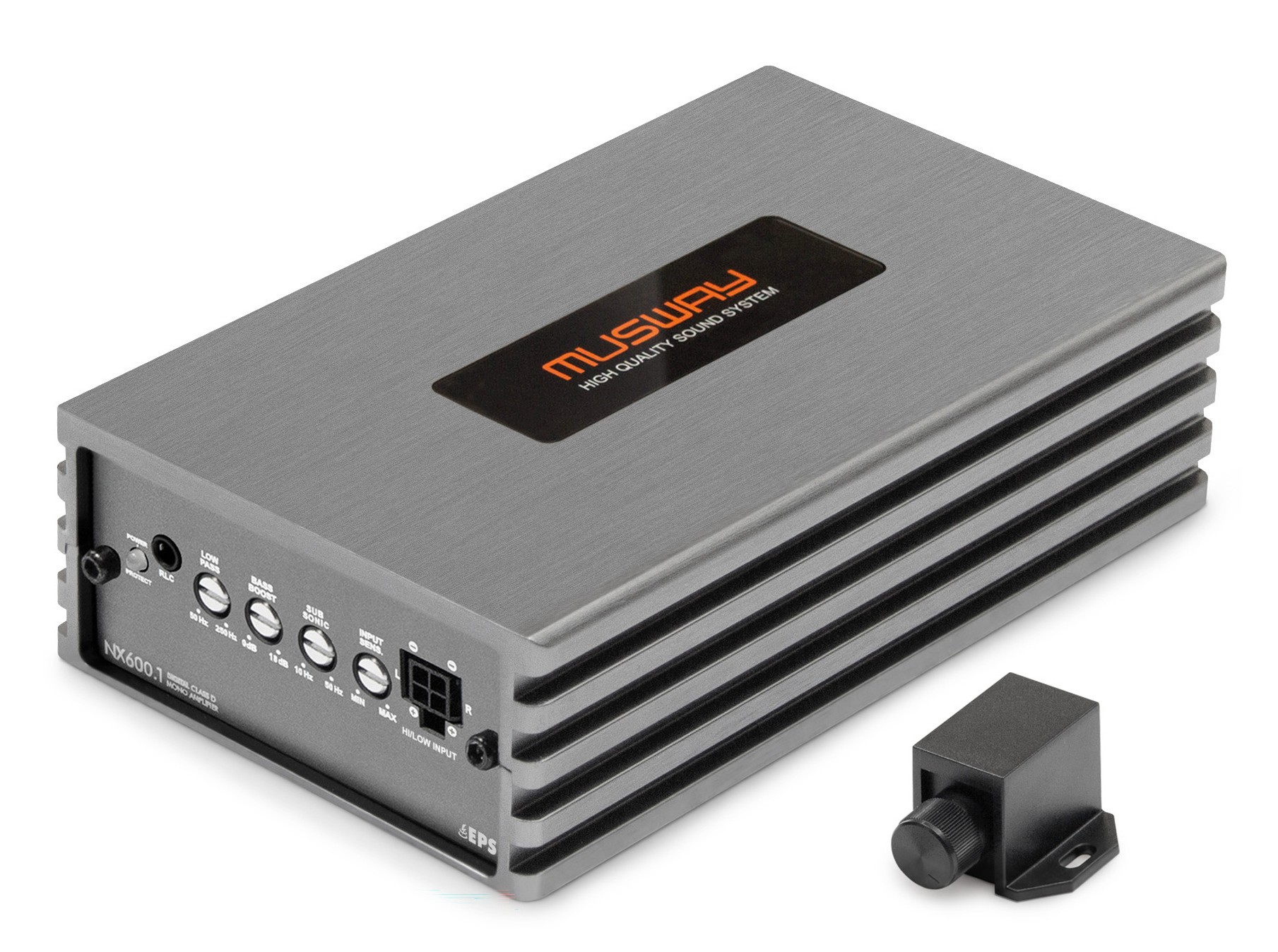
Musway NX600.1 is a powerful class D monoblock from the new NX line of micro amplifiers, combining exceptionally compact dimensions with the power and features of full-size car amplifiers. The middle model of the three monoblocks in this series delivers up to 600 W RMS at 1 Ω and is an ideal solution for powering more powerful subwoofers in installations where every centimeter of space counts. Despite its miniature size, it provides ample power reserve, low distortion and precise control over bass reproduction. The rich feature set includes an adjustable low-pass, subsonic filter and bass boost control, allowing adaptation to the specific subwoofer and installation. RCA and high-level inputs with EPS and automatic turn-on simplify connections, while compatibility with start-stop systems expands options for use in modern vehicles. The package also includes a compact wired remote for convenient adjustment of the subwoofer level from the driver’s seat. The amplifier’s exceptional capabilities are further confirmed by the prestigious KLANGTIPP award from the German magazine Car&Hifi.
High power in an exceptionally compact body
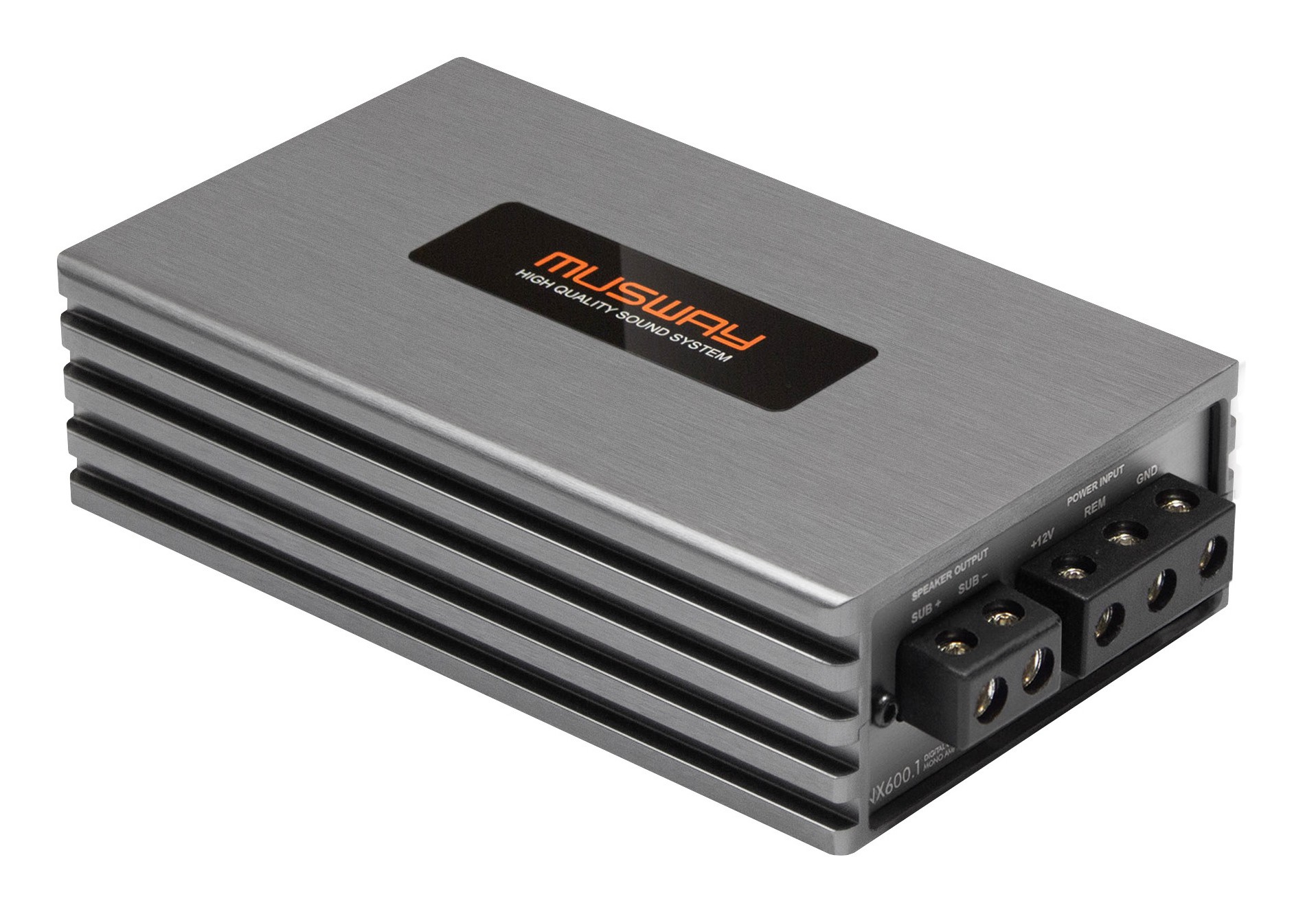
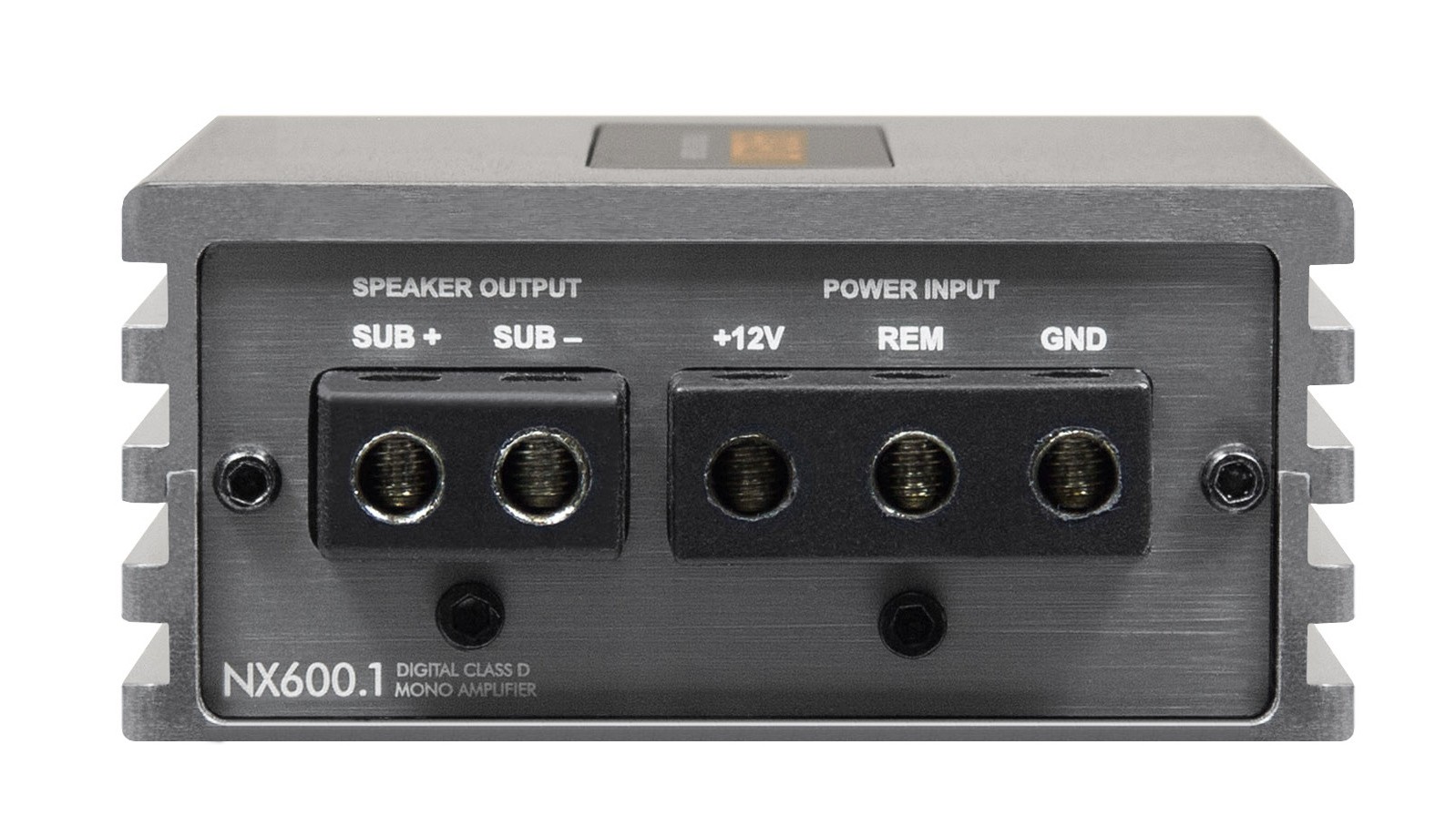
With dimensions of only 89 × 41 × 148 mm, the NX600.1 offers significantly more freedom when selecting an installation location than conventional large amplifiers. Its power reaches 250 W RMS at 4 Ω, 400 W RMS at 2 Ω and 600 W RMS at 1 Ω, enabling various subwoofer configurations depending on final impedance. Stability at 1 Ω expands wiring options and allows the amplifier to deliver its full power even with demanding subwoofer setups. The class D design with efficiency up to 89% limits energy losses and contributes to efficient operation in such a small package. The design retains characteristic Musway features – a brushed heatsink surface, rounded aluminum end caps and high-quality workmanship. A notable detail is the backlit logo placed behind a real glass window, which gives the amplifier an attractive look even when visibly mounted.
Precise bass tuning
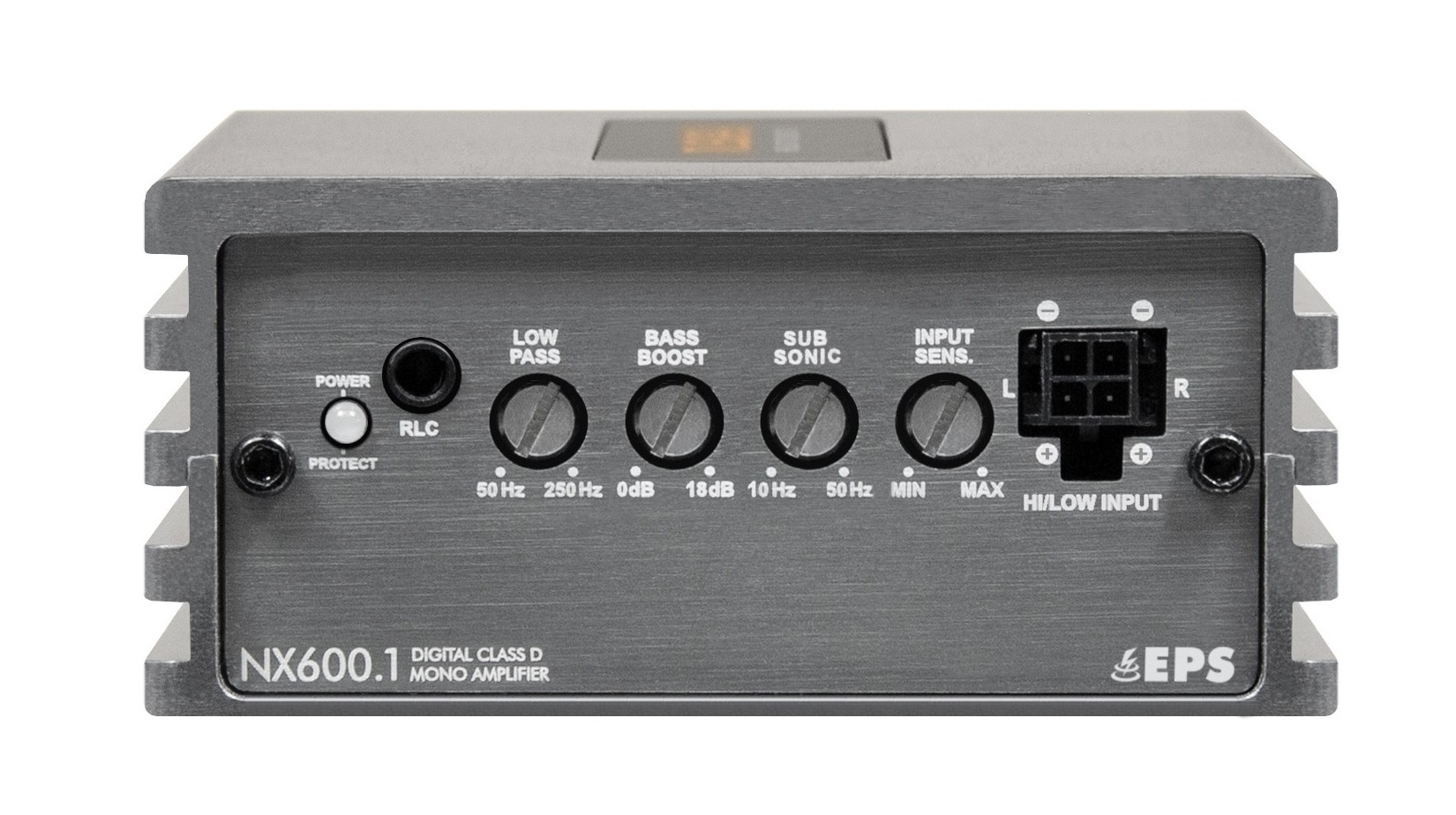
The NX600.1 offers a complete set of controls to precisely match a subwoofer with the other speakers in the car. The adjustable low-pass from 50 to 250 Hz limits the upper part of the reproduced band and allows setting the optimal crossover to the midbass speakers. The subsonic filter from 10 to 50 Hz suppresses the lowest frequencies that can unnecessarily burden the subwoofer and cause excessive cone excursion. The equipment is complemented by a continuously adjustable bass boost of up to 18 dB to emphasize the bass band and an input sensitivity control to adapt to the source signal level. With these options the amplifier can be used effectively with subwoofers in sealed and bass-reflex enclosures. The supplied wired remote also allows convenient adjustment of the subwoofer level according to the recording or personal preference without needing to access the amplifier directly.
Ready for modern vehicles
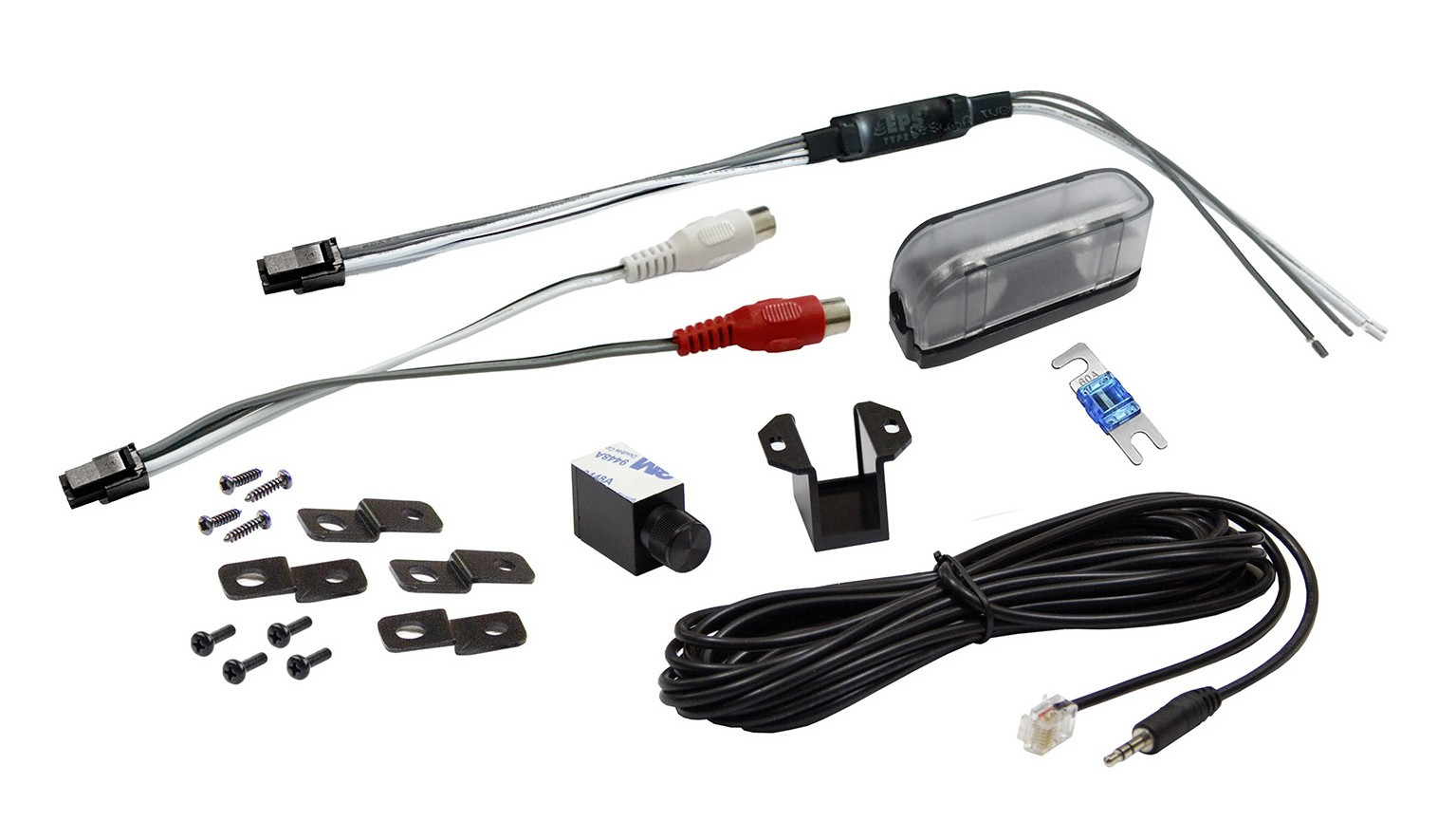
The amplifier can be connected via RCA inputs to a car stereo or an external DSP processor, or you can use the high-level inputs for direct connection to the factory head unit’s speaker outputs. Both connection options use the supplied cable adapters that match the amplifier’s space-saving design. The high-level adapter features the EPS (Error Protection System), which helps prevent error messages related to speaker diagnostics. When using the high-level input, automatic turn-on is also available, so a separate REM turn-on signal is not required for compatible head units. IFT (Interference Free Technology) reduces electromagnetic interference and helps preserve uninterrupted radio reception. The amplifier is, of course, prepared for vehicles equipped with start-stop systems.
Awarded in specialist tests
Musway NX600.1 underwent extensive testing by the German specialist magazine Car&Hifi in issue 3/2026, where it achieved an overall rating of 1.4 in the Oberklasse (upper class) and received the prestigious KLANGTIPP award for its sound quality. The editors particularly praised the extraordinary power reserve, precise subwoofer control and very low distortion, which remains low even at 2 Ω and 1 Ω loads. Laboratory measurements at a supply voltage of 13.8 V confirmed outputs of 252 W at 4 Ω, 422 W at 2 Ω and 596 W at 1 Ω, practically matching the manufacturer’s declared specifications. In listening tests the amplifier impressed with emphatic, dynamic and controlled bass performance even with larger subwoofers. The build quality, rich feature set and exceptional power-to-size ratio were also rated very positively. The result is not only the KLANGTIPP award but also an excellent price/performance rating.
Key features
- 1-channel class D micro amplifier for powering a subwoofer.
- Power 250 W RMS at 4 Ω / 400 W RMS at 2 Ω / 600 W RMS at 1 Ω.
- Stable operation at 1 Ω load.
- Highly efficient design with low distortion.
- Accurate and dynamic bass reproduction with high power reserve.
- Adjustable low-pass and subsonic filter.
- Continuously adjustable bass boost.
- Input sensitivity control.
- RCA inputs via the supplied cable adapter.
- High-level inputs for connection to factory head units.
- EPS system to reduce speaker-diagnostic error messages.
- Automatic turn-on when using high-level inputs.
- IFT technology minimizing electromagnetic interference.
- Prepared for vehicles with start-stop systems.
- Compact wired subwoofer level remote included.
- Exceptionally compact body with brushed finish and aluminum end caps.
- Backlit logo behind a real glass window.
- KLANGTIPP award in Car&Hifi test 3/2026.
About the brand
MUSWAY stands for the motto “Music is the Way.” The brand was born out of a passion for high-quality sound reproduction and first made a name with high-quality Hi-Res audio players and digital signal processors. The real breakthrough came with the introduction of the first class D amplifiers with integrated DSP, which gradually became internationally acclaimed in specialist magazine tests and won numerous prestigious awards, including EISA. Since 2015 the brand’s development has been anchored in Germany, where product design, technical tuning and final concept development take place. Musway has built a reputation as a maker of compact, technically advanced and musically natural components that combine modern digital technologies with an emphasis on clean and linear sound. The portfolio today includes standalone and DSP amplifiers, speakers and subwoofers, with each new generation continuing the brand’s philosophy – to offer the maximum musical experience without compromises in technology, functionality or craftsmanship.
| Catalog number | NX600.1 |
| Brand | Musway |
| Links | Official web presentation |
| Number of amplifier channelsAmplifiers are divided into: - Monoblocks - 2-channel - 3-channel - 4-channel - 5-channel - 6-channel - multi-channel Each channel is used to power one speaker for the coaxial type, or one side if they are component speakers. Monoblock type amplifiers are mainly used for subwoofers. 2-channel are suitable for both subwoofers and, for example, the front pair of speakers in a car. 3-channel is used for front or rear speakers + subwoofer. 4-channel are used for front + rear speakers or 1 pair of speakers + subwoofer. 6 or 5-channel are used for 2 pairs of speakers + subwoofer, most often. Bridging means connecting the amplifier to a bridge, using the + pole from one channel and the - pole from the other channel. In most cases this is shown as "BRIDGED" on the amplifier. | 1 |
| Energy class of the amplifierAmplifiers are divided into two basic classes: analog and digital . Analog amplifiers (A/B) have higher consumption requirements, but usually have a more natural sound. Digital amplifiers (D) have significantly lower consumption and higher efficiency, but the sound may not be as faithful as with classic analog amplifiers. | D |
| RMS power into 4 ΩRMS power when loading speakers or subwoofer at 4 Ω. RMS power is the constant power of the amplifier and is one of the most important parameters when choosing an amplifier. | 250 W |
| RMS power into 2 ΩRMS power when loading speakers or subwoofer at 2 Ω. RMS power is the constant power of the amplifier and is one of the most important parameters when choosing an amplifier. | 400 W |
| RMS power into 1 ΩRMS power when the subwoofer is loaded at 1 Ω. RMS power is the constant power of the amplifier and is one of the most important parameters when choosing an amplifier. When connected to 1 Ω, significant heating of the amplifier may occur. | 600 W |
| Frequency rangeThe ability of the amplifier to reproduce the signal from the lowest frequency to the highest = faithfully reproduce the sound in a specific frequency band. Professionally: In the frequency range from 40 to 16,000 Hz, the vast majority of fundamental and overtones (harmonics) of all musical instruments are found. We are interested in the course of the radiated sound pressure in this range of frequencies when the loudspeaker system is supplied with constant power. We call this course the frequency characteristic, which tells us the level of radiated sound pressure in decibels (dB) depending on the frequency. The frequency characteristic of a speaker or speaker system can be expressed most succinctly with a graph. Mostly, however, the frequency characteristic is indicated by indicating the maximum tolerance of the sound pressure in the given frequency range, e.g. 50 to 15,000 Hz -+ 6 dB. Since the frequency characteristics of loudspeakers and systems in general are quite uneven, some manufacturers do not even specify this maximum tolerance of sound pressure in decibels in their catalogs for reasons of prestige. Data impoverished in this way is unfortunately worthless. What is valid is that the manufacturer offers a speaker system with a frequency range of 30 to 20,000 Hz, if he is worried about stating the maximum unevenness of the sound pressure in this range, because he can have a tolerance of, for example, +- 20 dB. The unevenness or undulation of the frequency curve in good speaker systems for high-quality music performance should not exceed +-3 dB in the 80 to 12,000 Hz band and +-6 dB in the 40 to 16,000 Hz band. Greater unevenness already depletes or emphasizes certain tonal areas, which can cause audible or even disturbing distortion. The proportion between fundamental tones and higher harmonics also changes, thereby changing the color of the sound, and individual musical instruments as well as the entire musical image sound unnatural. | 10 – 250 Hz |
| Harmonic Distortion (THD)Total harmonic distortion indicates how much the input signal is distorted in the amplifier. Distortions appear as overtones contained in the output signal. The proportion of originally absent parts of the signal is given as a percentage, typical values are between 0.001% and 0.5%. Distortion is measured in their power band. If it exceeds the limit of 0.7% from a certain power, it is the value of the output power of the given amplifier, from which it no longer plays without distortion and from which the distortion usually increases steeply, so that no further increase in power can be counted on. The lower the value, the better. | < 0.02 % |
| Signal-to-noise ratioThe signal-to-noise ratio means that the output signal always contains noise. The signal-to-noise ratio expresses how much of this noise is compared to the useful signal. The so-called A value is given, which does not take deep and very high frequencies into account. This corresponds to the characteristic of human hearing, which is not so sensitive to deep frequencies, especially below 1 kHz. The higher the value, the better the amplifier is. | > 90 dB |
| Damping factorDF - Damping Factor . It is the ratio of the load (repro + cables, crossover, etc.) to the internal resistance of the amplifier. The bigger the DF, the more controlled the bass. Amplifiers with a lower DF tend to hum. Subwoofers with a higher Q in the bass reflex and sometimes in the enclosure will also cause humming. | > 200 |
| High level inputsThe high-level input on the amplifier allows connection directly to the existing speakers in the car without additional purchase of an external high/low adapter. Important equipment in the case of installing an amplifier on an original car radio. | Yes, with EPS function |
| Input sensitivityIn order for the amplifier to perform its function correctly, it requires an input signal of a certain level, which is different for car radios. It is measured in "Volts" (e.g. 2 V, 4 V, etc.) The higher the value at the output of the pre-amplifier, or car radio, the less demands are placed on the power of the amplifier. However, the amplifier must allow this input sensitivity, and for that reason this value is also given for the amplifier. | 370 mV – 8 V |
| Automatic on and offThis function allows you to automatically switch on the amplifier. | Yes |
| Low-pass filter (LPF)LPF / LP or "low pass filter" offers the possibility to adjust the amplifier using a potentiometer so that the lower band plays only the frequencies in a certain band that you need. This filter is used to adjust the frequency range for the subwoofer, so that it does not overload or distort the sound. Example: Amplifiers most often have an LPF from 20 to 300 Hz. We recommend setting this potentiometer in the range of 45-80 Hz. | 50 – 250 Hz |
| SubsonicA subsonic filter is essentially a high-pass filter for very low frequencies, typically 45 Hz or lower. Anything below this setting is weakened. The point is that the subwoofer does not go below the subsonic filter setting and does not overload itself with very low frequencies. A useful function, if set correctly, the subwoofer is not overloaded. | 10 – 50 Hz |
| Bass boostBass boost or bass enhancement. With this function, the bass itself can be emphasized, at a high level of bass boost, the speakers and the subwoofer can distort a lot and the sound will be worse than better. We therefore recommend using the "bass boost" function wisely. With maximum use of bass boost, there is a risk of damage to the speakers and thus to the subwoofer. | 0 – 18 dB @ 45 Hz |
| Phase shiftPhase shift is a linear electronic oscillator that produces a sinusoidal output. It consists of an inverting part of the amplifier such as a transistor. The feedback network "shifts" the phase at the output of the amplifier by 180 degrees to the oscillation frequency and gives positive feedback. The Phase shift filter produces a phase shift that increases with increasing frequency. This is usually used when the subwoofer sub-assembly is out with the magnet, or when two amplifiers are connected externally. Phase Shift is also used with active speaker wiring, where the time shift of the speakers is set. The point is that the subwoofer does not play the bass late, and for this reason better amplifiers offer this phase reversal option. | 0 – 180° |
| On-board voltage rangeThe ability of the amplifier to operate at a specified voltage. As the voltage decreases, so does the power of the amplifier. The ideal voltage in a car is between 13.8 and 14.4 V. | 10.5 – 16.5 V |
| The value of the fuses on the amplifierFrom the value of the fuses on the amplifier, you can get a true picture of the real performance of the amplifier. | 1 x 60 A (external) |
| Remote control included in the packageSome models of amplifiers also come with wired remote controls in the package, which on one side plug into the amplifier and on the other side you have a potentiometer that you can place anywhere in the cabin. A common place to place the remote control is under the steering wheel. The advantage is the regulation of power, and therefore volume, depending on driving conditions and the mood of the crew in the car. | Yes |
| Dimensions of the amplifier | 89 x 41 x 148 mm |