
Musway FOUR100 amplifier
More about the product
Musway FOUR100 Amplifier
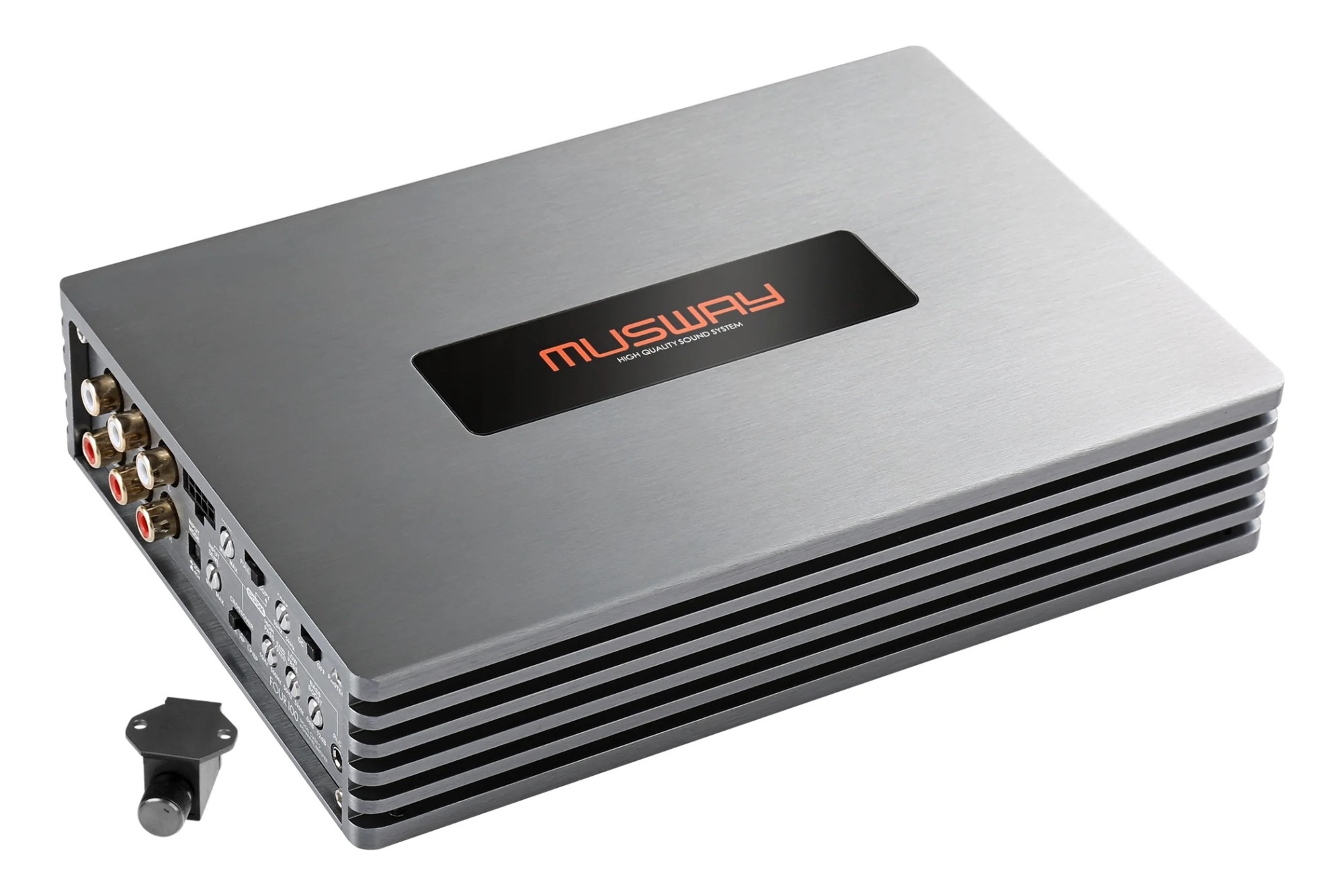
The Musway FOUR100 is a modern 4-channel Class D amplifier designed for powerful car audio systems where high power, flexible wiring options and compact dimensions are essential. The amplifier offers above-standard power to drive both a front system and a subwoofer within a single installation. Its design is based on the proven Musway MX platform and, thanks to its compact size, it can be installed in limited spaces without compromises in performance. The elegant brushed-aluminum chassis with a backlit glass logo follows the design of other Musway amplifiers and makes it easy to pair with the brand’s DSP amplifiers and processors. Seamless integration into modern vehicles is a given – the amplifier features both RCA and high-level inputs with EPS® (up to 20 V), automatic turn-on on signal detection, and support for start-stop systems. IFT (Interference Free Technology) minimizes electromagnetic interference and ensures clean radio reception. A compact bass level remote control is included in the package.
Compact size, big power reserve
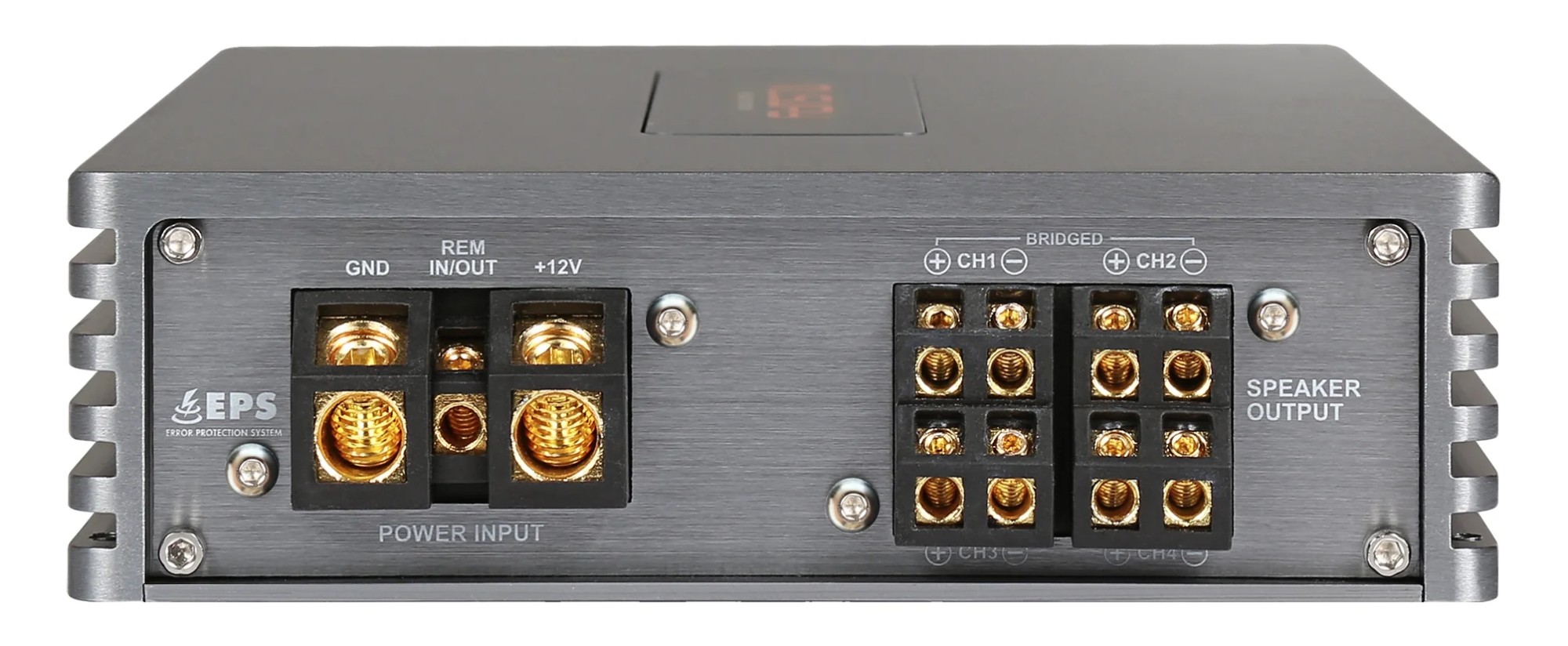
The amplifier provides stable 4 × 200 W RMS at 2 Ω, or 2 × 400 W RMS bridged, allowing it to power a complete front system as well as a subwoofer within a single installation. In DHR mode, output reaches up to 235 W RMS per channel at 2 Ω, delivering even greater dynamics and driver control. Thanks to this, the FOUR100 handles not only standard component speakers but also more demanding drivers or combinations with a bridged subwoofer. Despite its high power, the amplifier maintains very compact dimensions, enabling installation even in tight spaces. The brushed-aluminum chassis ensures efficient heat dissipation and high mechanical durability. The design is complemented by a recessed backlit glass logo and precisely machined aluminum side panels, reflecting Musway’s attention to detail and build quality.
Flexible tuning
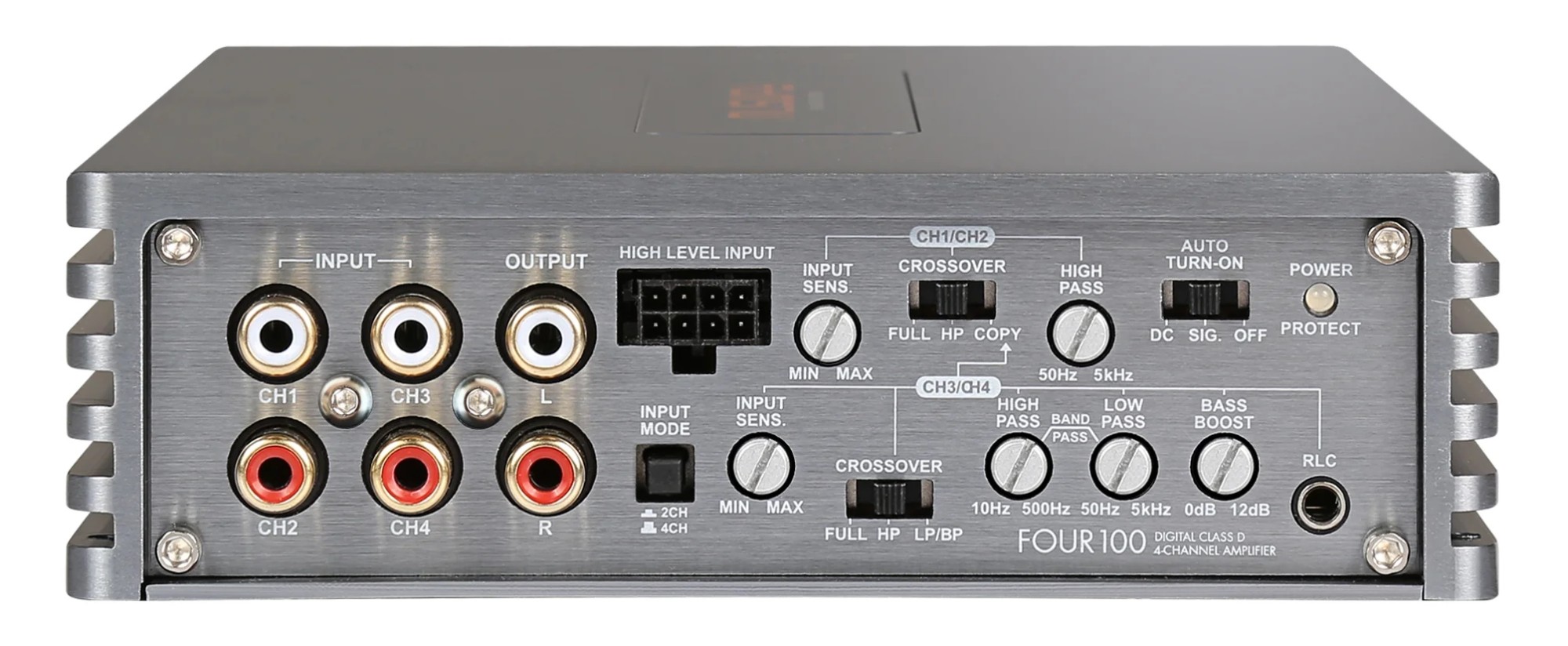
The FOUR100 offers significantly broader tuning options than the smaller models in the series. Channels 1/2 feature a high-pass filter covering 50 – 5000 Hz, while channels 3/4 allow full adjustments including high-pass and low-pass filters, bandpass and bass boost. This makes the amplifier suitable for active front-system setups or combinations of speakers and a subwoofer without the need for an external processor. A practical feature is the ability to copy the CH3/4 signal to CH1/2 and a variable input selection.
Ready for modern vehicles
The amplifier is equipped with both low-level RCA inputs and high-level inputs for direct connection to factory head units. Automatic turn-on on signal detection is standard, so the amplifier can be used in modern vehicles that lack a conventional REM signal. IFT (Interference Free Technology) minimizes electromagnetic interference and helps preserve clear radio reception, while the EPS (Error Protection System) protects the amplifier from operational faults. The amplifier’s design is also prepared for vehicles equipped with start-stop systems.
Main features
- 4-channel Class D amplifier.
- Power 4 × 120 W RMS at 4 Ω / 4 × 200 W RMS at 2 Ω.
- Bridged power 2 × 400 W RMS at 4 Ω.
- DHR mode up to 4 × 235 W RMS at 2 Ω.
- High-pass filters 50 – 5000 Hz (CH1/2).
- High-pass and low-pass filters 10 – 5000 Hz (CH3/4).
- Bandpass function and bass boost 0 – 12 dB.
- Ability to copy CH3/4 signal to CH1/2.
- RCA inputs and outputs.
- High-level inputs with EPS® (up to 20 V).
- Automatic turn-on (Auto Turn-On).
- IFT® interference-reduction technology.
- Start-stop compatibility.
- Remote bass-level control.
- Robust aluminum chassis with premium finish.
- Compact dimensions 150 × 45 × 234 mm.
About the brand
MUSWAY stands for the motto “Music is the Way.” The brand was born from a passion for high-quality sound reproduction and first made a mark with high-quality Hi-Res audio players and digital signal processors. The real breakthrough came with the introduction of the first Class D amplifiers with integrated DSP, which gradually became internationally acclaimed products in expert magazine tests and won several prestigious awards, including EISA. Since 2015, the brand’s development has been anchored in Germany, where product design, technical tuning and final concept development take place. Musway has built a reputation for compact, technically advanced yet musically natural components that combine modern digital technologies with a focus on clean, linear sound. The portfolio now includes standalone and DSP amplifiers, speakers and subwoofers, with each new generation continuing the brand philosophy – offering the maximum musical experience without compromises in technology, functionality or craftsmanship.
| Catalog number | FOUR100 |
| Brand | Musway |
| Links | Official web presentation |
| Number of amplifier channelsAmplifiers are divided into: - Monoblocks - 2-channel - 3-channel - 4-channel - 5-channel - 6-channel - multi-channel Each channel is used to power one speaker for the coaxial type, or one side if they are component speakers. Monoblock type amplifiers are mainly used for subwoofers. 2-channel are suitable for both subwoofers and, for example, the front pair of speakers in a car. 3-channel is used for front or rear speakers + subwoofer. 4-channel are used for front + rear speakers or 1 pair of speakers + subwoofer. 6 or 5-channel are used for 2 pairs of speakers + subwoofer, most often. Bridging means connecting the amplifier to a bridge, using the + pole from one channel and the - pole from the other channel. In most cases this is shown as "BRIDGED" on the amplifier. | 4 |
| Energy class of the amplifierAmplifiers are divided into two basic classes: analog and digital . Analog amplifiers (A/B) have higher consumption requirements, but usually have a more natural sound. Digital amplifiers (D) have significantly lower consumption and higher efficiency, but the sound may not be as faithful as with classic analog amplifiers. | D |
| RMS power into 4 ΩRMS power when loading speakers or subwoofer at 4 Ω. RMS power is the constant power of the amplifier and is one of the most important parameters when choosing an amplifier. | 4 x 120 / 2 x 400 W |
| RMS power into 2 ΩRMS power when loading speakers or subwoofer at 2 Ω. RMS power is the constant power of the amplifier and is one of the most important parameters when choosing an amplifier. | 4 x 200 W |
| Frequency rangeThe ability of the amplifier to reproduce the signal from the lowest frequency to the highest = faithfully reproduce the sound in a specific frequency band. Professionally: In the frequency range from 40 to 16,000 Hz, the vast majority of fundamental and overtones (harmonics) of all musical instruments are found. We are interested in the course of the radiated sound pressure in this range of frequencies when the loudspeaker system is supplied with constant power. We call this course the frequency characteristic, which tells us the level of radiated sound pressure in decibels (dB) depending on the frequency. The frequency characteristic of a speaker or speaker system can be expressed most succinctly with a graph. Mostly, however, the frequency characteristic is indicated by indicating the maximum tolerance of the sound pressure in the given frequency range, e.g. 50 to 15,000 Hz -+ 6 dB. Since the frequency characteristics of loudspeakers and systems in general are quite uneven, some manufacturers do not even specify this maximum tolerance of sound pressure in decibels in their catalogs for reasons of prestige. Data impoverished in this way is unfortunately worthless. What is valid is that the manufacturer offers a speaker system with a frequency range of 30 to 20,000 Hz, if he is worried about stating the maximum unevenness of the sound pressure in this range, because he can have a tolerance of, for example, +- 20 dB. The unevenness or undulation of the frequency curve in good speaker systems for high-quality music performance should not exceed +-3 dB in the 80 to 12,000 Hz band and +-6 dB in the 40 to 16,000 Hz band. Greater unevenness already depletes or emphasizes certain tonal areas, which can cause audible or even disturbing distortion. The proportion between fundamental tones and higher harmonics also changes, thereby changing the color of the sound, and individual musical instruments as well as the entire musical image sound unnatural. | 4 – 39000 Hz |
| Harmonic Distortion (THD)Total harmonic distortion indicates how much the input signal is distorted in the amplifier. Distortions appear as overtones contained in the output signal. The proportion of originally absent parts of the signal is given as a percentage, typical values are between 0.001% and 0.5%. Distortion is measured in their power band. If it exceeds the limit of 0.7% from a certain power, it is the value of the output power of the given amplifier, from which it no longer plays without distortion and from which the distortion usually increases steeply, so that no further increase in power can be counted on. The lower the value, the better. | < 0.027% |
| Signal-to-noise ratioThe signal-to-noise ratio means that the output signal always contains noise. The signal-to-noise ratio expresses how much of this noise is compared to the useful signal. The so-called A value is given, which does not take deep and very high frequencies into account. This corresponds to the characteristic of human hearing, which is not so sensitive to deep frequencies, especially below 1 kHz. The higher the value, the better the amplifier is. | 106 dB |
| Damping factorDF - Damping Factor . It is the ratio of the load (repro + cables, crossover, etc.) to the internal resistance of the amplifier. The bigger the DF, the more controlled the bass. Amplifiers with a lower DF tend to hum. Subwoofers with a higher Q in the bass reflex and sometimes in the enclosure will also cause humming. | 300 |
| High level inputsThe high-level input on the amplifier allows connection directly to the existing speakers in the car without additional purchase of an external high/low adapter. Important equipment in the case of installing an amplifier on an original car radio. | Yes, with EPS function |
| Input sensitivityIn order for the amplifier to perform its function correctly, it requires an input signal of a certain level, which is different for car radios. It is measured in "Volts" (e.g. 2 V, 4 V, etc.) The higher the value at the output of the pre-amplifier, or car radio, the less demands are placed on the power of the amplifier. However, the amplifier must allow this input sensitivity, and for that reason this value is also given for the amplifier. | High-level: 600 mV - 20 V, RCA: 200 mV - 6.5 V |
| Automatic on and offThis function allows you to automatically switch on the amplifier. | Yes |
| High pass filter (HPF)HPF / HP or The "hi pass filter" offers the option of setting the amplifier using a potentiometer so that medium, possibly mid-bass and treble frequencies play upwards from a certain frequency. Example: Amplifiers most often have an HPF from 40 to 300 Hz. If we set the potentiometer to a value of approx. 150 Hz, the sound will be clipped so that it plays frequencies from 150 Hz up to the maximum upper limit of the entire frequency range of the amplifier, perhaps up to 20,000 Hz. We recommend setting this potentiometer in the range of 80-160 Hz. Thanks to this setting option, the speakers can handle a higher performance, as you will not overload them with bass in the lower frequency range. | 50 – 5000 Hz (channel 1+2), 10 – 500 Hz (channel 3+4) |
| Low-pass filter (LPF)LPF / LP or "low pass filter" offers the possibility to adjust the amplifier using a potentiometer so that the lower band plays only the frequencies in a certain band that you need. This filter is used to adjust the frequency range for the subwoofer, so that it does not overload or distort the sound. Example: Amplifiers most often have an LPF from 20 to 300 Hz. We recommend setting this potentiometer in the range of 45-80 Hz. | 50 – 5000 Hz |
| Bass boostBass boost or bass enhancement. With this function, the bass itself can be emphasized, at a high level of bass boost, the speakers and the subwoofer can distort a lot and the sound will be worse than better. We therefore recommend using the "bass boost" function wisely. With maximum use of bass boost, there is a risk of damage to the speakers and thus to the subwoofer. | 0 – 12 dB @ 45 Hz |
| On-board voltage rangeThe ability of the amplifier to operate at a specified voltage. As the voltage decreases, so does the power of the amplifier. The ideal voltage in a car is between 13.8 and 14.4 V. | 8 – 15 V |
| The value of the fuses on the amplifierFrom the value of the fuses on the amplifier, you can get a true picture of the real performance of the amplifier. | 1 x 70 A (external) |
| Remote control included in the packageSome models of amplifiers also come with wired remote controls in the package, which on one side plug into the amplifier and on the other side you have a potentiometer that you can place anywhere in the cabin. A common place to place the remote control is under the steering wheel. The advantage is the regulation of power, and therefore volume, depending on driving conditions and the mood of the crew in the car. | Yes |
| Dimensions of the amplifier | 150 x 45 x 220 mm |
| Mass | 2.8 Kg |