
Marine amplifier with DSP Hertz Venezia V8 DSPx²
More about the product
- You can return the goods to us within 14 days

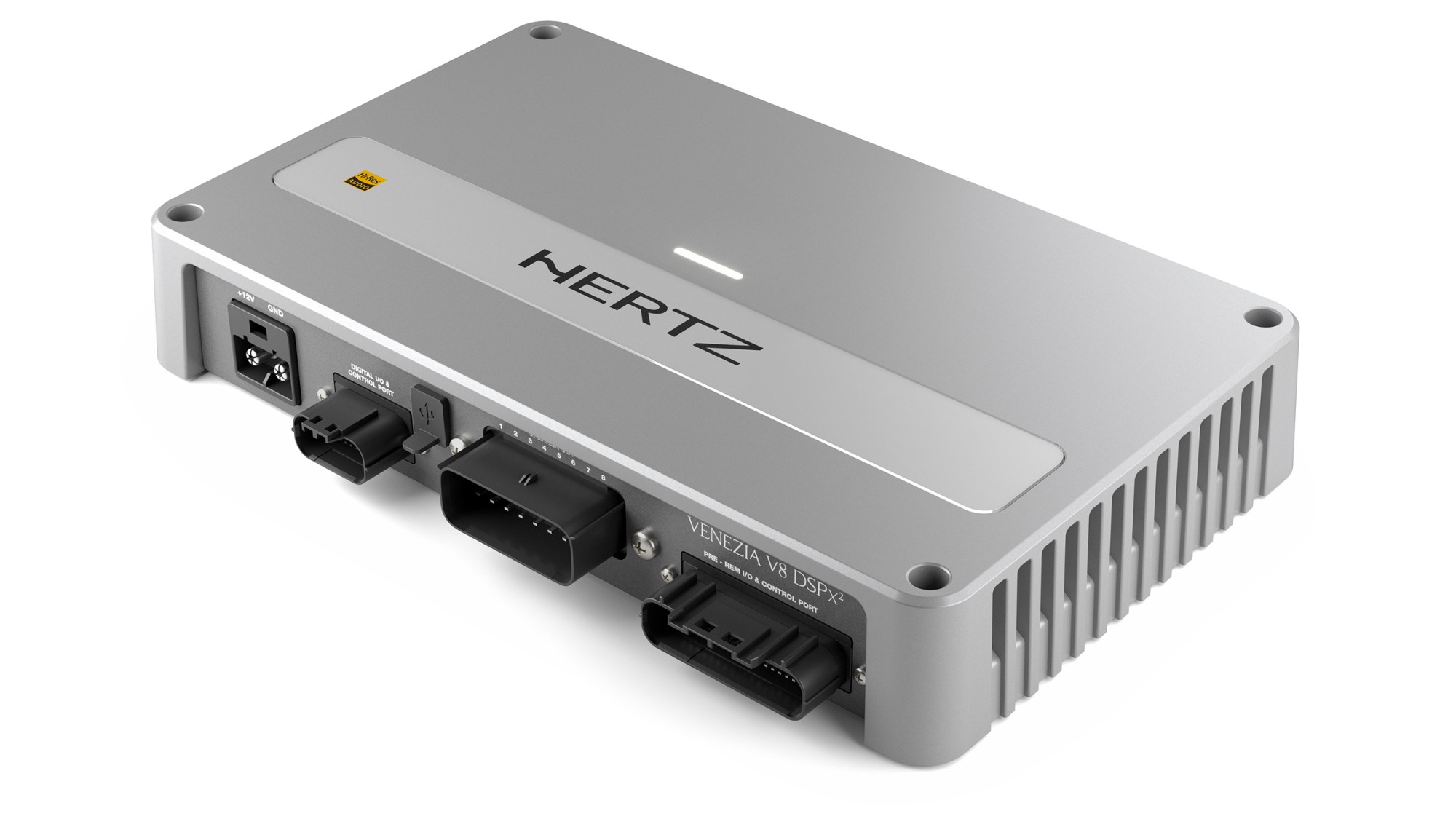
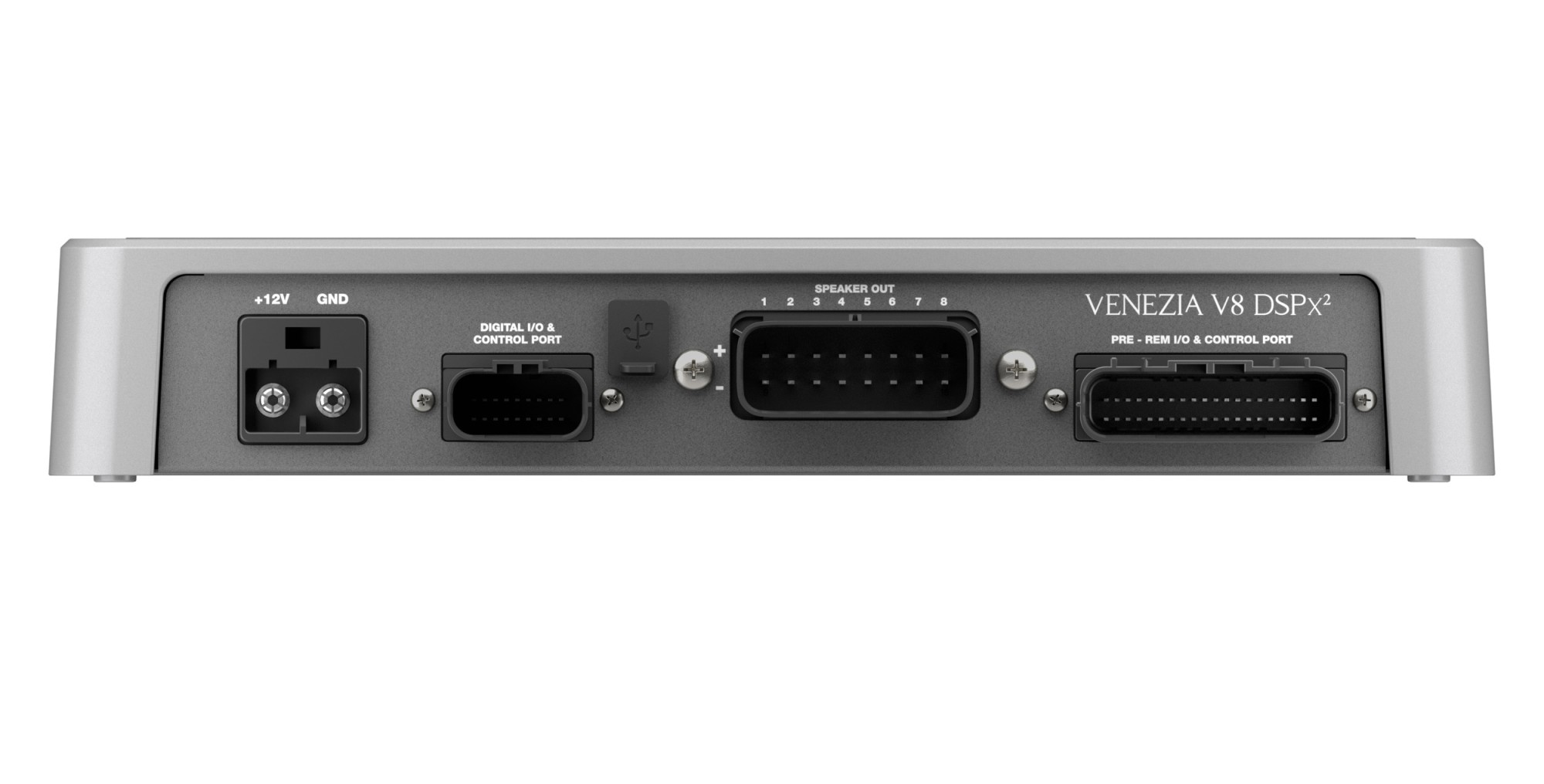
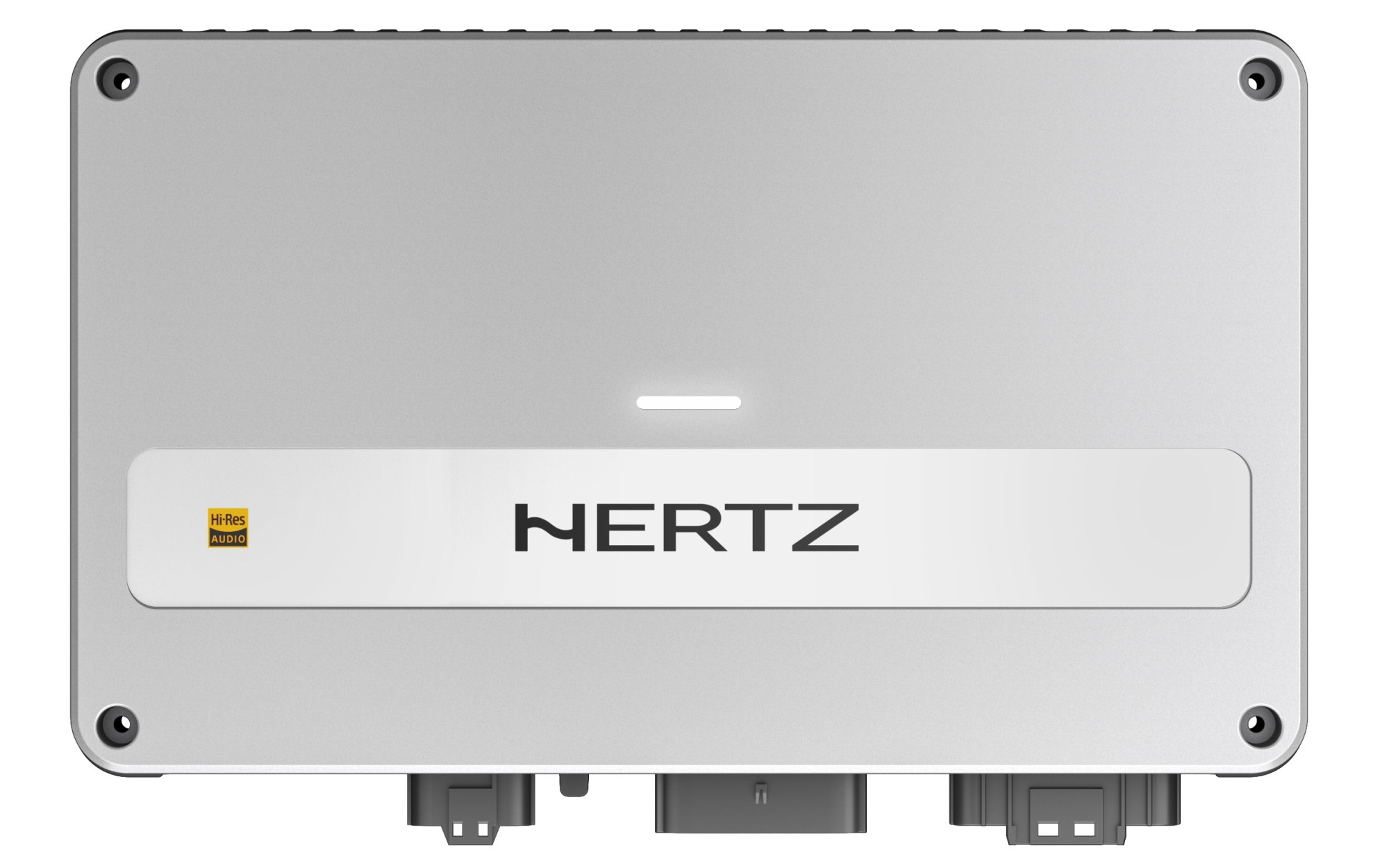
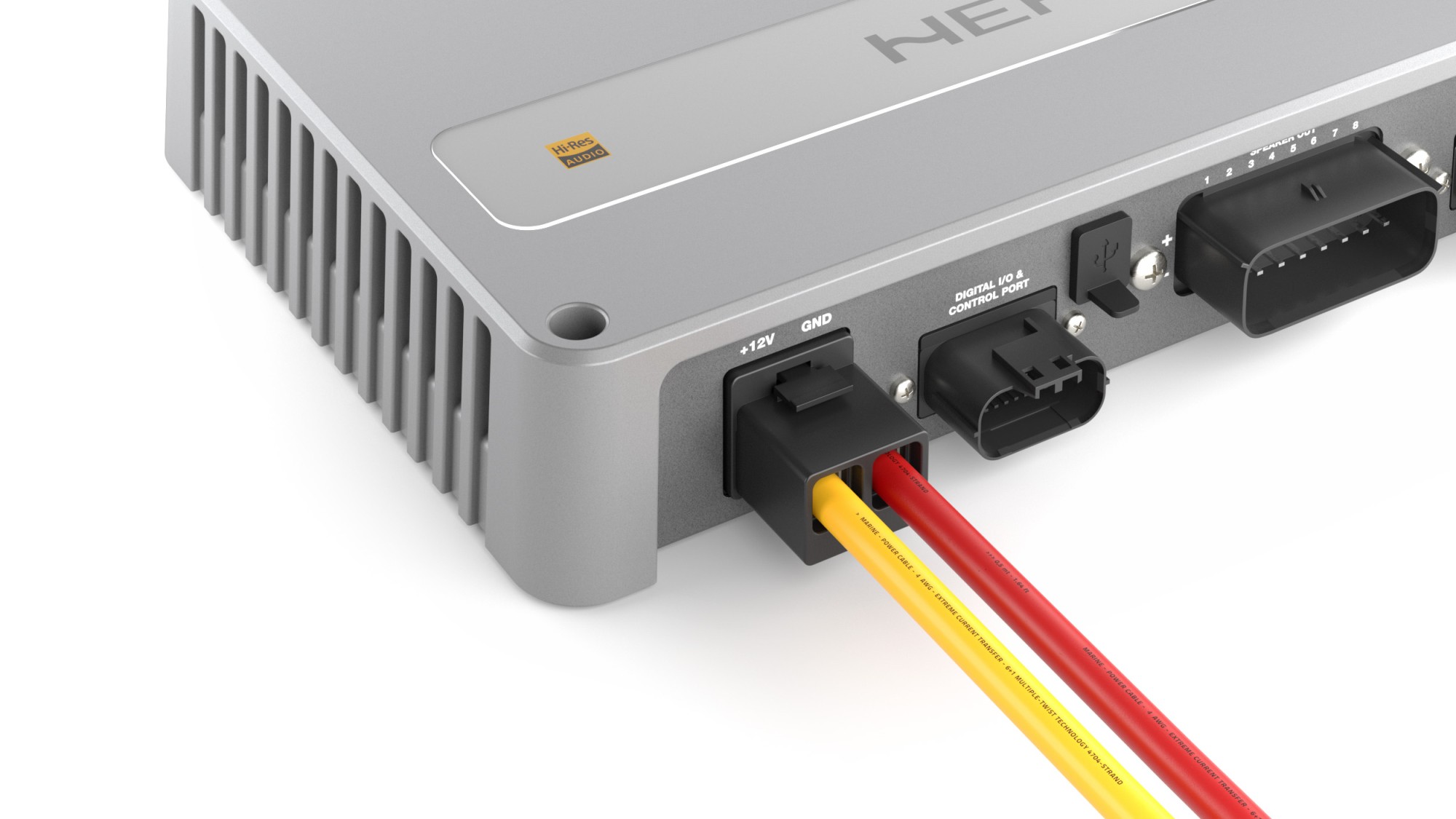
Hertz Venezia V8 DSPx²
Hertz VENEZIA V8 DSPX² is a premium 8-channel marine amplifier with an integrated DSP processor, combining high power, exceptionally advanced tuning options and a design engineered for use in the demanding environment of boats and yachts. It delivers up to 2000 W RMS total power, a pair of powerful DSP processors, support for Hi-Res Audio 24-bit / 96 kHz and the advanced Hertz bit Wave platform with EVOCA® technology. The result is extremely precise control of the entire audio system, high dynamics and the ability to create extensive multi-zone sound setups. The power stage uses advanced Advanced D-Class technology and provides 8 × 160 W RMS at 4 Ω or 8 × 250 W RMS at 2 Ω. When bridged, up to 4 × 500 W RMS at 4 Ω is available. VENEZIA V8 DSPX² therefore offers enough power not only for standard speakers but also for demanding multi-channel marine installations with high requirements for dynamics and volume.
Dual DSP processor and EVOCA® technology
The heart of the amplifier is two Analog Devices ADAU1467 DSP processors, which provide ample computing power for extensive real-time signal processing. The user has detailed control over active crossovers, parametric and graphic equalizers, time alignment, phase and routing of individual signals. The Hertz bit Wave platform also includes EVOCA® technology, which models the behavior of connected speakers in real time. This helps reduce distortion and mechanical stress on drivers, refines low-frequency reproduction and improves overall dynamics and clarity.
Hi-Res Audio and precise signal processing
VENEZIA V8 DSPX² supports audio processing up to 24-bit / 96 kHz and offers an amplifier frequency range of 10 to 42,000 Hz. This preserves a high level of detail, dynamics and spatial presentation even in large open installations. The DSP allows filters of type Full, High-Pass, Low-Pass and Band-Pass with a range of characteristics and slopes. Available options include Linkwitz-Riley, Butterworth, Bessel or Chebyshev up to 48 dB/oct. Precise time alignment is also available up to 510 cm with a resolution of 0.01 ms.
Advanced multi-zone sound
The amplifier is also ready for extensive multi-zone systems. A2B technology allows up to three compatible amplifiers to be digitally linked with a single cable to create a synchronized system with up to 16 DSP channels. Installation becomes simpler, requires less cabling, and maintains fully digital signal transmission. VENEZIA V8 DSPX² also supports automatically activated sound profiles. Individual modes can be triggered by an external signal and adapt the system settings to specific uses — for example loud sound for watersports, a party on deck, or quiet listening while cruising.
Pure Marine Certified construction
Hertz VENEZIA V8 DSPX² was developed specifically for demanding marine environments. The robust aluminum chassis and electronic components are engineered to withstand humidity, salt spray, UV exposure, vibration and high temperatures. The Marine Grade printed circuit boards feature a protective anti-corrosion coating and the amplifier meets IP64 protection requirements. Thanks to the combination of exceptional power, dual DSP, EVOCA® technology, A2B digital communication and durable marine construction, Hertz VENEZIA V8 DSPX² is a solution for the most demanding sound systems on boats and luxury yachts.
Main features
- Premium 8-channel marine amplifier with integrated DSP processor.
- Total power up to 2000 W RMS.
- Power: 8 × 160 W RMS at 4 Ω.
- Power: 8 × 250 W RMS at 2 Ω.
- Power up to 4 × 500 W RMS at 4 Ω in bridged configuration.
- Advanced D-Class power technology.
- Pair of Analog Devices ADAU1467 DSP processors.
- Support for Hi-Res Audio 24-bit / 96 kHz.
- Amplifier frequency range 10 to 42,000 Hz.
- Hertz bit Wave platform for comprehensive DSP configuration.
- EVOCA® technology for real-time optimization of speaker behavior.
- Active HP, LP, BP and Full crossovers with extensive tuning options.
- Linkwitz-Riley, Butterworth, Bessel, Chebyshev and QLP filter types.
- Output parametric and graphic equalizer with 15 bands.
- Time alignment up to 510 cm with 0.01 ms adjustment precision.
- Automatically activated sound profiles for different usage modes.
- A2B digital communication for linking multiple amplifiers.
- Ability to create systems with up to 16 synchronized DSP channels.
- 12 low-level analog inputs.
- 6 preamp outputs.
- Digital coaxial S/PDIF input up to 24-bit / 96 kHz.
- USB-C connection to a computer.
- Compatibility with Windows 10 and Windows 11.
- Pure Marine Certified construction for demanding marine environments.
- Protection against humidity, corrosion, salt spray, UV and vibration.
- Ingress protection rating IP64.
- Robust aluminum chassis.
About the brand
The most famous European brand in the car hi‑fi segment? Hertz audio! It is a brand founded in 1998 in Italy. Hertz is part of Elettromedia, which also owns Audison and Connection. How did the name Hertz come about? Hertz — the unit of frequency, the number of cycles per second (Hz). Everything in Hertz car audio reflects their passion for music and their attention to every detail of what they produce. Over the years the company has built an excellent team of talented and dedicated engineers committed to designing products at the highest level. Every new project and product stems primarily from the needs of the brand’s fans and is developed to connect them directly with the emotional power of music. Hertz’s philosophy is a unique combination of premium sound, a living tradition, ingenious innovation and high quality, all combined in a complete product range for maximum customer satisfaction. Hertz offers a full lineup of speakers, amplifiers and subwoofers that let you experience the thrill of high‑quality sound in any situation. Deep knowledge of in‑vehicle acoustics, design requirements and manufacturing processes keeps Hertz products at a high standard. To achieve Hertz’s high quality standards, the company does not settle for testing samples from each batch: it uses the most advanced testing tools to analyze every component through a computerized inspection process overseen by highly qualified personnel. The result is a negligible warranty rate and consistently high quality across all Hertz products.| Catalog number | 78213020 |
| Brand | Hertz |
| Links | Official web presentation (English) |
| Number of amplifier channelsAmplifiers are divided into: - Monoblocks - 2-channel - 3-channel - 4-channel - 5-channel - 6-channel - multi-channel Each channel is used to power one speaker for the coaxial type, or one side if they are component speakers. Monoblock type amplifiers are mainly used for subwoofers. 2-channel are suitable for both subwoofers and, for example, the front pair of speakers in a car. 3-channel is used for front or rear speakers + subwoofer. 4-channel are used for front + rear speakers or 1 pair of speakers + subwoofer. 6 or 5-channel are used for 2 pairs of speakers + subwoofer, most often. Bridging means connecting the amplifier to a bridge, using the + pole from one channel and the - pole from the other channel. In most cases this is shown as "BRIDGED" on the amplifier. | 8 |
| Energy class of the amplifierAmplifiers are divided into two basic classes: analog and digital . Analog amplifiers (A/B) have higher consumption requirements, but usually have a more natural sound. Digital amplifiers (D) have significantly lower consumption and higher efficiency, but the sound may not be as faithful as with classic analog amplifiers. | ADC |
| RMS power into 4 ΩRMS power when loading speakers or subwoofer at 4 Ω. RMS power is the constant power of the amplifier and is one of the most important parameters when choosing an amplifier. | 8 x 160 / 4 x 500 W |
| RMS power into 2 ΩRMS power when loading speakers or subwoofer at 2 Ω. RMS power is the constant power of the amplifier and is one of the most important parameters when choosing an amplifier. | 8 x 250 W |
| Frequency rangeThe ability of the amplifier to reproduce the signal from the lowest frequency to the highest = faithfully reproduce the sound in a specific frequency band. Professionally: In the frequency range from 40 to 16,000 Hz, the vast majority of fundamental and overtones (harmonics) of all musical instruments are found. We are interested in the course of the radiated sound pressure in this range of frequencies when the loudspeaker system is supplied with constant power. We call this course the frequency characteristic, which tells us the level of radiated sound pressure in decibels (dB) depending on the frequency. The frequency characteristic of a speaker or speaker system can be expressed most succinctly with a graph. Mostly, however, the frequency characteristic is indicated by indicating the maximum tolerance of the sound pressure in the given frequency range, e.g. 50 to 15,000 Hz -+ 6 dB. Since the frequency characteristics of loudspeakers and systems in general are quite uneven, some manufacturers do not even specify this maximum tolerance of sound pressure in decibels in their catalogs for reasons of prestige. Data impoverished in this way is unfortunately worthless. What is valid is that the manufacturer offers a speaker system with a frequency range of 30 to 20,000 Hz, if he is worried about stating the maximum unevenness of the sound pressure in this range, because he can have a tolerance of, for example, +- 20 dB. The unevenness or undulation of the frequency curve in good speaker systems for high-quality music performance should not exceed +-3 dB in the 80 to 12,000 Hz band and +-6 dB in the 40 to 16,000 Hz band. Greater unevenness already depletes or emphasizes certain tonal areas, which can cause audible or even disturbing distortion. The proportion between fundamental tones and higher harmonics also changes, thereby changing the color of the sound, and individual musical instruments as well as the entire musical image sound unnatural. | 20 Hz - 20 kHz |
| Harmonic Distortion (THD)Total harmonic distortion indicates how much the input signal is distorted in the amplifier. Distortions appear as overtones contained in the output signal. The proportion of originally absent parts of the signal is given as a percentage, typical values are between 0.001% and 0.5%. Distortion is measured in their power band. If it exceeds the limit of 0.7% from a certain power, it is the value of the output power of the given amplifier, from which it no longer plays without distortion and from which the distortion usually increases steeply, so that no further increase in power can be counted on. The lower the value, the better. | < 0.04% THD+N at 1 kHz, 4 Ω, 70% power |
| Signal-to-noise ratioThe signal-to-noise ratio means that the output signal always contains noise. The signal-to-noise ratio expresses how much of this noise is compared to the useful signal. The so-called A value is given, which does not take deep and very high frequencies into account. This corresponds to the characteristic of human hearing, which is not so sensitive to deep frequencies, especially below 1 kHz. The higher the value, the better the amplifier is. | 98 dBA |
| Input sensitivityIn order for the amplifier to perform its function correctly, it requires an input signal of a certain level, which is different for car radios. It is measured in "Volts" (e.g. 2 V, 4 V, etc.) The higher the value at the output of the pre-amplifier, or car radio, the less demands are placed on the power of the amplifier. However, the amplifier must allow this input sensitivity, and for that reason this value is also given for the amplifier. | 0.6 - 6 Vrms |
| On-board voltage rangeThe ability of the amplifier to operate at a specified voltage. As the voltage decreases, so does the power of the amplifier. The ideal voltage in a car is between 13.8 and 14.4 V. | 11 - 15 VDC |
| Remote control included in the packageSome models of amplifiers also come with wired remote controls in the package, which on one side plug into the amplifier and on the other side you have a potentiometer that you can place anywhere in the cabin. A common place to place the remote control is under the steering wheel. The advantage is the regulation of power, and therefore volume, depending on driving conditions and the mood of the crew in the car. | No |
| Dimensions of the amplifier | 330 × 200 × 55.5 mm |
| Mass | 4.2 kg |