
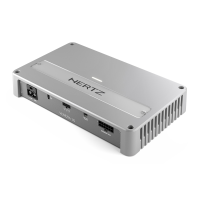
Hertz Venezia V4C amplifier
More about the product
- You can return the goods to us within 14 days
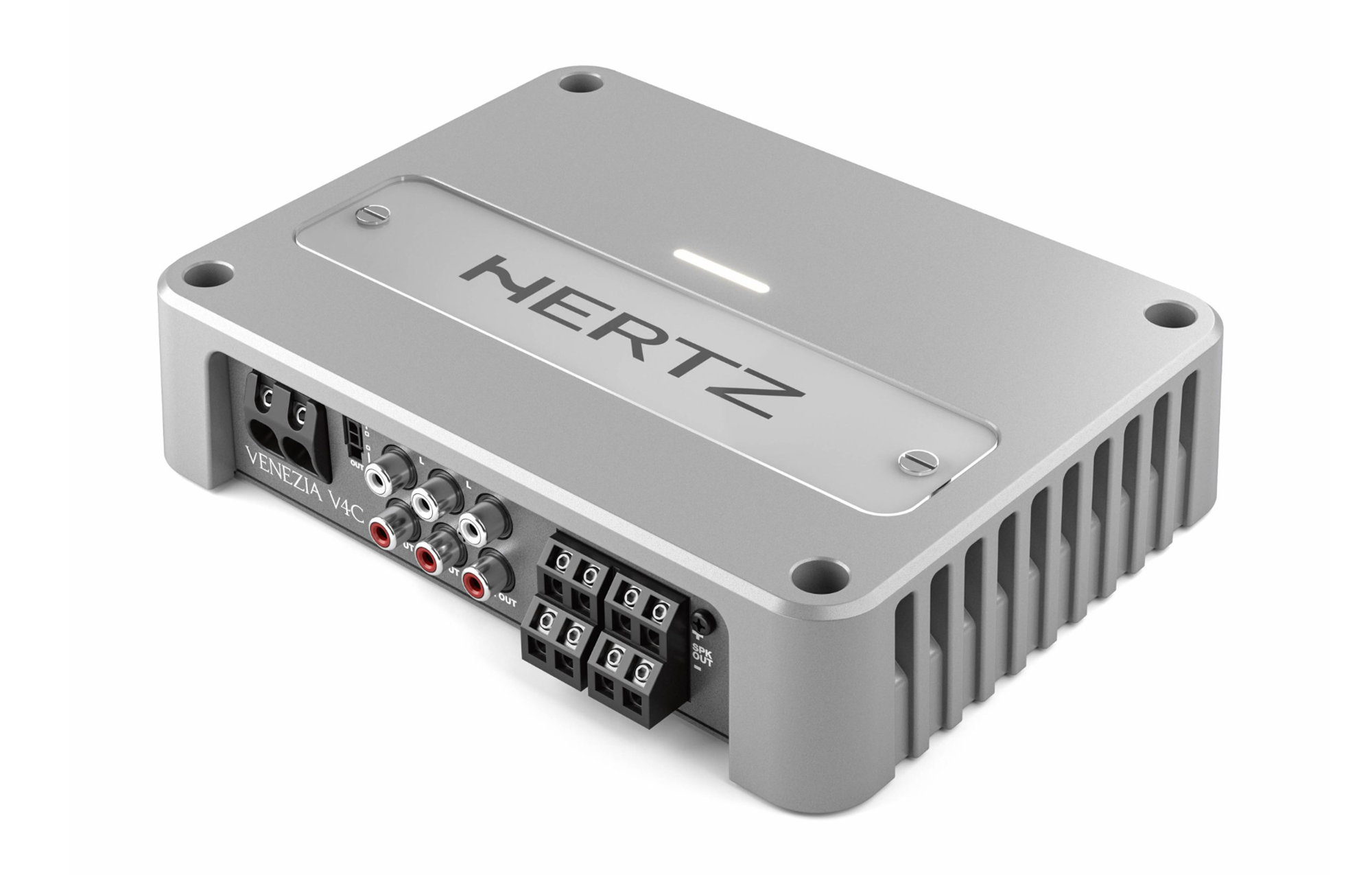
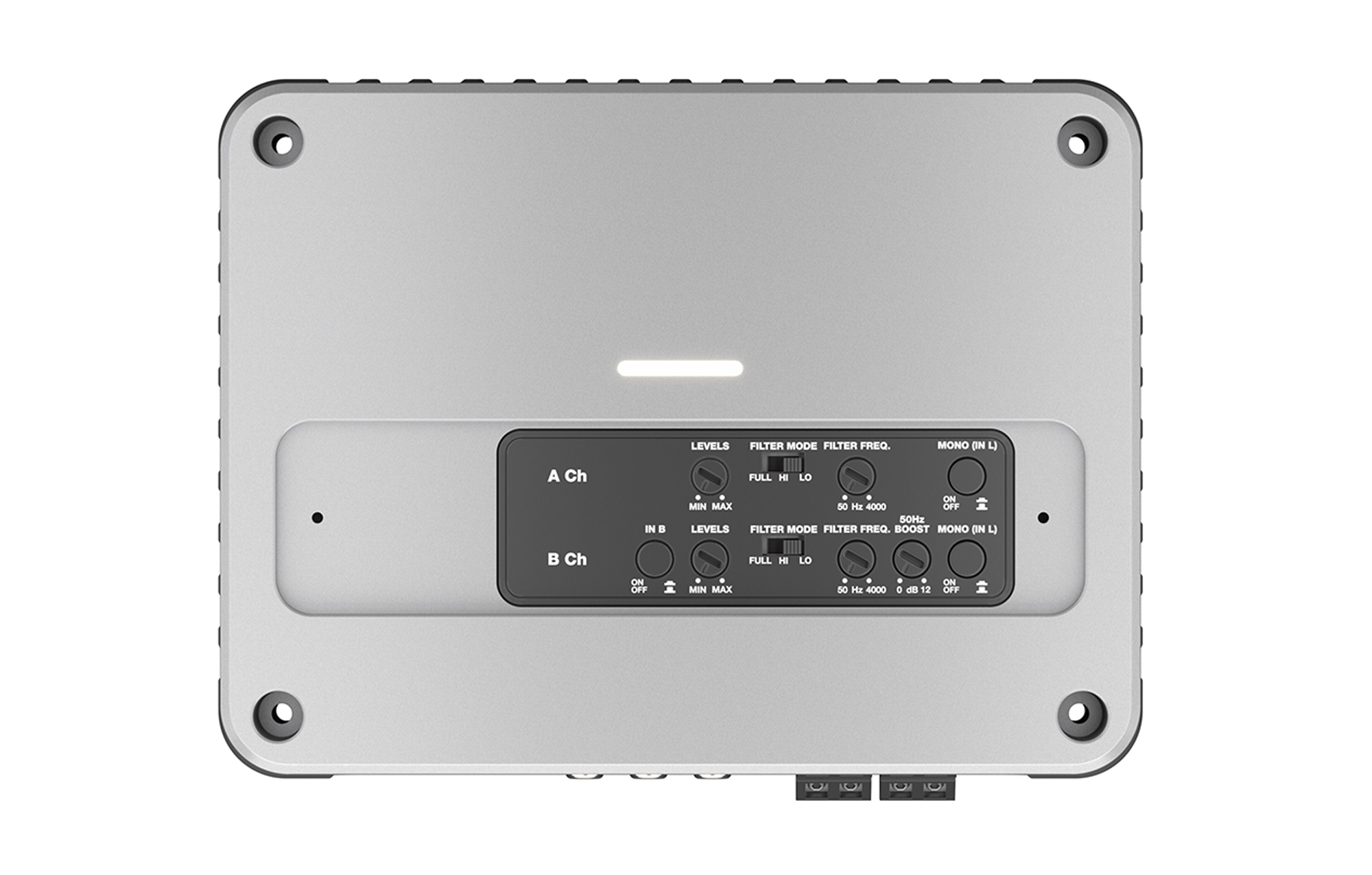
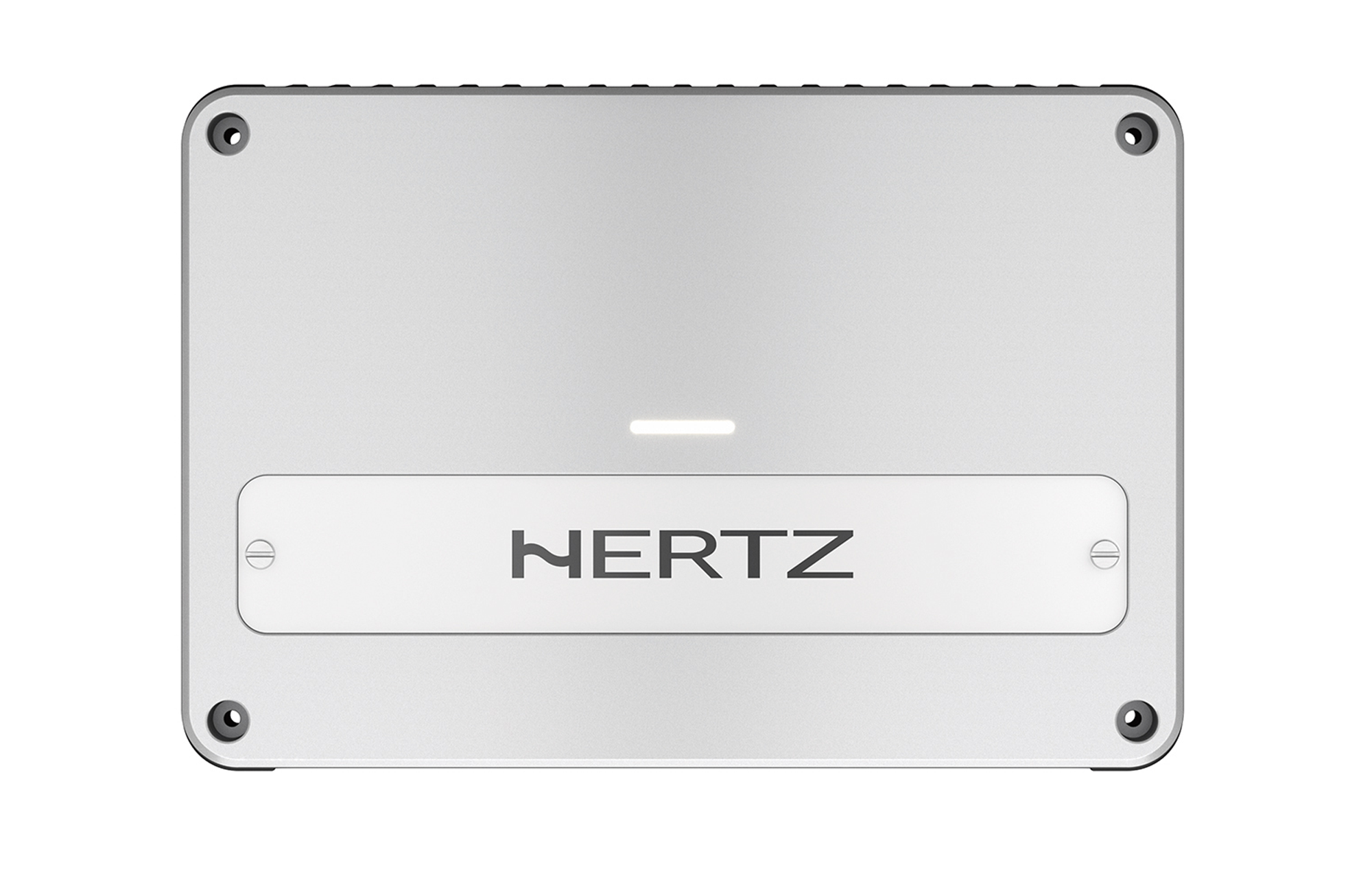
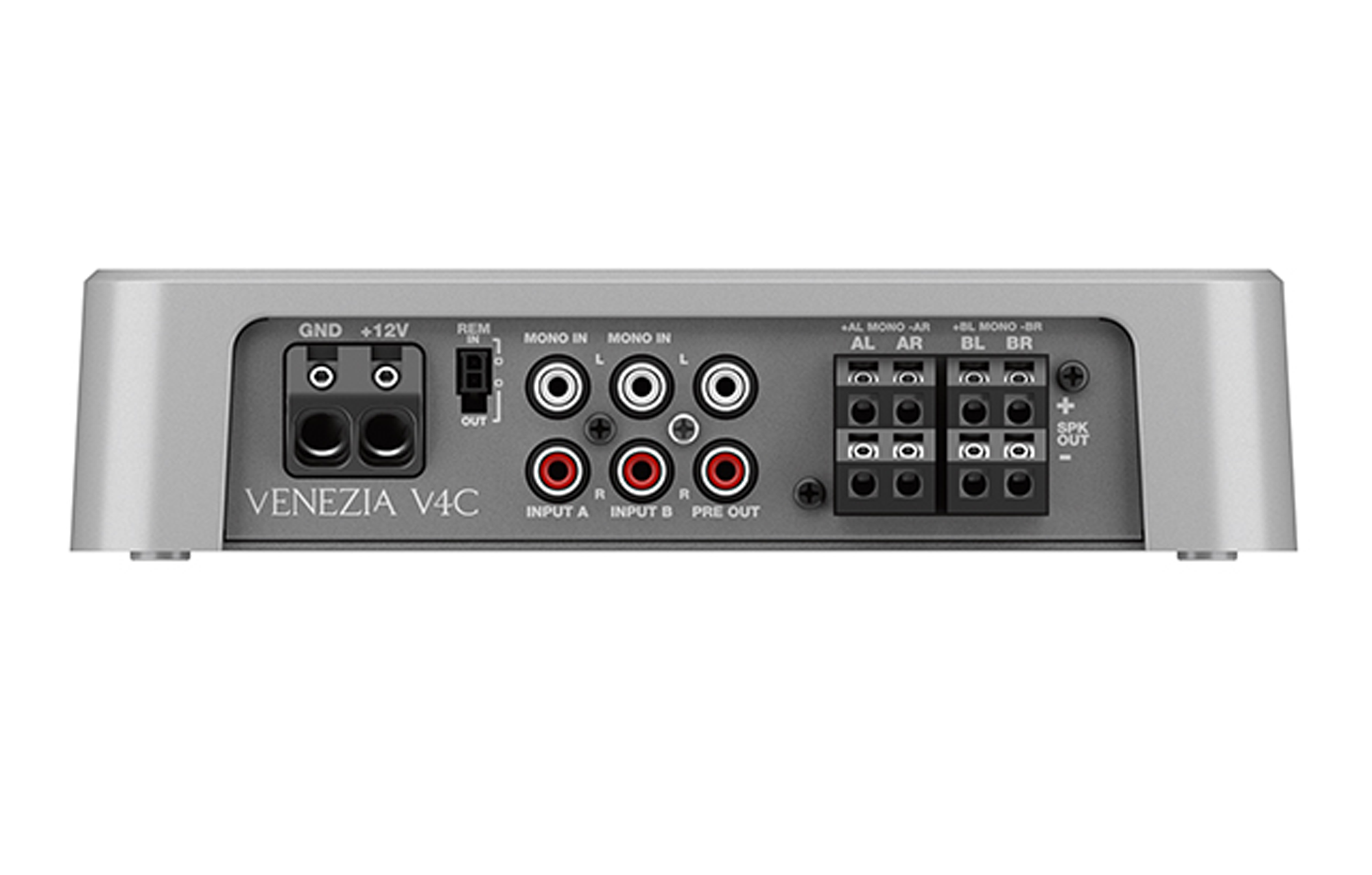
Amplifier Hertz Venezia V4C
The compact marine amplifier Venezia V4C is characterized by an optimized power/size ratio, boosting 110 W x 4 (4 Ω) and 380 W x 2 (4 Ω). Hertz Advanced Class D technology maximizes efficiency and power while minimizing heat and electromagnetic radiation, enhancing sound quality that reaches new heights thanks to Hi-Res certification! High-performance channels with bridging capability provide the output levels needed in a marine environment. Venezia V4C is designed and tested for marine applications (UV, salt fog, vibration, high/low temperature, thermal shock) and is IPX2 certified. The Safe-Lock input, output, and power connections simplify installation and increase durability in the field. The fanless convection cooling system is integrated into the cast heat sink chassis. A balanced, fully differential input circuit suppresses electromagnetic noise and interference. The powerful and flexible preamp filter options far exceed the capabilities of most mobile amplifiers. Lastly, the Venezia V4C is fully protected against short circuit, overload, and thermal protection with automatic reset.
Main Features
- Designed and tested for marine applications (UV, salt fog, vibration, high/low temperature, thermal shock) with IPX2 certification.
- ADC (Advanced D-Class) technology 2 Ω (1 Ω for mono models) stable output stage providing Hi-Res certified sound performance with excellent efficiency.
- Compact pressure-cast aluminum design with fanless convection cooling system ensuring low operating temperature even at maximum power.
- Balanced, fully differential input circuit for suppressing electromagnetic interference.
- Bridge operating mode for subwoofer control or creating a powerful dual-mono system.
- Built-in filter section protected by a polycarbonate panel suitable for any system configuration.
- Protection against short circuit, overload, and thermal protection with automatic reset.
- Plug&Play input and output connections with safety lock.
- Patented Plug&Play power supply connector with safety lock.
About the Brand
The most renowned European brand in the car hi-fi segment? Hertz audio! Founded in 1998 in Italy, Hertz is part of Elettromedia, which owns Hertz, Audison, and Connection. How did the name Hertz come about? Hertz - a unit of frequency, number of cycles per second (Hz). Everything in Hertz car audio reflects the brand's passion for music, caring about everything they produce. Over the years, this company has built an excellent team of talented and dedicated engineers committed to designing products at the highest level. Every new project and product stems from the needs of the brand's fans, developed to connect them directly with the emotional power of music. The Hertz brand philosophy is a unique combination of premium sound, vibrant tradition, sophisticated innovation, and high quality, combined in a complete range of products for maximum customer satisfaction. Hertz offers a complete product range of speakers, amplifiers, and subwoofers, allowing you to experience the thrill of high-quality sound in any situation. In-depth knowledge of car interior acoustics, design requirements, and manufacturing processes keep Hertz products at a high level. To achieve Hertz's high-quality standards, the company doesn't settle for testing samples from each batch: it uses the most advanced testing tools to analyze each component through a computer-controlled process under the supervision of highly qualified personnel. This results in a negligible complaint rate and high quality of all Hertz products.| Catalog number | VENEZIA V4C |
| Brand | Hertz |
| Links | Official web presentation (English) |
| Number of amplifier channelsAmplifiers are divided into: - Monoblocks - 2-channel - 3-channel - 4-channel - 5-channel - 6-channel - multi-channel Each channel is used to power one speaker for the coaxial type, or one side if they are component speakers. Monoblock type amplifiers are mainly used for subwoofers. 2-channel are suitable for both subwoofers and, for example, the front pair of speakers in a car. 3-channel is used for front or rear speakers + subwoofer. 4-channel are used for front + rear speakers or 1 pair of speakers + subwoofer. 6 or 5-channel are used for 2 pairs of speakers + subwoofer, most often. Bridging means connecting the amplifier to a bridge, using the + pole from one channel and the - pole from the other channel. In most cases this is shown as "BRIDGED" on the amplifier. | 4 |
| Energy class of the amplifierAmplifiers are divided into two basic classes: analog and digital . Analog amplifiers (A/B) have higher consumption requirements, but usually have a more natural sound. Digital amplifiers (D) have significantly lower consumption and higher efficiency, but the sound may not be as faithful as with classic analog amplifiers. | ADC |
| RMS power into 4 ΩRMS power when loading speakers or subwoofer at 4 Ω. RMS power is the constant power of the amplifier and is one of the most important parameters when choosing an amplifier. | 4 x 110 / 2 x 380 W |
| RMS power into 2 ΩRMS power when loading speakers or subwoofer at 2 Ω. RMS power is the constant power of the amplifier and is one of the most important parameters when choosing an amplifier. | 4 x 190 W |
| Harmonic Distortion (THD)Total harmonic distortion indicates how much the input signal is distorted in the amplifier. Distortions appear as overtones contained in the output signal. The proportion of originally absent parts of the signal is given as a percentage, typical values are between 0.001% and 0.5%. Distortion is measured in their power band. If it exceeds the limit of 0.7% from a certain power, it is the value of the output power of the given amplifier, from which it no longer plays without distortion and from which the distortion usually increases steeply, so that no further increase in power can be counted on. The lower the value, the better. | 0.06 % |
| Signal-to-noise ratioThe signal-to-noise ratio means that the output signal always contains noise. The signal-to-noise ratio expresses how much of this noise is compared to the useful signal. The so-called A value is given, which does not take deep and very high frequencies into account. This corresponds to the characteristic of human hearing, which is not so sensitive to deep frequencies, especially below 1 kHz. The higher the value, the better the amplifier is. | 102 dB |
| Damping factorDF - Damping Factor . It is the ratio of the load (repro + cables, crossover, etc.) to the internal resistance of the amplifier. The bigger the DF, the more controlled the bass. Amplifiers with a lower DF tend to hum. Subwoofers with a higher Q in the bass reflex and sometimes in the enclosure will also cause humming. | 150 |
| High level inputsThe high-level input on the amplifier allows connection directly to the existing speakers in the car without additional purchase of an external high/low adapter. Important equipment in the case of installing an amplifier on an original car radio. | Yes |
| Input sensitivityIn order for the amplifier to perform its function correctly, it requires an input signal of a certain level, which is different for car radios. It is measured in "Volts" (e.g. 2 V, 4 V, etc.) The higher the value at the output of the pre-amplifier, or car radio, the less demands are placed on the power of the amplifier. However, the amplifier must allow this input sensitivity, and for that reason this value is also given for the amplifier. | 0.2 - 5 V |
| Automatic on and offThis function allows you to automatically switch on the amplifier. | Yes |
| High pass filter (HPF)HPF / HP or The "hi pass filter" offers the option of setting the amplifier using a potentiometer so that medium, possibly mid-bass and treble frequencies play upwards from a certain frequency. Example: Amplifiers most often have an HPF from 40 to 300 Hz. If we set the potentiometer to a value of approx. 150 Hz, the sound will be clipped so that it plays frequencies from 150 Hz up to the maximum upper limit of the entire frequency range of the amplifier, perhaps up to 20,000 Hz. We recommend setting this potentiometer in the range of 80-160 Hz. Thanks to this setting option, the speakers can handle a higher performance, as you will not overload them with bass in the lower frequency range. | 50 - 4000 Hz |
| Low-pass filter (LPF)LPF / LP or "low pass filter" offers the possibility to adjust the amplifier using a potentiometer so that the lower band plays only the frequencies in a certain band that you need. This filter is used to adjust the frequency range for the subwoofer, so that it does not overload or distort the sound. Example: Amplifiers most often have an LPF from 20 to 300 Hz. We recommend setting this potentiometer in the range of 45-80 Hz. | 50 - 4000 Hz |
| SubsonicA subsonic filter is essentially a high-pass filter for very low frequencies, typically 45 Hz or lower. Anything below this setting is weakened. The point is that the subwoofer does not go below the subsonic filter setting and does not overload itself with very low frequencies. A useful function, if set correctly, the subwoofer is not overloaded. | Yes |
| Bass boostBass boost or bass enhancement. With this function, the bass itself can be emphasized, at a high level of bass boost, the speakers and the subwoofer can distort a lot and the sound will be worse than better. We therefore recommend using the "bass boost" function wisely. With maximum use of bass boost, there is a risk of damage to the speakers and thus to the subwoofer. | Yes |
| On-board voltage rangeThe ability of the amplifier to operate at a specified voltage. As the voltage decreases, so does the power of the amplifier. The ideal voltage in a car is between 13.8 and 14.4 V. | 7 - 15 V |
| Remote control included in the packageSome models of amplifiers also come with wired remote controls in the package, which on one side plug into the amplifier and on the other side you have a potentiometer that you can place anywhere in the cabin. A common place to place the remote control is under the steering wheel. The advantage is the regulation of power, and therefore volume, depending on driving conditions and the mood of the crew in the car. | No |
| Dimensions of the amplifier | 205 x 155 x 40.5 mm |
| Mass | 1.96 kg |
Evaluation
You might also be interested
 UpdatedQuick preview1 Channel Marine Amplifier, 1 x 1260 W RMS into 1 Ω / ADC Class679,00 EUROn orderHertz Venezia V4 Free transport
 UpdatedQuick preview4-channel marine amplifier, 4 x 160 / 2 x 580 W RMS (4 Ω), 4 x 290 W RMS (2 Ω), ADC class739,00 EURIn stockHertz Venezia V5 Free transport
 UpdatedQuick preview5-channel marine amplifier, 4 x 130 + 1 x 490 W RMS (4 Ω) / 1 x 820 W RMS (2 Ω), ADC class929,00 EUROn orderHertz Venice V5C Free transport
 UpdatedQuick preview5-channel marine amplifier, 4 x 80 + 1 x 330 W RMS (4 Ω) / 1 x 550 W RMS (2 Ω), ADC class649,00 EUROn orderHertz Venezia V6 Free transport
 UpdatedQuick preview6-Channel Marine Amplifier, 6 x 160 W RMS (4 Ω) / 6 x 290 W RMS (2 Ω), ADC Class1.090,00 EUROn order