
Gladen Gamma 100.2 speakers
More about the product
- You can return the goods to us within 14 days
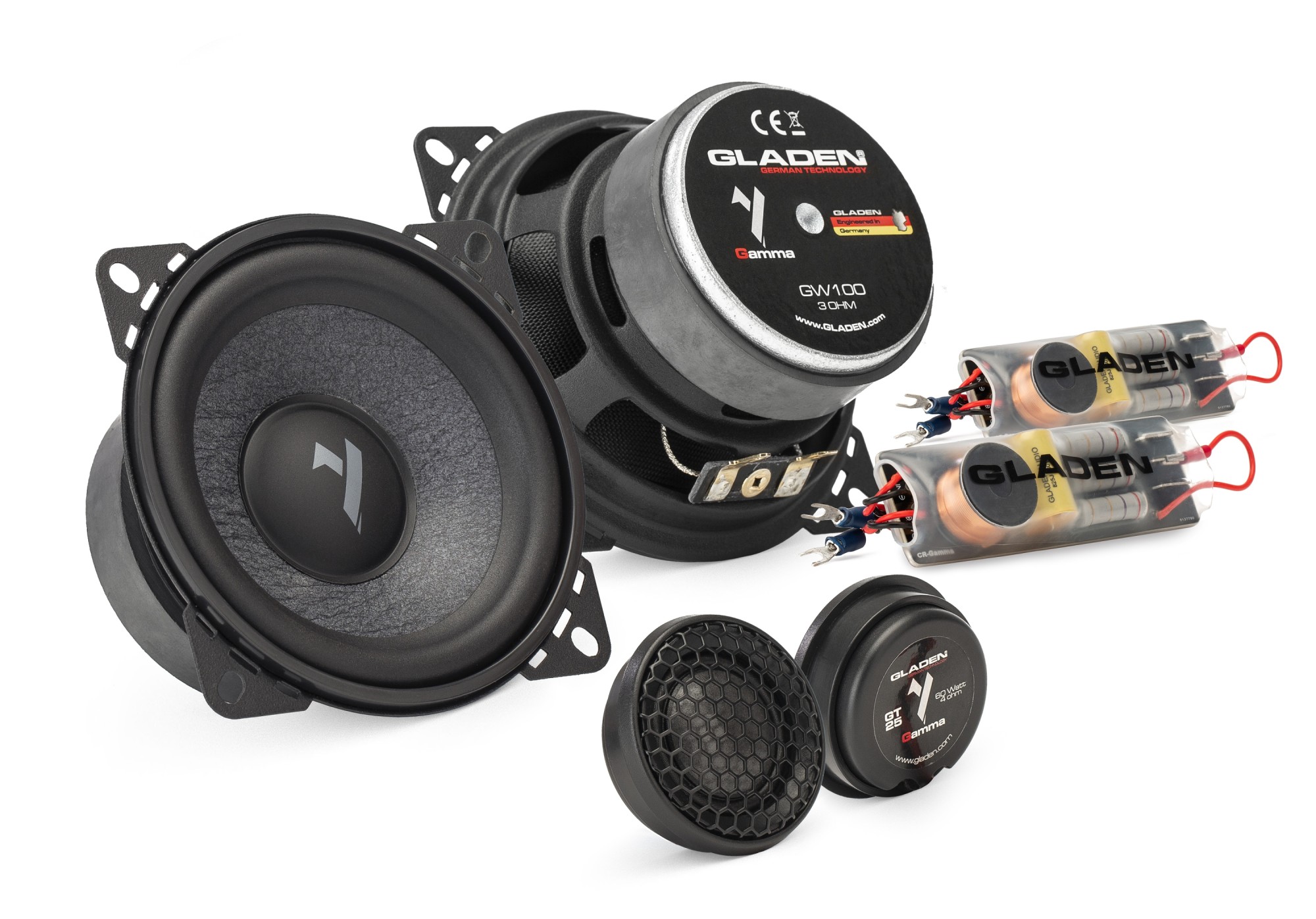
Gladen Gamma 100.2 Speakers
Gladen Gamma introduces a new generation of drivers designed for modern car audio systems where maximum demands are placed on accuracy, dynamics and control of the resulting sound. The entire series was developed with an emphasis on the most natural and detailed reproduction possible in the acoustically demanding environment of a car, without compromises in distortion, spatiality or tonal balance. Each driver in the Gamma line uses advanced cone materials, optimized magnetic systems and precisely matched parameters so that the individual bands seamlessly connect to create a homogeneous, realistic and exceptionally musical performance. Thanks to the flexible design, Gamma drivers are suitable both for OEM installations and for fully active competition systems with individual tuning.
Balanced Sound in a Compact Size
The Gladen Gamma 100.2 is a compact 2-way component system designed for vehicles with very limited installation space where larger speakers cannot be used, yet high demands are placed on sound quality. The system was developed to offer maximum sound quality in minimal space while preserving the natural, detailed and spatially accurate performance typical of the Gamma line. Thanks to high sensitivity and reduced impedance, the speakers can provide a significant sound improvement even when connected to factory radios, while also working flawlessly with quality external amplifiers. The Gamma 100.2 therefore represents an ideal solution for modern OEM installations, dashboards or door positions with minimal space.
Accurate Midbass with Excellent Clarity
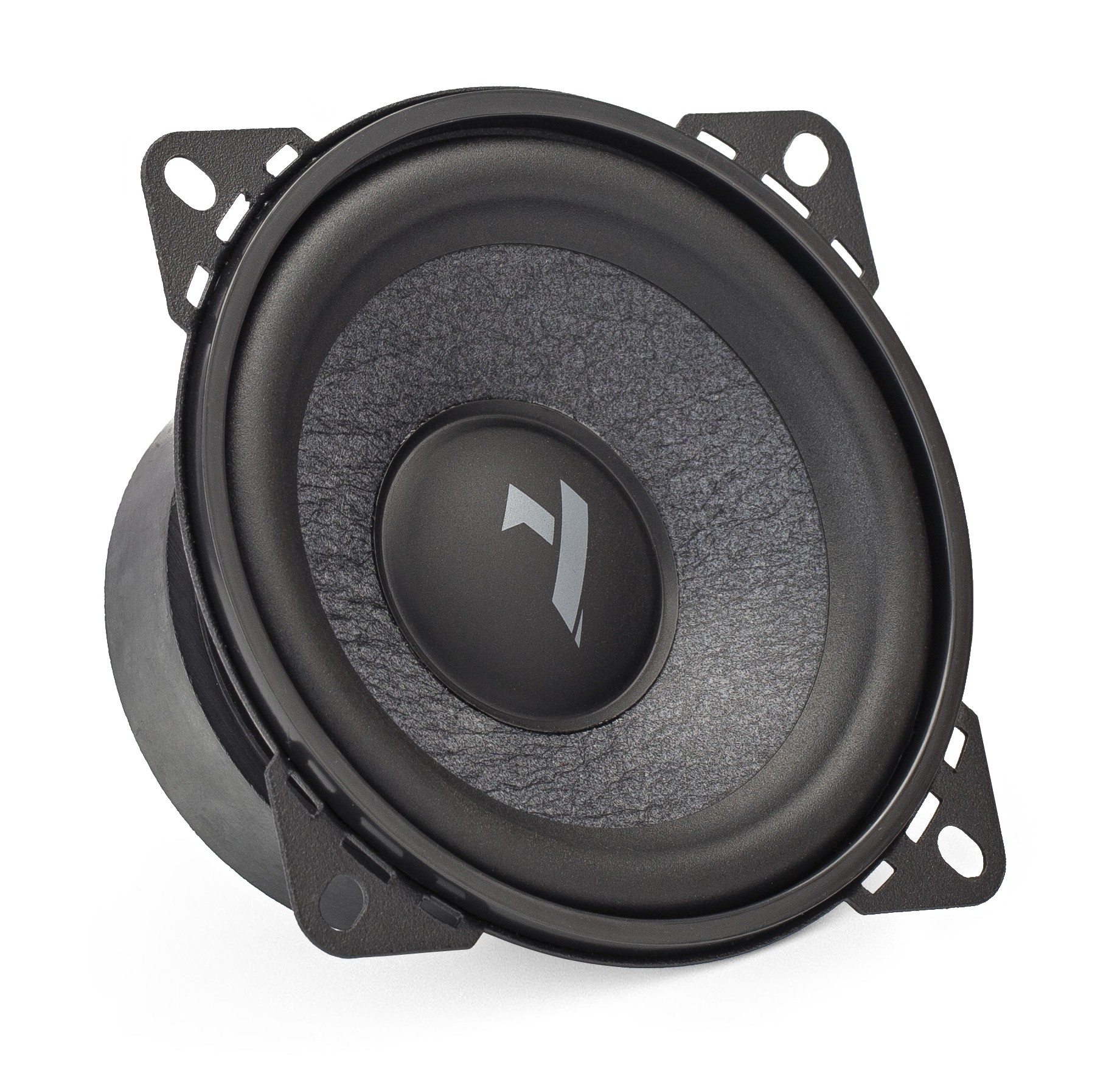
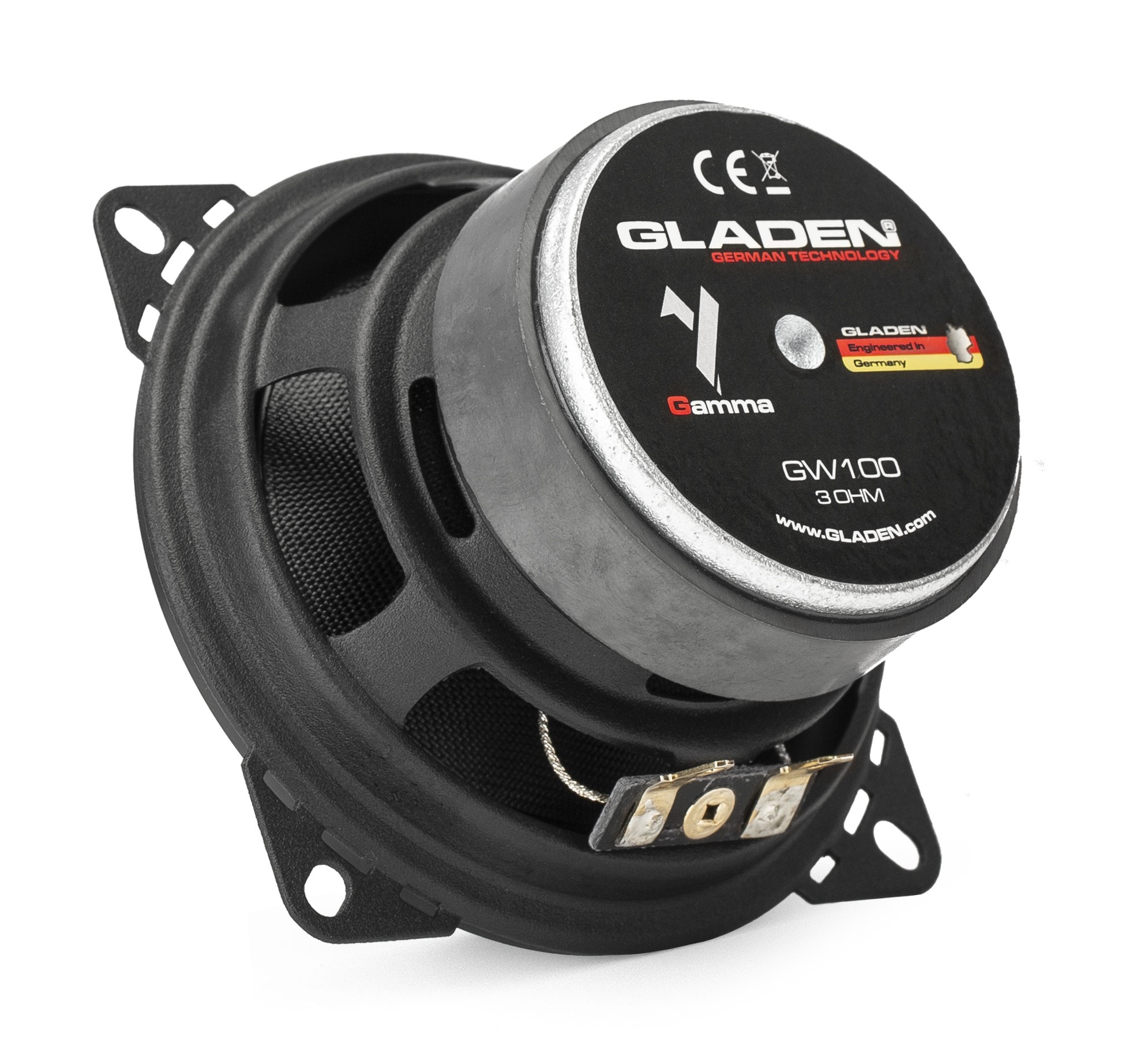
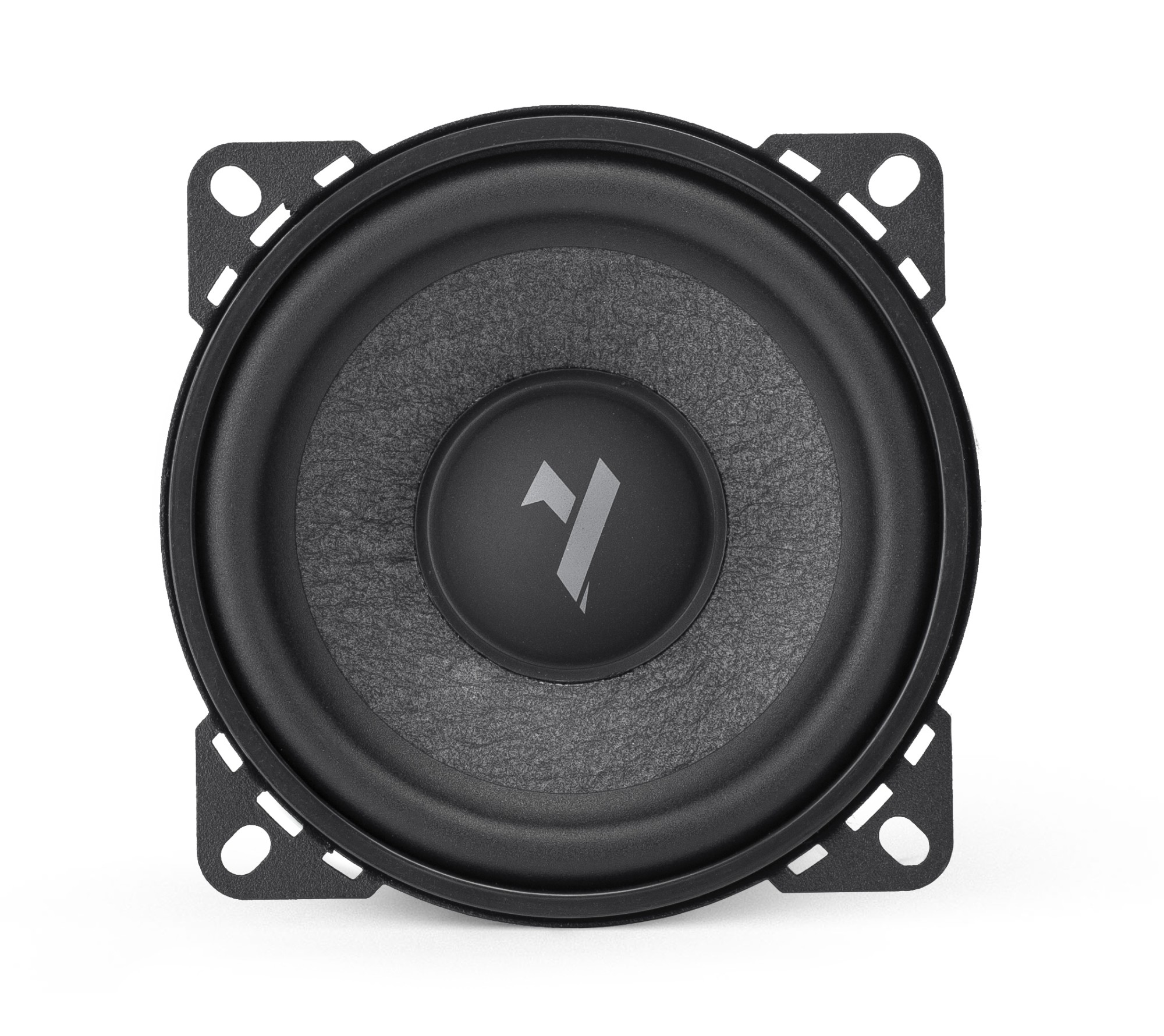
The 100 mm midbass driver uses a lightweight and stiff cone made of fiberglass and Nomex, ensuring fast response, high accuracy and very good control in the midrange. The driver excels in clean and natural vocal reproduction, precise instrument localization and excellent readability of details even in the acoustically complex environment of a car. Although it is a very compact driver, the system can produce a surprisingly full and mature sound with good structure and a balanced character. The foundation of the construction is a sturdy steel basket with an anti-resonant treatment that helps minimize unwanted vibrations and maintain reproduction clarity even at higher volumes.
Detailed and Spatial Gamma GT 25 Tweeter
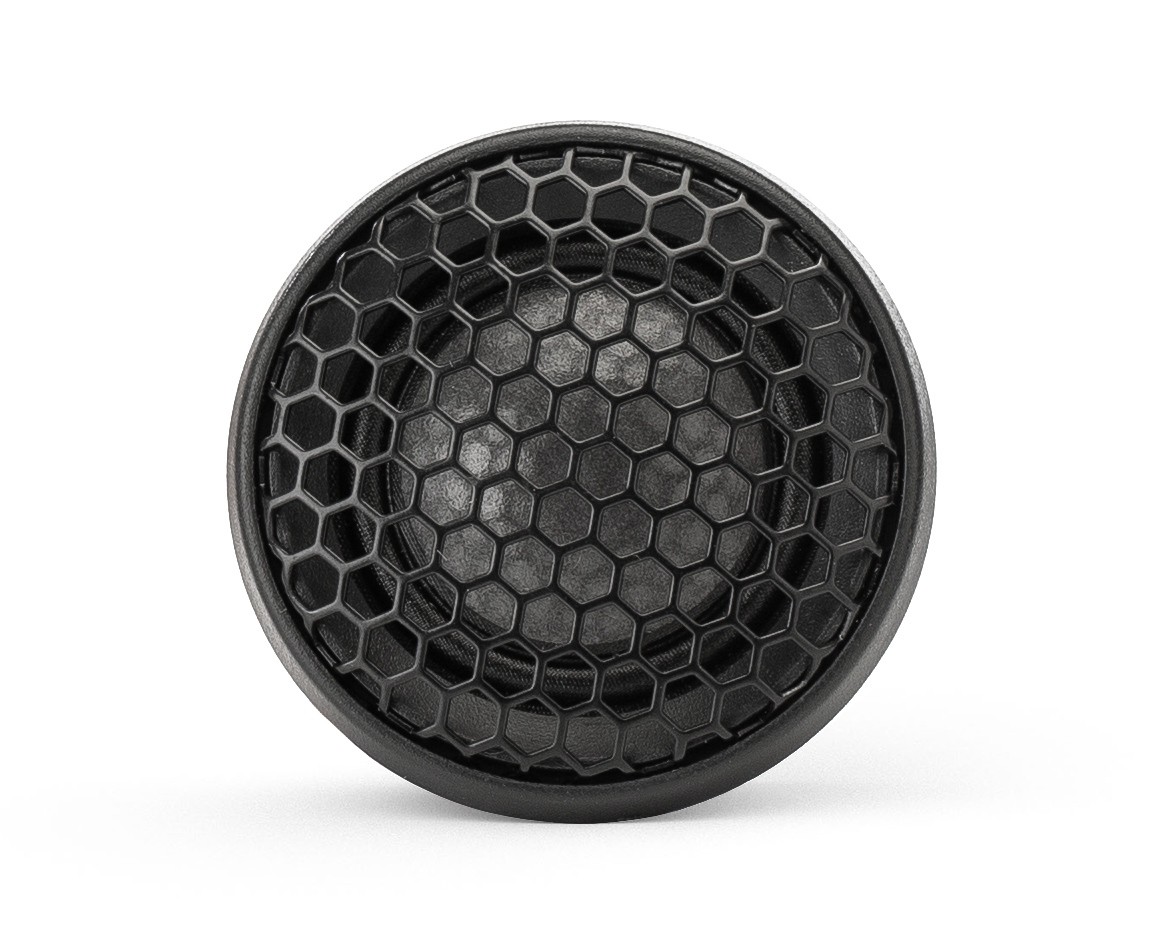
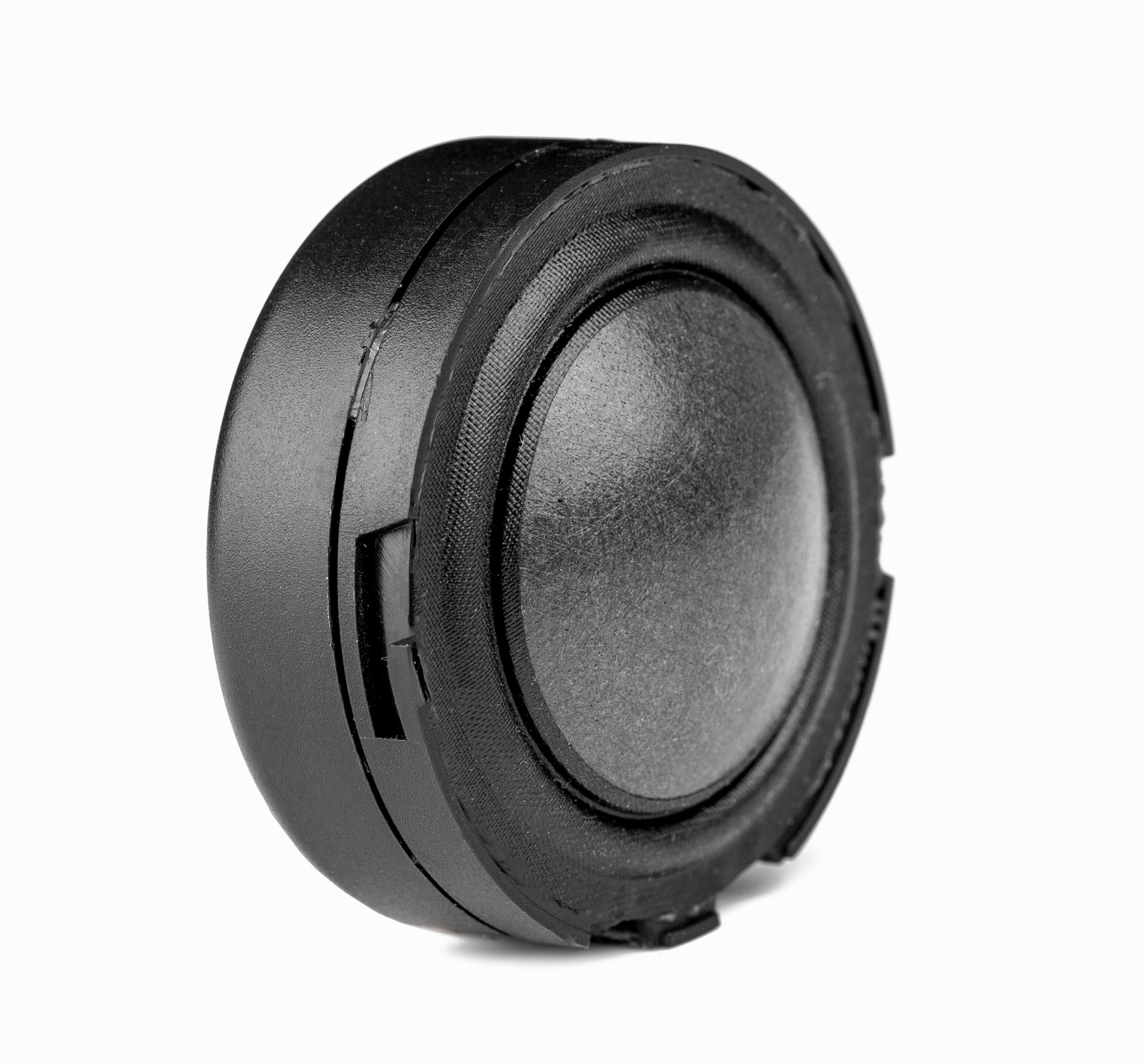
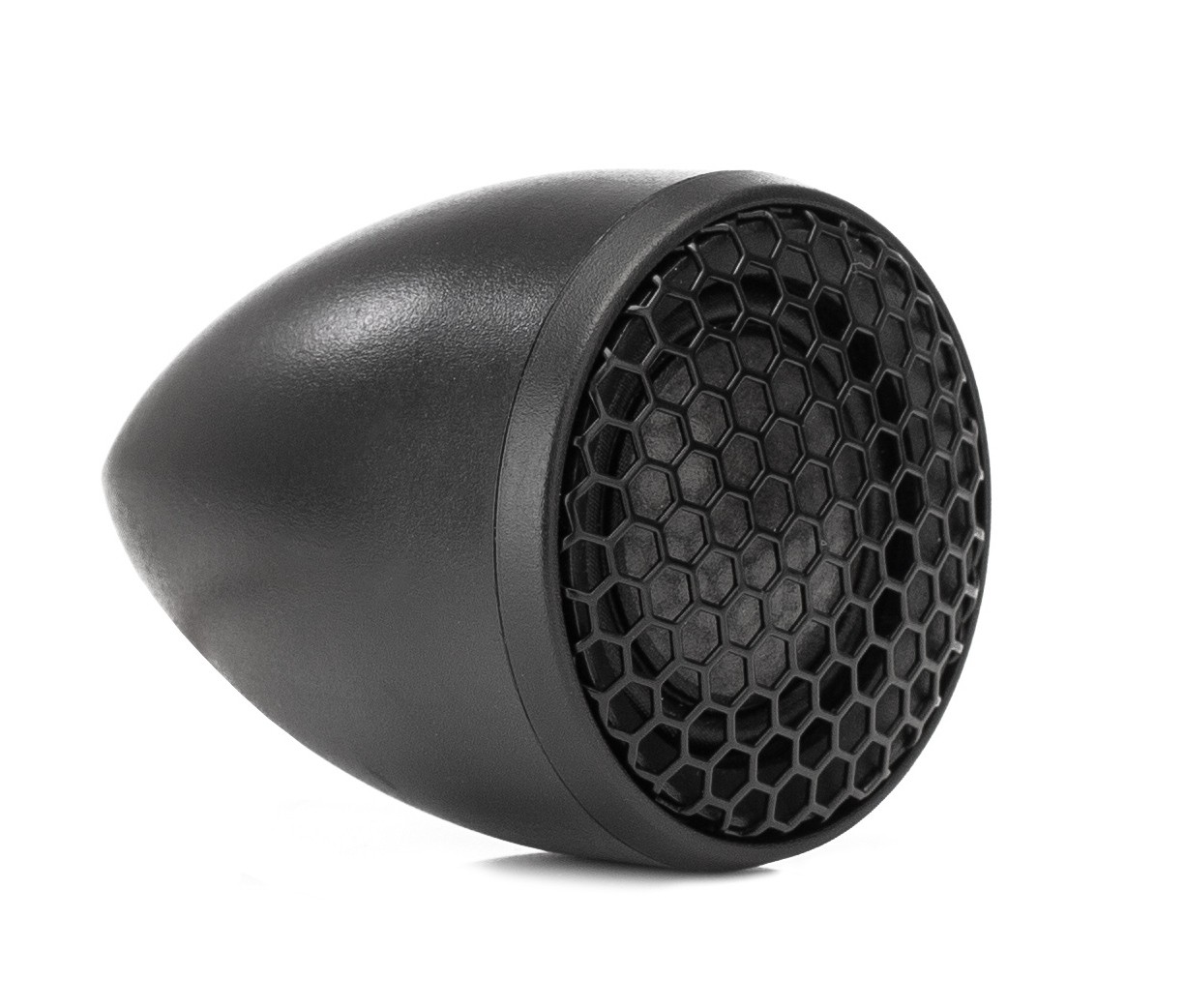
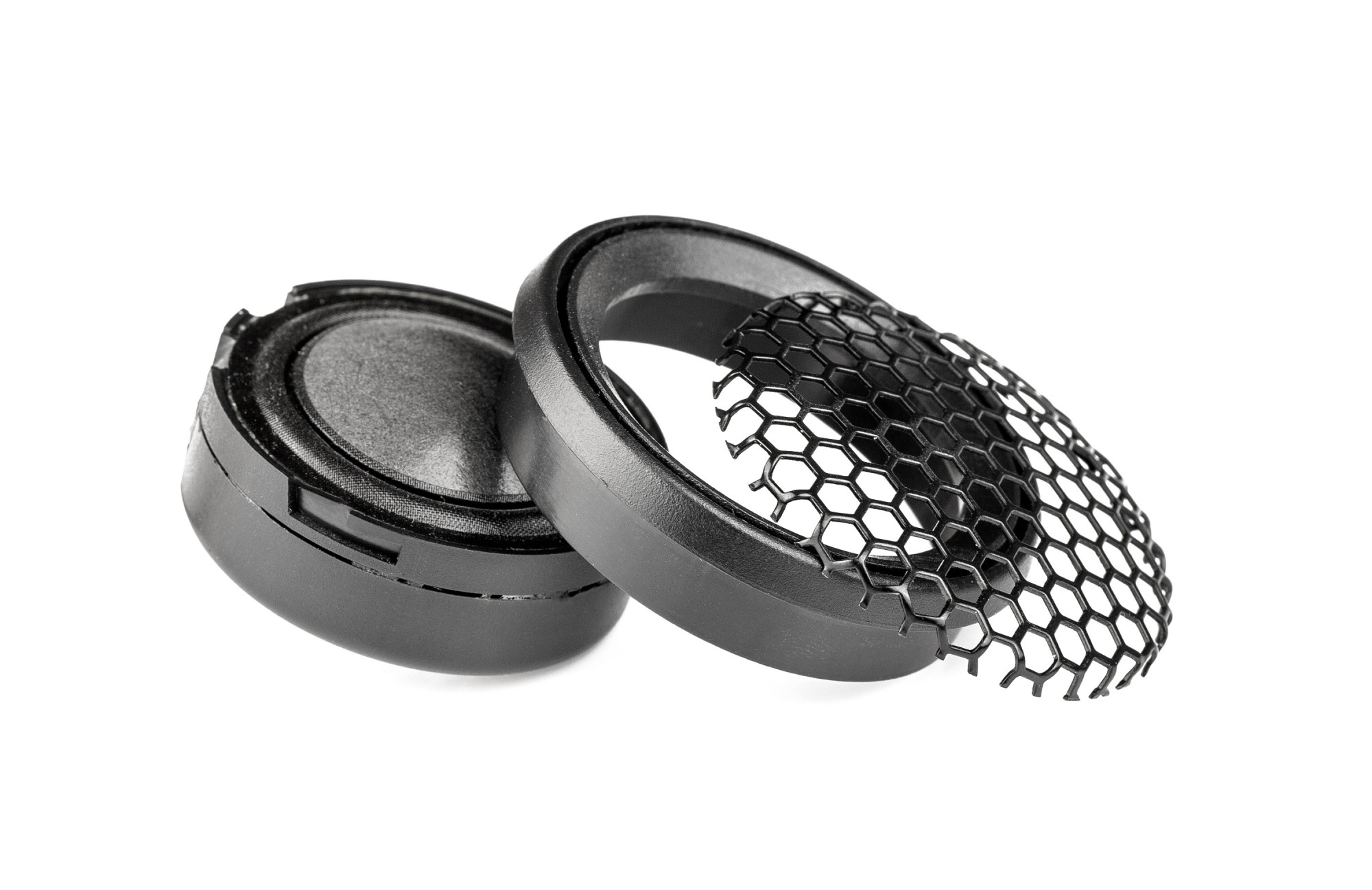
High frequencies are handled by the newly developed Gamma GT 25 tweeter with a carbon-graphene dome and a 25 mm voice coil. Thanks to extremely low moving mass and high diaphragm stiffness, the tweeter offers an exceptionally smooth, detailed and spatially accurate presentation without harshness. The plastic housing with an optimized rear chamber volume helps improve control over the reproduction and enables a calmer and more natural treble character even at higher volumes. The result is an open soundstage with precise instrument localization and excellent long-term listenability. A major advantage of the tweeter is also its very compact chassis, which can be further reduced by disassembling the driver, greatly facilitating installation even into very small OEM positions of modern vehicles. The package also includes stylish mounting cups for surface installation, allowing elegant placement of tweeters, for example on A-pillars or the dashboard.
Crossover Optimized for Real Automotive Conditions
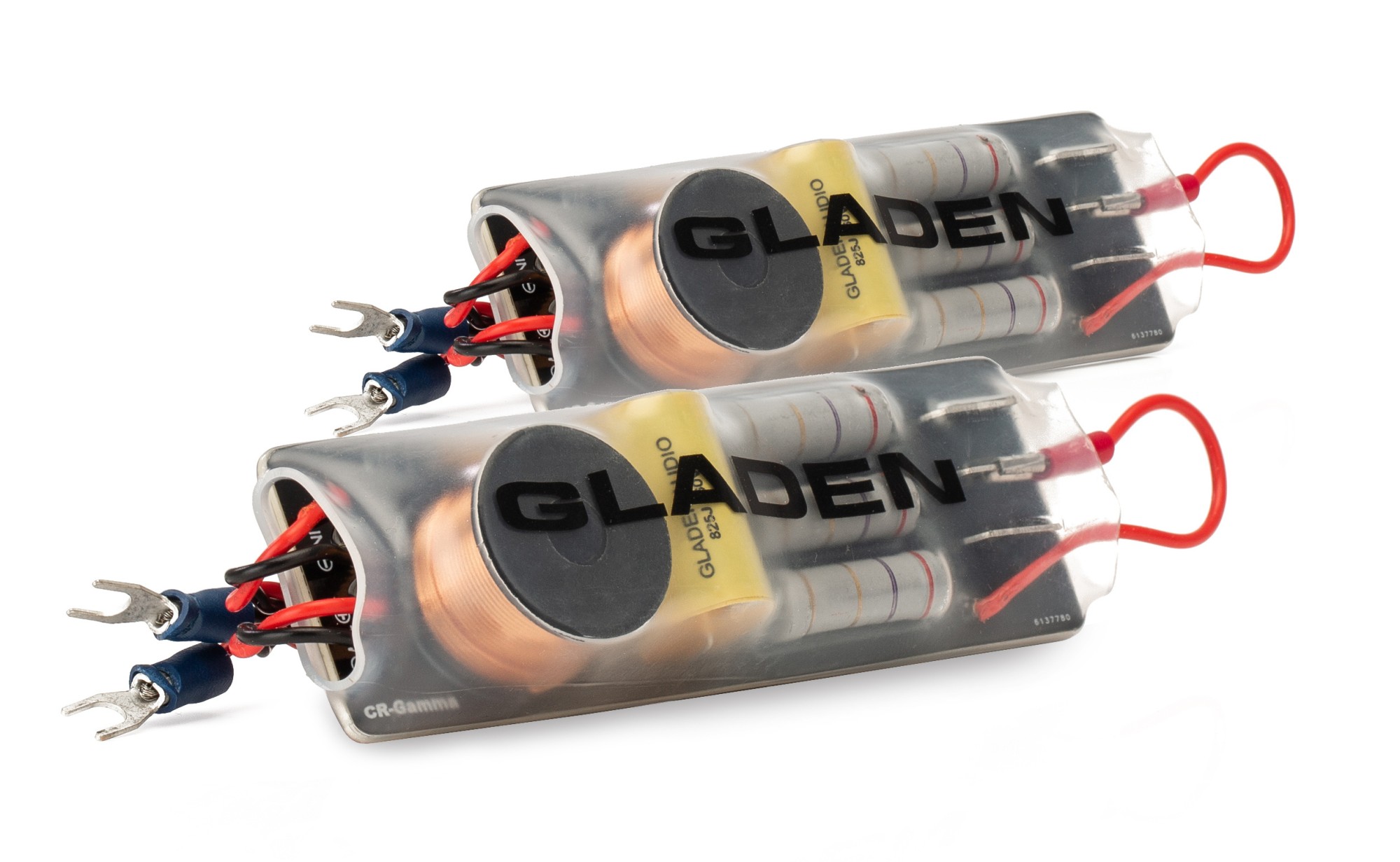
The system also includes the CR-Gamma crossover with a 12 dB/oct filter, which was specially designed for the Gamma series drivers. High-quality low-loss components ensure precise frequency band splitting and smooth transition between the drivers. The four-step tweeter level adjustment allows easy adaptation to the specific installation, vehicle acoustics and listener preferences. The compact design and system connector for the tweeter also greatly simplify the actual installation.
Key Features
- 2-way component system of the Gamma series.
- 100 mm midbass cone made of fiberglass.
- Sturdy steel basket with anti-resonant treatment.
- Nomex spider for high mechanical stability.
- Sensitivity above 91 dB for high system efficiency.
- Reduced 3 Ω impedance suitable for factory radios.
- Suitable for OEM upgrades and aftermarket amplifiers.
- Tweeter Gamma GT 25 with carbon-graphene dome.
- Compact tweeter chassis for easy OEM installation.
- Stylish mounting cups for surface installation included.
- CR-Gamma crossover with 12 dB/oct filter.
- 4-step tweeter level adjustment.
About the Brand
Gladen has been one of the most respected German car audio brands since its founding in 1997. The brand's founder, Henning Gladen, originally an aerospace engineer and the company's chief developer, brought the precision, technical know-how and attention to detail typical of the aerospace industry into Gladen products. Development and partly production still take place in Germany, which is reflected in the company's proprietary technologies, patented solutions and the materials used. Thanks to this philosophy, Gladen products are known for their natural, musical and long-term non-fatiguing sound as well as first-class workmanship, which has built the brand a strong reputation not only among demanding listeners but also in competitive EMMA installations across Europe. The brand also includes the renowned amplifier manufacturer Mosconi, allowing the creation of perfectly matched audio systems with an emphasis on tonality, dynamics and maximum reproduction fidelity.| Catalog number | GAMMA 100.2 |
| Brand | Gladen |
| Links | Official web presentation |
| Speaker typeCoaxial speakers: Coaxial speakers are characterized by a so-called all-in-one design. The tweeter and mid-bass speaker are in one basket. The advantage is simpler assembly, but thanks to the connection or proximity of the bands in one speaker, the sound quality will usually be reduced. As a rule, in the middle of the mid-bass speaker, there is a tweeter whose voice coil works in the second air gap of the common magnetic circuit. The three-way coaxial speaker consists of a mid-bass speaker, a center speaker and a separate tweeter in the front on a special beam. Component Speakers: Component speakers are characterized by a division into individual frequency bands, treble + mid-bass + or. bass band. The individual speakers can be placed completely separately, which results in a better sound and acoustic performance. In the vast majority of cases of component speakers, an external crossover is also supplied, which divides the treble, middle / mid-bass, and into the three-band the bass band or allows setting the decibel level of the tweeter (e.g. +2 dB, 0 dB, -2 dB), steepness (e.g. 6dB/Oct. 12dB/Oct.) or active or bi-amp connection. | 2-way component |
| RMS powerRMS speaker power is the constant power of the entire system, not just one speaker or one side. This is also the performance of continuous use of the speakers. If the RMS power is exceeded for a long time, the speakers may be irreversibly damaged! | 80 W |
| Max. (maximum performancePeak performance , which the speaker can play for a moment (approx. 0.5 s), for example when hitting drums in a song. If the max power is exceeded, the speakers will usually be damaged! | 140 W |
| Sensitivity (SPL 2.83V/1m)Sensitivity, sensitivity or efficiency of the speaker. Speaker sensitivity is given in decibels (dB) and simply put, the higher the value, the lower the demands on the amplifier's power. This is a defacto rating of how a speaker converts watts to sound. Sensitivity ratings are in noise level measured at 1 meter from the speaker using 1 W (watt of power) or using 2.83 volts at the source at 1 meter. A higher decibel level means the speaker is louder with less power. For every 3 dB increase in sensitivity, the speaker requires half the power to reproduce the same volume. For example, if an 88 dB speaker needs 100 Watts to produce a certain volume, then a speaker with a sensitivity of 91 dB needs only 50 Watts to reach the same volume. | 91 dB |
| Sensitivity (SPL 1W/1m)Sensitivity, sensitivity or efficiency of the speaker. Speaker sensitivity is given in decibels (dB) and simply put, the higher the value, the lower the demands on the amplifier's power. This is a defacto rating of how a speaker converts watts to sound. Sensitivity ratings are in noise level measured at 1 meter from the speaker using 1 W (watt of power) or using 2.83 volts at the source at 1 meter. A higher decibel level means the speaker is louder with less power. For every 3 dB increase in sensitivity, the speaker requires half the power to reproduce the same volume. For example, if an 88 dB speaker needs 100 Watts to produce a certain volume, then a speaker with a sensitivity of 91 dB needs only 50 Watts to reach the same volume. | 86.7 dB |
| ImpedanceImpedance - measurement of electrical resistance. When buying speakers, it is important to make sure that the impedance matches the amplifier or car stereo you are using. Example: A 2 Ohm speaker cannot be connected to an amplifier that is only stable up to 4 Ohms! A 4 Ohm speaker can easily be used with an amplifier that is stable up to 2 Ohms. The most common speaker impedance today is 3 - 4 Ohm. | 3 Ω |
| The diameter of the mid-bass speakerWe state the diameter of the speaker as the diameter of the entire speaker, not including the mounts, when smaller speakers (87, 100, 130 mm) have extra mounts. Some speakers are oval and there the dimension is given in inches, always the shortest side to the longest side. One inch is approx. 2.5 cm. | 100 mm |
| Installation depth of the mid-bass speakerThe installation depth of the speaker is measured from the bottom edge of the magnet to the bottom edge of the tin, plastic or cast speaker basket, or speaker bearing surfaces. | 48.5 mm |
| Mid-woofer diaphragm materialThe material that was used for the speaker diaphragm. Don't be afraid of the paper, it surprisingly has a very natural and high-quality sound and, thanks to the surface treatment, it can withstand moisture without any problems. | Glass fiber |
| Resonant frequency of the mid-bass speaker | 123 Hz |
| Voice coil diameter of the mid-bass speaker | 25 mm |
| Overall tweeter diameterThe total diameter of the tweeter is given as the diameter of the individual tweeter without the installation houses. | 49 mm (39.5 mm without grille) |
| Tweeter dome diameterThe net diameter of the dome (diaphragm) of the tweeter. | 25 mm |
| The overall depth of the tweeterThe total depth of the tweeter itself without the installation houses. | 14 mm |
| Tweeter dome materialThe shell material that was used in the manufacture of the tweeter. | Carbon fiber with graphene |
| The resonant frequency of the tweeter | 1050 Hz |
| Frequency crossover included in the packageThe crossover is an important part of defacto all loudspeakers. A crossover usually contains different resistor values, coil sizes, and capacitor types that fundamentally modify the sound. We describe below what the turnouts are for. Component Speakers: A crossover is part of every quality component speaker system. Its task is to ensure the distribution of frequencies that the amplifier produces in the entire acoustic spectrum of frequencies so that each of the speakers receives only that part of the band that it can optimally play in terms of efficiency and minimal distortion. Coaxial speakers: In most cases, coaxial loudspeakers have a simple crossover (6dB/Oct.) formed by a capacitor at the tweeter. | Yes (for tweeters) |
| Options for setting the frequency crossoverThe unwritten rule is that the more expensive the speakers, the more options the crossover has for adjusting the sound. The most common way to adjust the crossover is attenuation on the tweeter. More advanced crossovers also offer the option of setting the steepness on the mid-bass and tweeter or adjusting the frequency range. | Yes, 3 levels |
| Price forIf the price is for a pair, the package always includes 2 pieces of everything, e.g. 2x mid-bass, 2x tweeter and 2x crossover. | Pair |