
ESB Audio 9.1T-25 speakers
More about the product
- You can return the goods to us within 14 days
ESB Audio 9000 series speakers
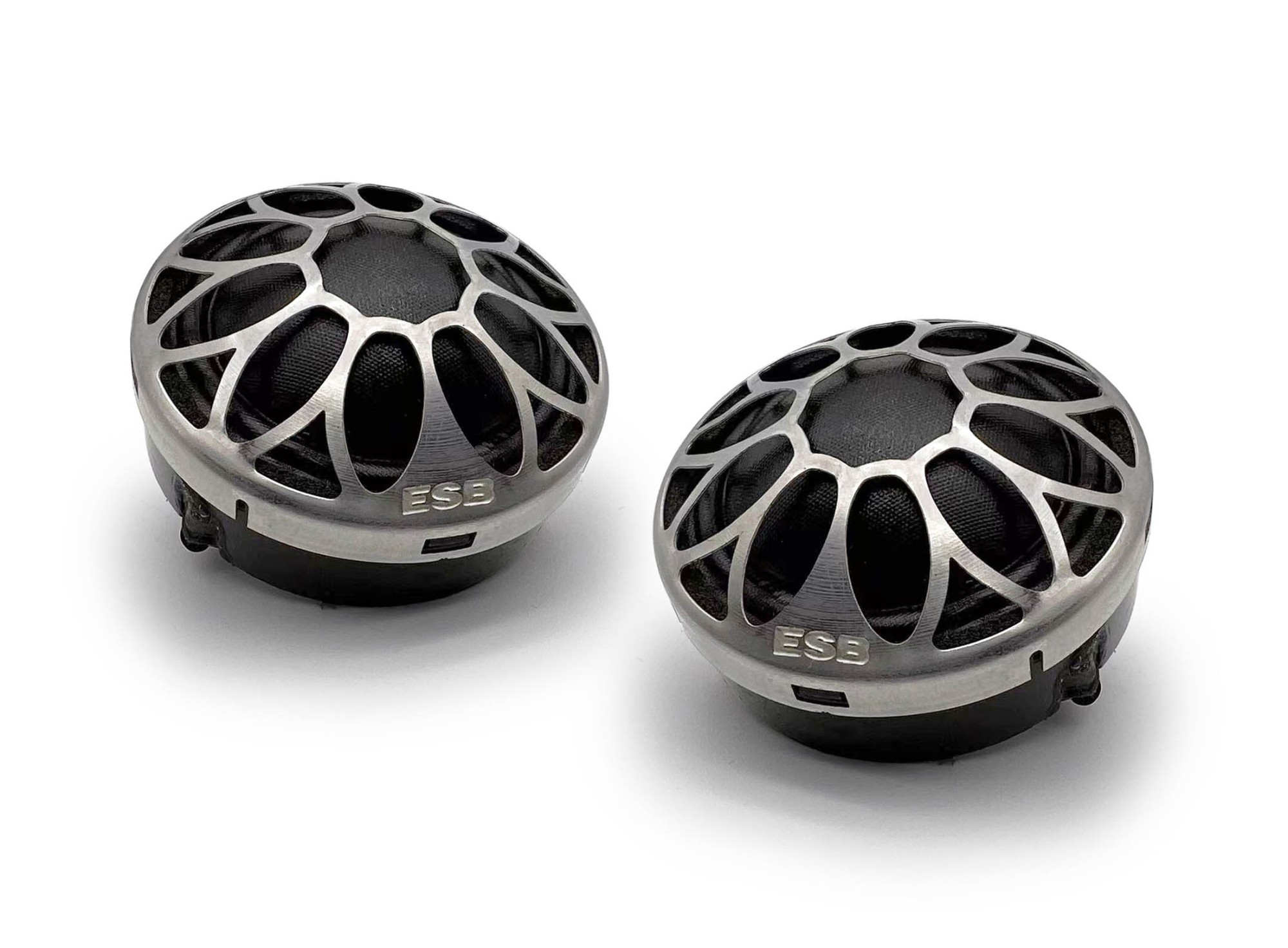
The ESB 9000 series speakers (Novemila) proudly belong to the high-end segment and belong to the most technologically advanced car speakers ever made. And also to the most elegant ones! Technology and design come together in a new and unusual aesthetic, thanks to the exceptional flower shape around the tweeter membrane and also on the bass and center speaker baskets. However, this luxurious design was not only created from an aesthetic point of view. It is an expression of innovation that will allow the acoustic refraction at the edges of the tweeters to be less pronounced and adapt to the design of the speakers. An analogy can be found in the new Rolls-Royce engines for state-of-the-art aircraft, which have the same shape on the trailing edge. Exactly where the air comes out and the main turbulence is created. With the new design, these engines have achieved great benefits such as a 10 dB reduction in cabin noise and at the same time a 10% reduction in fuel consumption. However, this is not just a coincidence. The designs of high-end ESB speakers and Rolls-Royce engines are based on the same assumption, namely to reduce undesirable sound characteristics at the edge of the speakers and engines respectively, and to effectively direct the air flow outwards. However, this is only one of the many exclusive technologies that you will find in the 9000 model series. It includes a total of six high-end separate components, two 2-band component systems and three 3-band systems, which will amaze you not only with their sound, but also with their unconventional luxury design and exceptional materials.
ESB Audio 9.1T-25 tweeters
ESB Audio 9.1T-25 represent one of the two tweeter options of the 9000 series. Individual models differ in the diameter of the dome and several other parameters and technologies, on the other hand, they have many technological and design solutions in common. The first thing you'll probably notice is the tweeter's beautiful design. However, it is not only an expression of Italian aesthetics, but it has its own justification. This design allows for perfect dimensional stability and ensures perfect connection of all parts with very tight tolerances, reducing distortion and improving performance. The diaphragm is made of lightweight semi-transparent silk, which is the perfect combination of lightness and strength, and is probably the most suitable material for extremely realistic musical reproduction today. The shell is impregnated with resin with integrated suspension and is made in one piece, which also includes suspension. This significantly reduces weight and allows the tweeter to reach very high frequencies. The absence of joints prevents decay and various vibration phenomena. The tweeter's high-quality neodymium magnet ensures tremendous magnetic force even after hours of use when the tweeter will be hot. The voice coil is very light and can operate easily above 20kHz and guarantees a fast transient response and a very natural sound. Also worth mentioning is the series of calibrated axial holes that connect the interior of the tweeter to the rear chamber obtained by joining the connector cover. This helps lower the resonant frequency, improves ventilation and reduces the impedance peak, making the response longer and more linear.
Main features of ESB Audio 9.1T-25 tweeters
- Calota with a diameter of 28 mm made of resin-impregnated silk.
- Lightweight removable steel grille with floral design and ESB logo.
- Felt damper under the hood made of pure wool with long fibers, which is the most effective material for absorbing and damping medium and high frequencies.
- The super-light 25mm aluminum voice coil with aluminum copper winding contributes significantly to the wide frequency range of this tweeter.
- The body of the tweeter is made of durable ABS plastic with excellent self-damping.
- Magnetic plate made of extremely low carbon steel.
- The F52H neodymium main magnet represents the most suitable solution both for magnetic strength in relation to weight and for supporting high temperatures (120°C versus 80°C for a "classic" neodymium magnet).
- The pole plate is manufactured using a numerically controlled machine, not by stamping, which greatly reduces design tolerances in favor of performance.
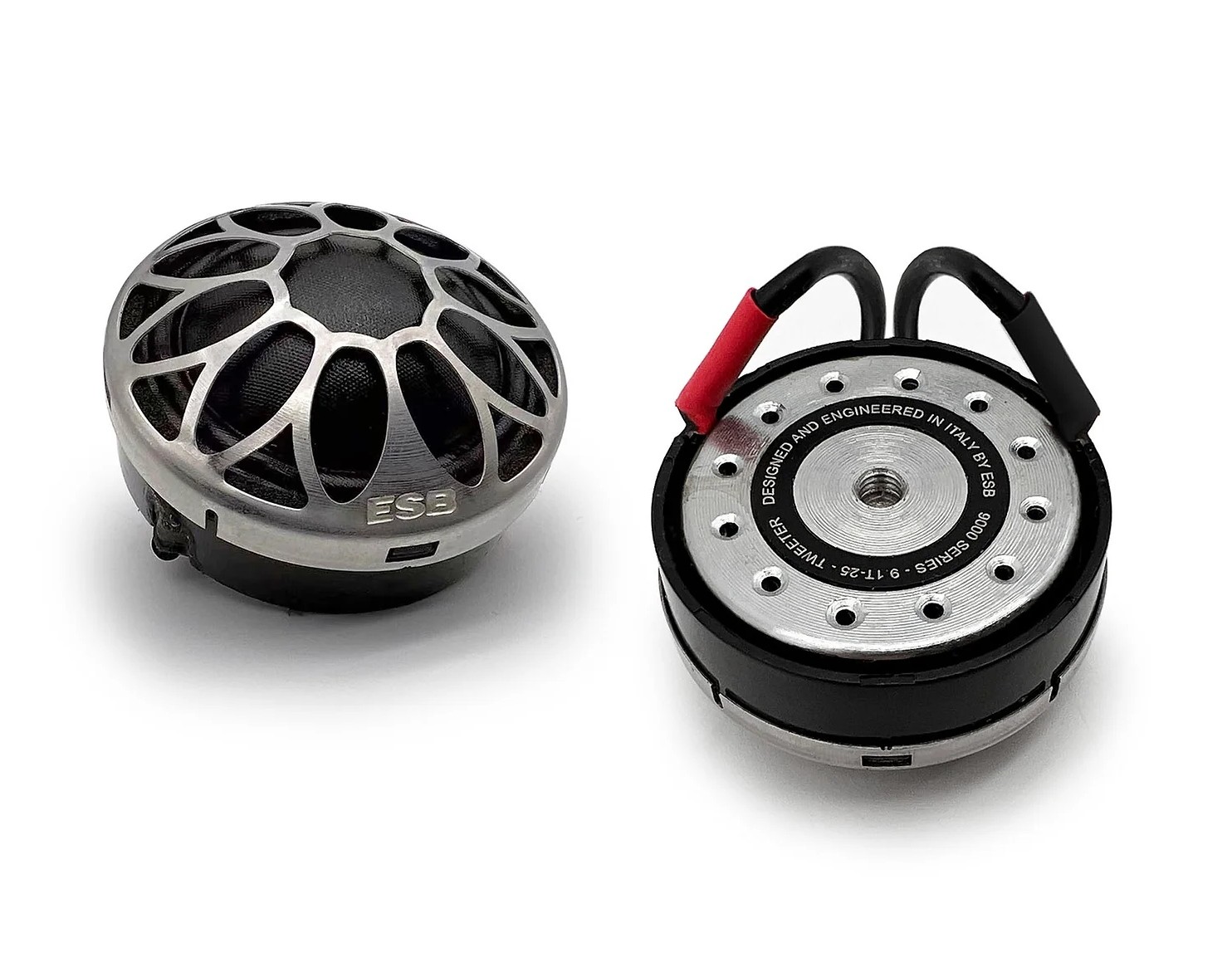
- The plate has twelve axial holes in the lower part created to eliminate the air back pressure caused by the movement of the dome. This makes it possible to reduce the distortions that would inevitably occur due to the deformation of the fine silk and also helps to reduce the frequency resonance of the tweeter.
- Gold-plated copper terminals and extremely flexible connection cables with a high silver content to reduce electrical connection losses.
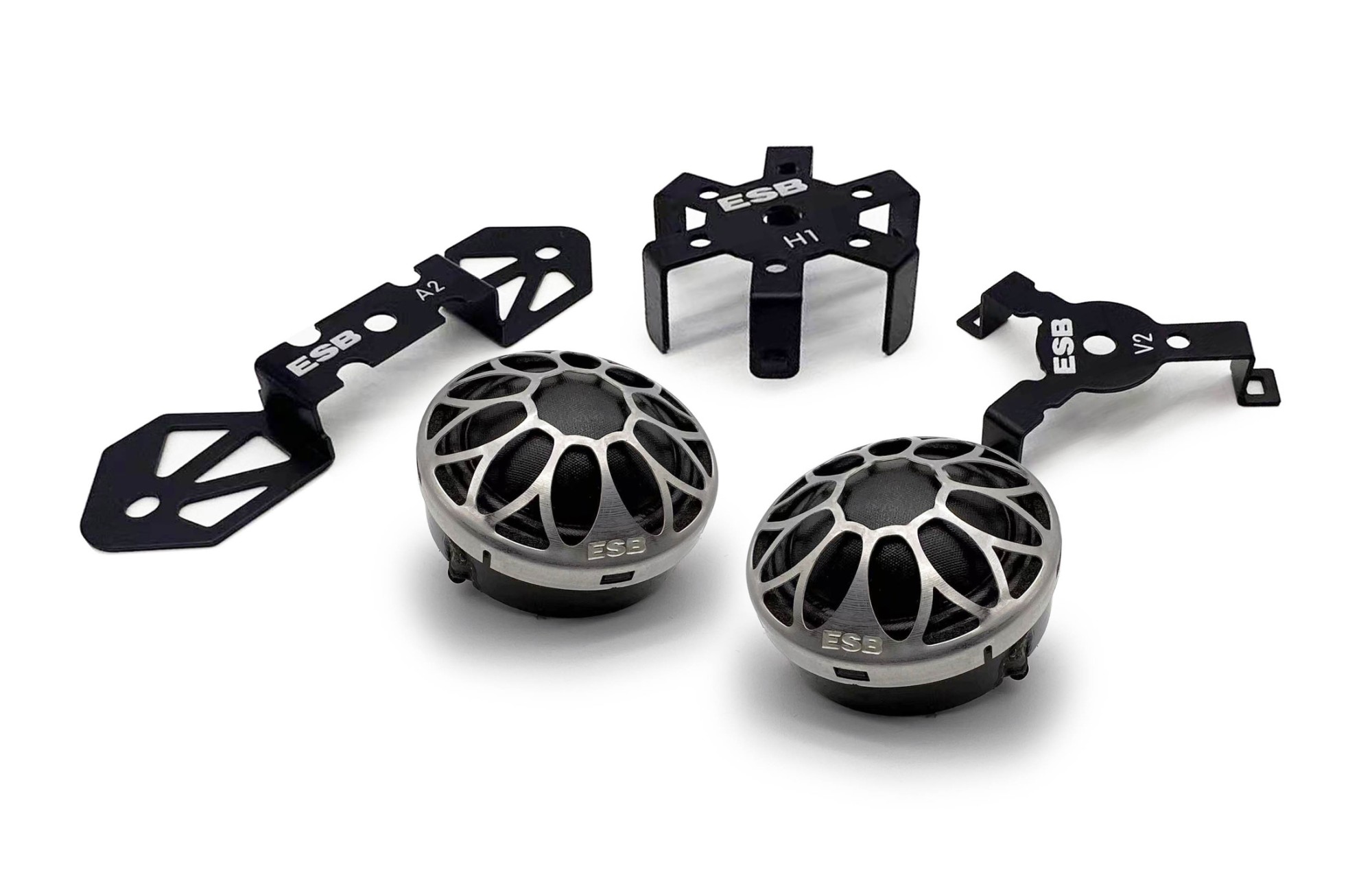
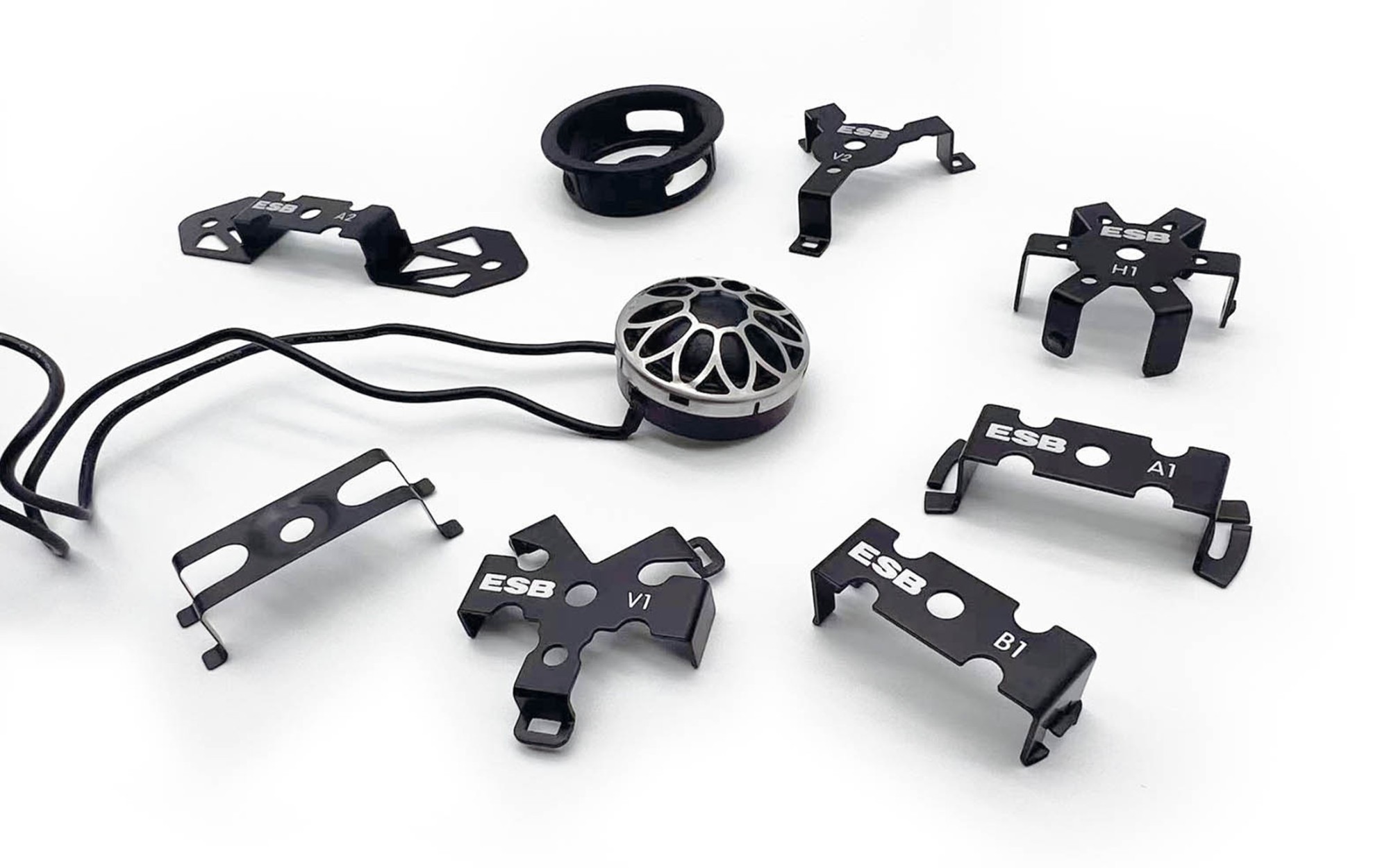
- In the package you will find 8 parts of mounting accessories for variable installation.
- The rear side of the tweeter is equipped with a threaded hole, which significantly increases the possibilities of fixing it in non-traditional conditions inside cars.
About the ESB Audio brand
The history of ESB Audio dates back to 1972, when this Italian brand was officially founded. ESB audio is one of the most famous speaker system manufacturers of the second half of the 20th century, and during their rich history they have launched many innovative technologies and many high-end home audio products that have achieved huge worldwide success. Based on the experience gained, in 1984, ESB engineers began to engage in research aimed at optimizing sound in the automotive environment, and two years later began the production of the first car speakers. Thanks to the great success, ESB began to focus more and more on the automotive industry and its demanding challenges. Car Audio is starting to be a phenomenon of the time, and in 2005 a school focused exclusively on vehicle sound was founded in the city of Aprilia, where ESB is based. It was then that the final decision was made to leave the world of home audio and focus exclusively on vehicle sound systems. Currently, ESB is part of the Italian company Apex Group, together with the American manufacturer of audiophile amplifiers and DSP processors Zapco. The offer includes several model lines of speakers, led by the super high-end three-way Diecimila system, which represents probably the highest quality and most expensive car speakers on the market today. And that is the main mission of ESB audio. To produce speakers of the highest quality, focused on faithful sound, which will allow the user to reproduce as the interpreter intended. Exactly according to the company's slogan "Just like live".
| Catalog number | ESB 9.1T-25 |
| Brand | ESB Audio |
| Links | Official web presentation (English) |
| Speaker typeCoaxial speakers: Coaxial speakers are characterized by a so-called all-in-one design. The tweeter and mid-bass speaker are in one basket. The advantage is simpler assembly, but thanks to the connection or proximity of the bands in one speaker, the sound quality will usually be reduced. As a rule, in the middle of the mid-bass speaker, there is a tweeter whose voice coil works in the second air gap of the common magnetic circuit. The three-way coaxial speaker consists of a mid-bass speaker, a center speaker and a separate tweeter in the front on a special beam. Component Speakers: Component speakers are characterized by a division into individual frequency bands, treble + mid-bass + or. bass band. The individual speakers can be placed completely separately, which results in a better sound and acoustic performance. In the vast majority of cases of component speakers, an external crossover is also supplied, which divides the treble, middle / mid-bass, and into the three-band the bass band or allows setting the decibel level of the tweeter (e.g. +2 dB, 0 dB, -2 dB), steepness (e.g. 6dB/Oct. 12dB/Oct.) or active or bi-amp connection. | Tweeter |
| RMS powerRMS speaker power is the constant power of the entire system, not just one speaker or one side. This is also the performance of continuous use of the speakers. If the RMS power is exceeded for a long time, the speakers may be irreversibly damaged! | 100 W |
| Max. (maximum performancePeak performance , which the speaker can play for a moment (approx. 0.5 s), for example when hitting drums in a song. If the max power is exceeded, the speakers will usually be damaged! | 220 W |
| Sensitivity (SPL 1W/1m)Sensitivity, sensitivity or efficiency of the speaker. Speaker sensitivity is given in decibels (dB) and simply put, the higher the value, the lower the demands on the amplifier's power. This is a defacto rating of how a speaker converts watts to sound. Sensitivity ratings are in noise level measured at 1 meter from the speaker using 1 W (watt of power) or using 2.83 volts at the source at 1 meter. A higher decibel level means the speaker is louder with less power. For every 3 dB increase in sensitivity, the speaker requires half the power to reproduce the same volume. For example, if an 88 dB speaker needs 100 Watts to produce a certain volume, then a speaker with a sensitivity of 91 dB needs only 50 Watts to reach the same volume. | 91 dB |
| ImpedanceImpedance - measurement of electrical resistance. When buying speakers, it is important to make sure that the impedance matches the amplifier or car stereo you are using. Example: A 2 Ohm speaker cannot be connected to an amplifier that is only stable up to 4 Ohms! A 4 Ohm speaker can easily be used with an amplifier that is stable up to 2 Ohms. The most common speaker impedance today is 3 - 4 Ohm. | 4 Ω |
| Frequency rangeThe ability of the speakers to play a signal from the lowest frequency to the highest, or the speaker's ability to faithfully reproduce sound in a specific frequency band. Professionally: In the frequency range from 40 to 16,000 Hz, the vast majority of fundamental and overtones (harmonics) of all musical instruments are found. We are interested in the course of the radiated sound pressure in this range of frequencies when the loudspeaker system is supplied with constant power. We call this course the frequency characteristic, which tells us the level of radiated sound pressure in decibels (dB) depending on the frequency. The frequency characteristic of a speaker or speaker system can be expressed most succinctly with a graph. Mostly, however, the frequency characteristic is indicated by indicating the maximum tolerance of the sound pressure in the given frequency range, e.g. 50 to 15,000 Hz -+ 6 dB. Since the frequency characteristics of loudspeakers and systems in general are quite uneven, some manufacturers do not even specify this maximum tolerance of sound pressure in decibels in their catalogs for reasons of prestige. Data impoverished in this way is unfortunately worthless. What is valid is that the manufacturer offers a speaker system with a frequency range of 30 to 20,000 Hz, if he is worried about stating the maximum unevenness of the sound pressure in this range, because he can have a tolerance of, for example, +- 20 dB. The unevenness or undulation of the frequency curve in good speaker systems for high-quality music performance should not exceed +-3 dB in the 80 to 12,000 Hz band and +-6 dB in the 40 to 16,000 Hz band. Greater unevenness already depletes or emphasizes certain tonal areas, which can cause audible or even disturbing distortion. The proportion between fundamental tones and higher harmonics also changes, thereby changing the color of the sound, and individual musical instruments as well as the entire musical image sound unnatural. | 1100 - 25000 Hz |
| Overall tweeter diameterThe total diameter of the tweeter is given as the diameter of the individual tweeter without the installation houses. | 38 mm |
| Tweeter dome diameterThe net diameter of the dome (diaphragm) of the tweeter. | 25 mm |
| Tweeter dome materialThe shell material that was used in the manufacture of the tweeter. | Silk |
| The resonant frequency of the tweeter | 1334 Hz |
| Frequency crossover included in the packageThe crossover is an important part of defacto all loudspeakers. A crossover usually contains different resistor values, coil sizes, and capacitor types that fundamentally modify the sound. We describe below what the turnouts are for. Component Speakers: A crossover is part of every quality component speaker system. Its task is to ensure the distribution of frequencies that the amplifier produces in the entire acoustic spectrum of frequencies so that each of the speakers receives only that part of the band that it can optimally play in terms of efficiency and minimal distortion. Coaxial speakers: In most cases, coaxial loudspeakers have a simple crossover (6dB/Oct.) formed by a capacitor at the tweeter. | No |
| Cover grids included in the packageOriginal cover grilles in speaker packaging. | Yes |
| Price forIf the price is for a pair, the package always includes 2 pieces of everything, e.g. 2x mid-bass, 2x tweeter and 2x crossover. | Pair |