
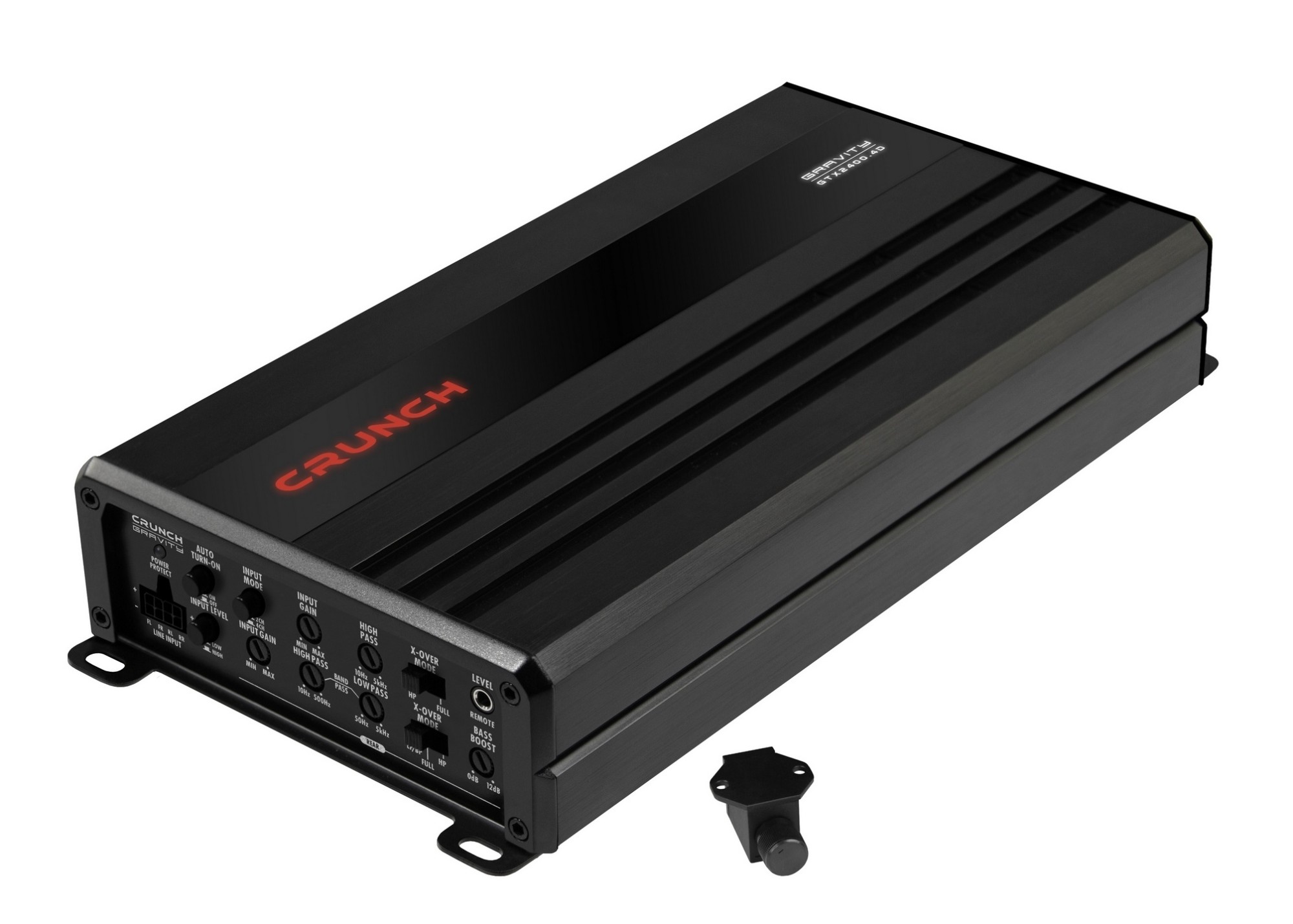
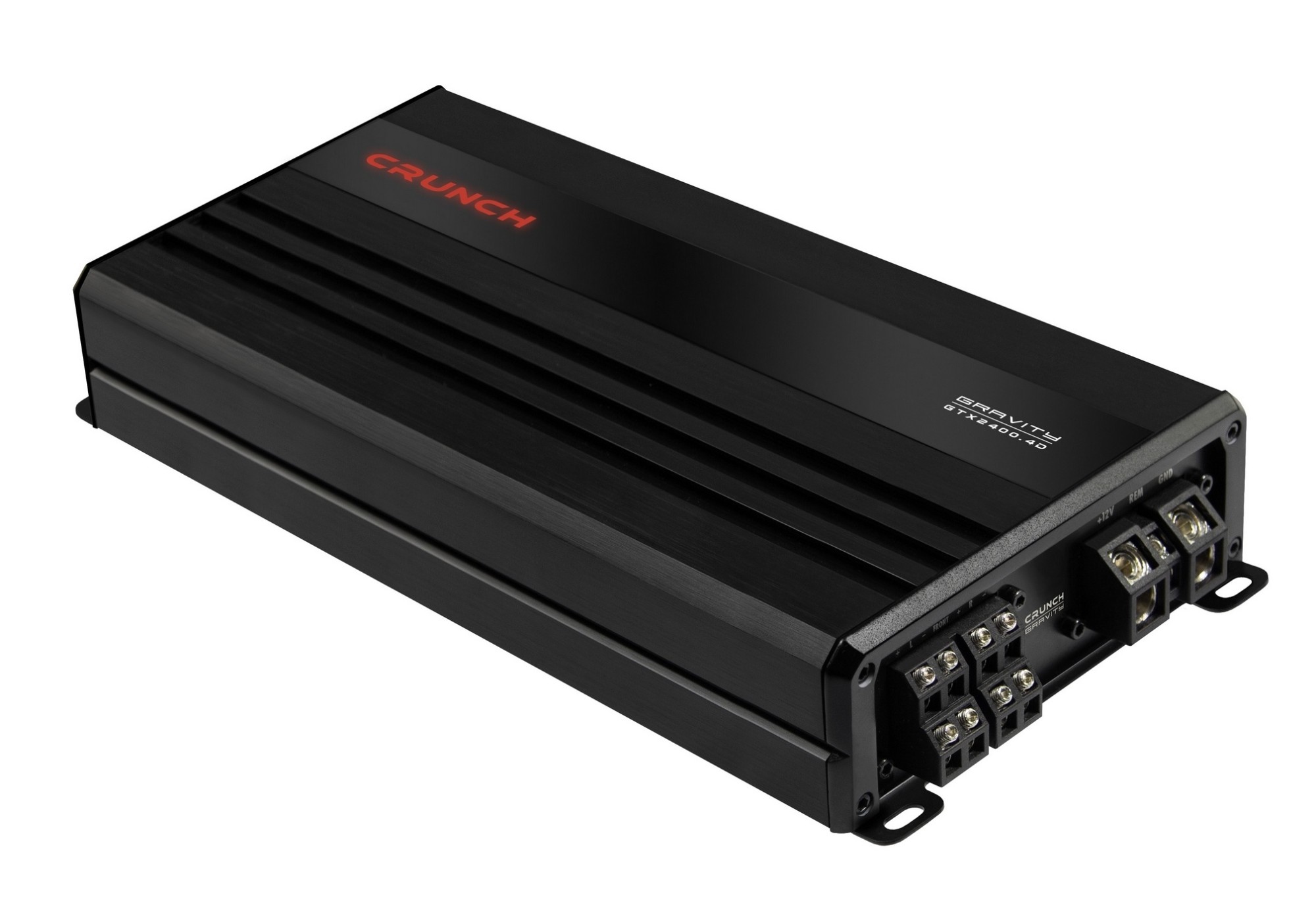
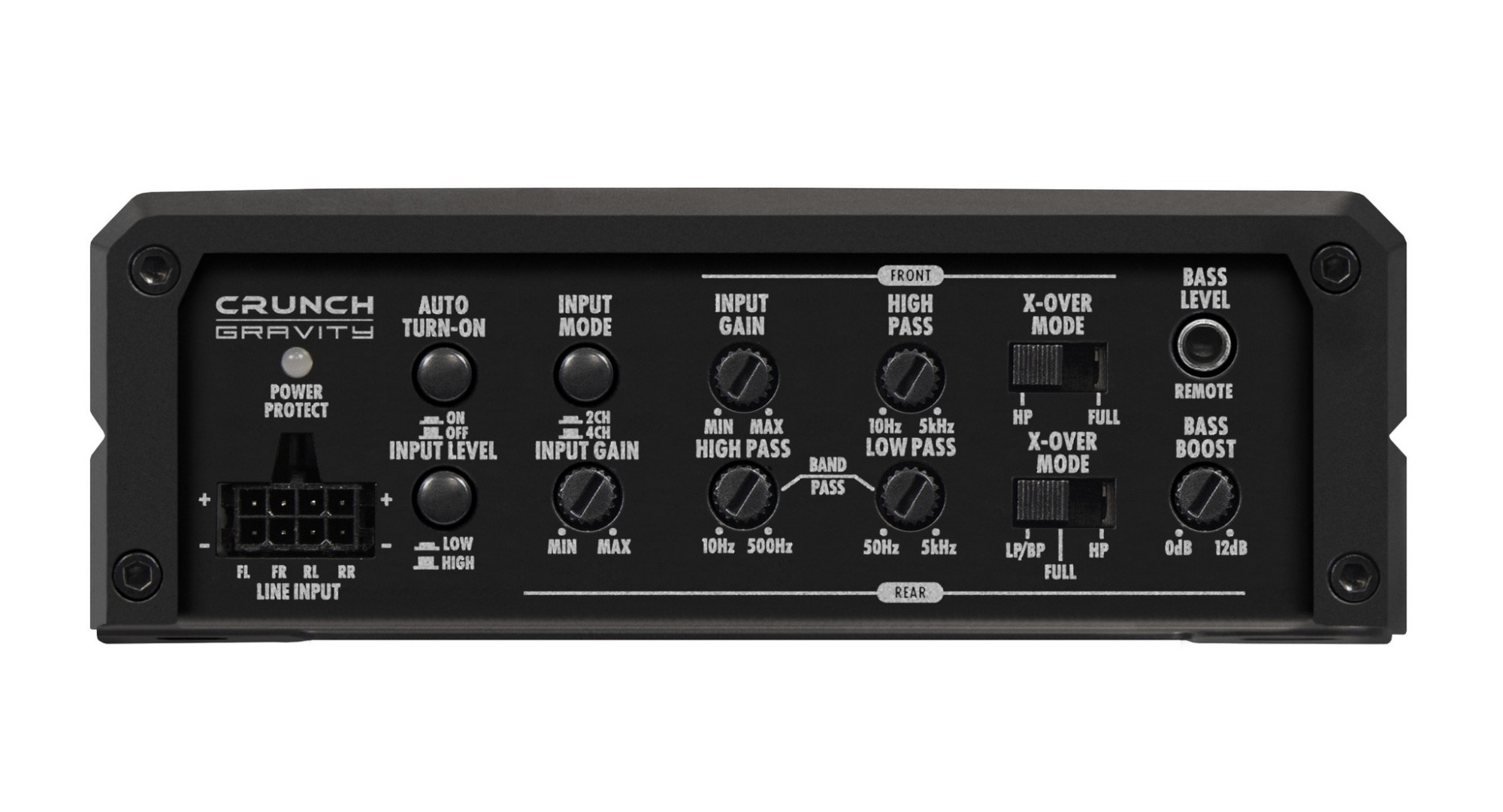
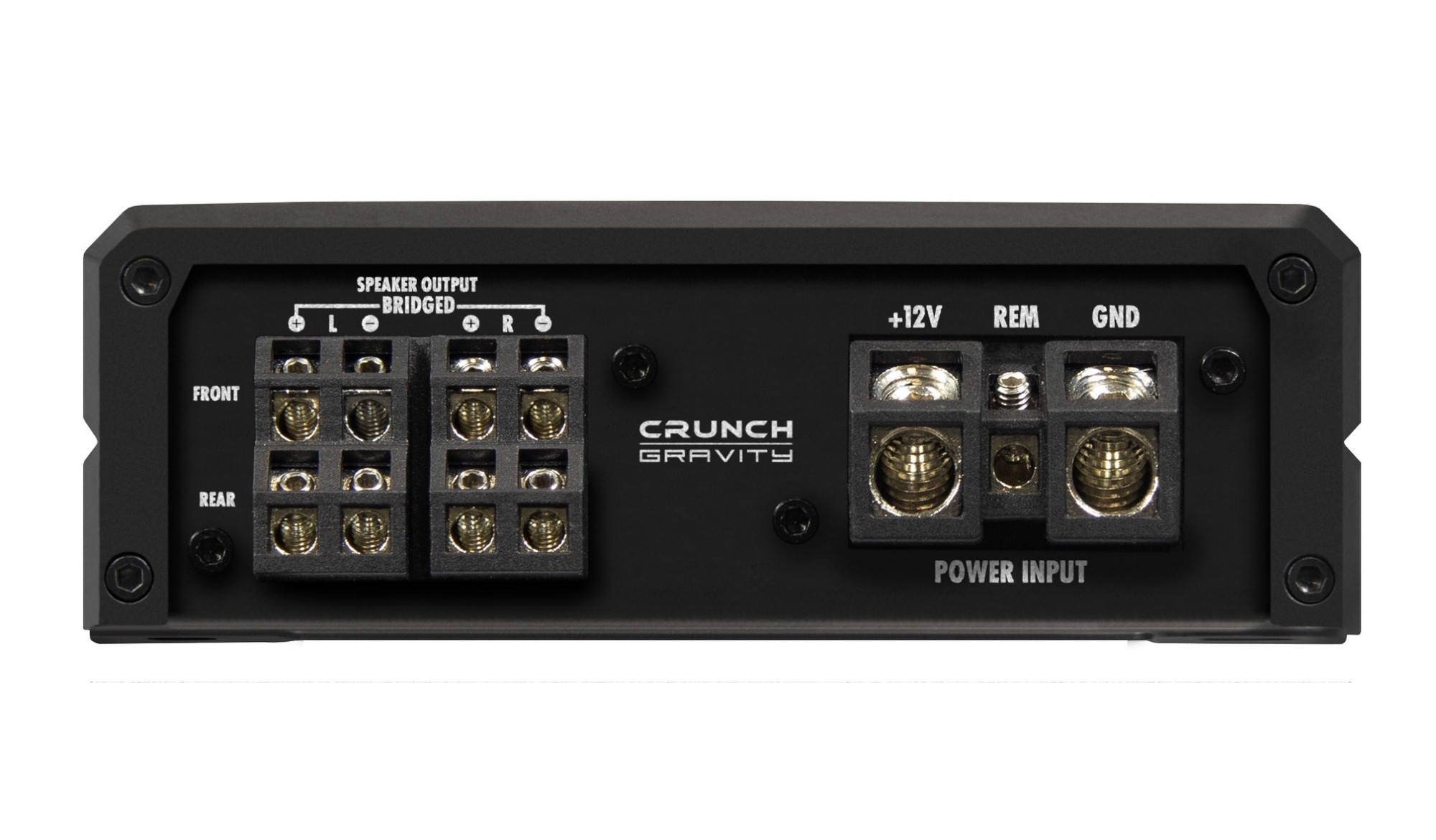
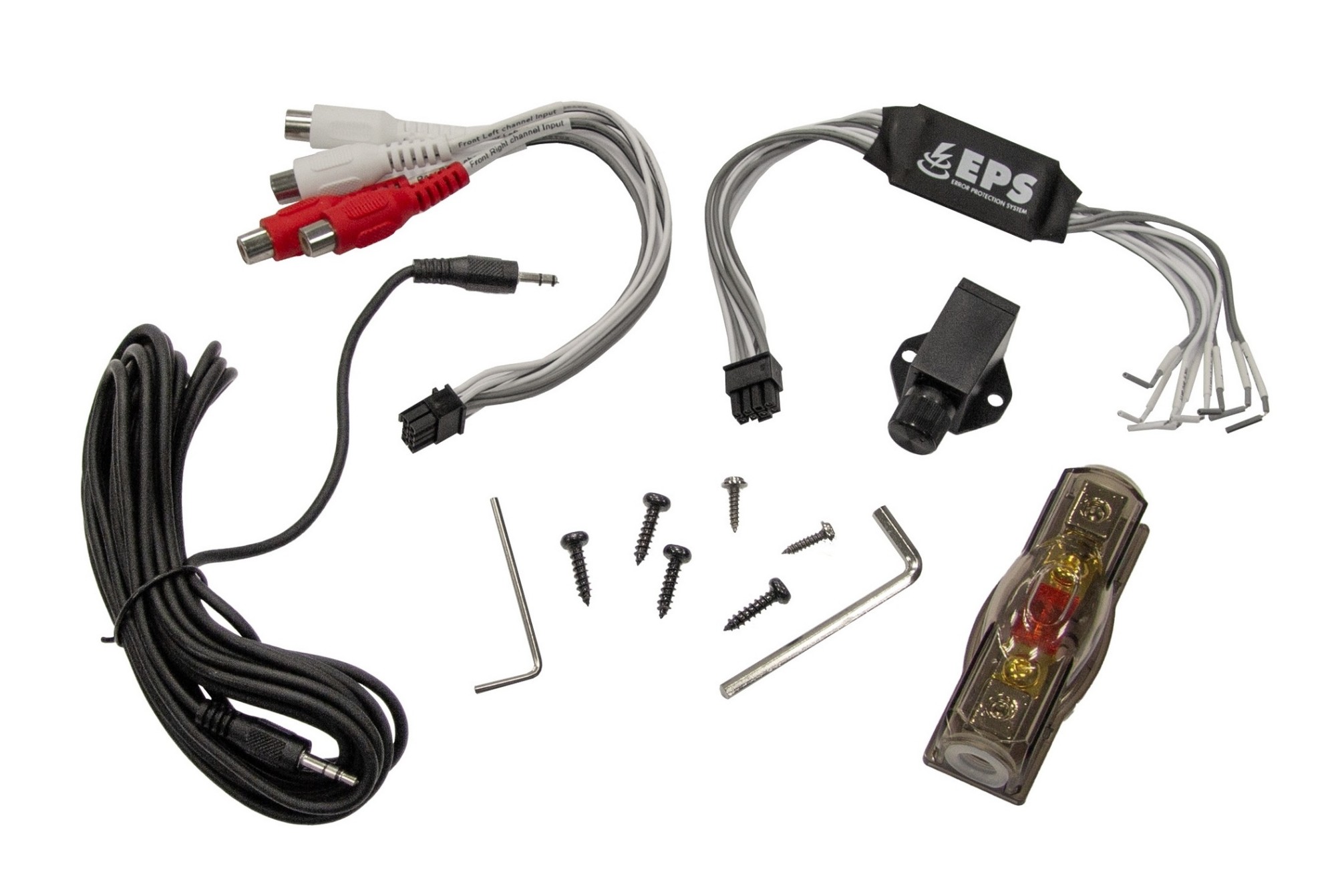
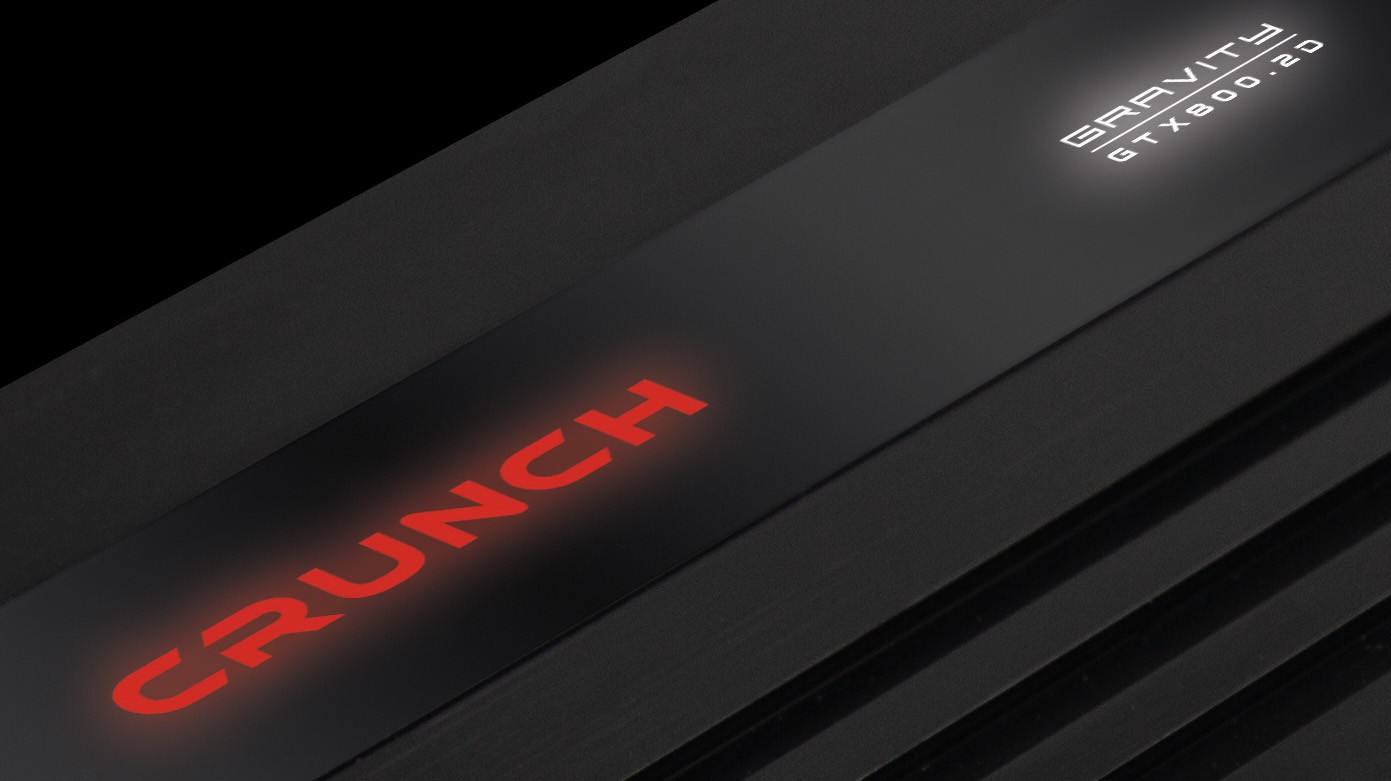
Crunch GTX2400.4D is a compact four-channel amplifier from the GRAVITY GTX series, which includes a total of 10 models focused on small dimensions and high power in their class. Thanks to its Class D design, it offers efficient operation and a solid power reserve while maintaining a very compact body that allows installation even in space-limited areas of the vehicle. The model is suitable for powering speakers and a bridged subwoofer and allows basic system adjustment using high-pass and low-pass filters, a bass boost function and a bandpass mode. Both RCA and high-level inputs with automatic turn-on are standard, and the package also includes a remote bass level control. The design is complemented by an aluminum heatsink and a top panel with a two-color backlit logo and model marking, which gives the amplifier a more distinctive visual character.
Crunch GTX2400.4D Amplifier
More about the product
- You can return the goods to us within 14 days
Crunch GTX2400.4D Amplifier
Main features
- 4-channel Class D amplifier from the Gravity GTX series.
- Compact dimensions for easy installation even in space-limited locations
- Power: 4 × 200 W RMS at 4 Ω, 4 × 300 W RMS at 2 Ω.
- Bridged configuration option: 2 × 600 W RMS at 4 Ω for powering a subwoofer.
- Adjustable high-pass and low-pass filters.
- Continuously adjustable bass boost to emphasize low frequencies as needed.
- Bandpass mode for more flexible system configuration.
- RCA inputs via cable connectors.
- High-level inputs with EPS® and automatic turn-on function.
- Compact remote bass level control.
- Aluminum heatsink and two-color backlit top panel.
About the brand
Crunch has been active in the car audio market for more than three decades. The brand originated in the 1980s in the United States and gradually became established among manufacturers of affordable sound systems intended for standard and less demanding installations. Later the brand became part of the American group Maxxsonics USA, which also includes other well-known car audio brands such as Hifonics, MB Quart and Autotek in its portfolio. Within this group Crunch has long been positioned as a cost-effective alternative focused on simple and functional solutions for amplifying and expanding factory audio systems. Crunch's range includes a wide portfolio of amplifiers, speakers, subwoofers and accessories with a favorable price-to-quality ratio.
| Catalog number | GTX2400.4D |
| Brand | Crunch |
| Links | Official web presentation |
| Energy class of the amplifierAmplifiers are divided into two basic classes: analog and digital . Analog amplifiers (A/B) have higher consumption requirements, but usually have a more natural sound. Digital amplifiers (D) have significantly lower consumption and higher efficiency, but the sound may not be as faithful as with classic analog amplifiers. | D |
| Number of amplifier channelsAmplifiers are divided into: - Monoblocks - 2-channel - 3-channel - 4-channel - 5-channel - 6-channel - multi-channel Each channel is used to power one speaker for the coaxial type, or one side if they are component speakers. Monoblock type amplifiers are mainly used for subwoofers. 2-channel are suitable for both subwoofers and, for example, the front pair of speakers in a car. 3-channel is used for front or rear speakers + subwoofer. 4-channel are used for front + rear speakers or 1 pair of speakers + subwoofer. 6 or 5-channel are used for 2 pairs of speakers + subwoofer, most often. Bridging means connecting the amplifier to a bridge, using the + pole from one channel and the - pole from the other channel. In most cases this is shown as "BRIDGED" on the amplifier. | 4 |
| RMS power into 4 ΩRMS power when loading speakers or subwoofer at 4 Ω. RMS power is the constant power of the amplifier and is one of the most important parameters when choosing an amplifier. | 4 x 200 / 2 x 600 W |
| RMS power into 2 ΩRMS power when loading speakers or subwoofer at 2 Ω. RMS power is the constant power of the amplifier and is one of the most important parameters when choosing an amplifier. | 4 x 300 W |
| Speaker impedance | 2 – 8 Ω |
| Harmonic Distortion (THD)Total harmonic distortion indicates how much the input signal is distorted in the amplifier. Distortions appear as overtones contained in the output signal. The proportion of originally absent parts of the signal is given as a percentage, typical values are between 0.001% and 0.5%. Distortion is measured in their power band. If it exceeds the limit of 0.7% from a certain power, it is the value of the output power of the given amplifier, from which it no longer plays without distortion and from which the distortion usually increases steeply, so that no further increase in power can be counted on. The lower the value, the better. | 0.10 % |
| Signal-to-noise ratioThe signal-to-noise ratio means that the output signal always contains noise. The signal-to-noise ratio expresses how much of this noise is compared to the useful signal. The so-called A value is given, which does not take deep and very high frequencies into account. This corresponds to the characteristic of human hearing, which is not so sensitive to deep frequencies, especially below 1 kHz. The higher the value, the better the amplifier is. | 106 dB |
| Input sensitivityIn order for the amplifier to perform its function correctly, it requires an input signal of a certain level, which is different for car radios. It is measured in "Volts" (e.g. 2 V, 4 V, etc.) The higher the value at the output of the pre-amplifier, or car radio, the less demands are placed on the power of the amplifier. However, the amplifier must allow this input sensitivity, and for that reason this value is also given for the amplifier. | 350 mV - 8.3 V (High Level) / 250 mV - 6.3 V (RCA) |
| High pass filter (HPF)HPF / HP or The "hi pass filter" offers the option of setting the amplifier using a potentiometer so that medium, possibly mid-bass and treble frequencies play upwards from a certain frequency. Example: Amplifiers most often have an HPF from 40 to 300 Hz. If we set the potentiometer to a value of approx. 150 Hz, the sound will be clipped so that it plays frequencies from 150 Hz up to the maximum upper limit of the entire frequency range of the amplifier, perhaps up to 20,000 Hz. We recommend setting this potentiometer in the range of 80-160 Hz. Thanks to this setting option, the speakers can handle a higher performance, as you will not overload them with bass in the lower frequency range. | 10 – 5000 Hz (channel 1 + 2), 10 – 500 Hz (channel 3 + 4) |
| Low-pass filter (LPF)LPF / LP or "low pass filter" offers the possibility to adjust the amplifier using a potentiometer so that the lower band plays only the frequencies in a certain band that you need. This filter is used to adjust the frequency range for the subwoofer, so that it does not overload or distort the sound. Example: Amplifiers most often have an LPF from 20 to 300 Hz. We recommend setting this potentiometer in the range of 45-80 Hz. | 50 – 5000 Hz (channel 3 + 4) |
| Bass boostBass boost or bass enhancement. With this function, the bass itself can be emphasized, at a high level of bass boost, the speakers and the subwoofer can distort a lot and the sound will be worse than better. We therefore recommend using the "bass boost" function wisely. With maximum use of bass boost, there is a risk of damage to the speakers and thus to the subwoofer. | 0 – 12 dB @ 45 Hz |
| Damping factorDF - Damping Factor . It is the ratio of the load (repro + cables, crossover, etc.) to the internal resistance of the amplifier. The bigger the DF, the more controlled the bass. Amplifiers with a lower DF tend to hum. Subwoofers with a higher Q in the bass reflex and sometimes in the enclosure will also cause humming. | 115 |
| On-board voltage rangeThe ability of the amplifier to operate at a specified voltage. As the voltage decreases, so does the power of the amplifier. The ideal voltage in a car is between 13.8 and 14.4 V. | 8 - 16 V |
| The value of the fuses on the amplifierFrom the value of the fuses on the amplifier, you can get a true picture of the real performance of the amplifier. | 1 x 120 A (external) |
| High level inputsThe high-level input on the amplifier allows connection directly to the existing speakers in the car without additional purchase of an external high/low adapter. Important equipment in the case of installing an amplifier on an original car radio. | Yes |
| Automatic on and offThis function allows you to automatically switch on the amplifier. | Yes |
| Socket input terminalsFerrule terminals allow better wiring contact to the amplifier. It is also a more secure form of terminals. If you are tightening the sleeve terminals, we recommend retightening them after 1 day, as the connected cable gradually compresses. | Yes |
| Input for wired remote controlIf the amplifier has a remote control input. | Yes |
| Remote control included in the packageSome models of amplifiers also come with wired remote controls in the package, which on one side plug into the amplifier and on the other side you have a potentiometer that you can place anywhere in the cabin. A common place to place the remote control is under the steering wheel. The advantage is the regulation of power, and therefore volume, depending on driving conditions and the mood of the crew in the car. | Yes |
| Dimensions of the amplifier | 270 x 48 x 135 mm |
| Mass | 2.65 Kg |