
Amplifier with DSP processor Onkyo R-MS25
More about the product
- You can return the goods to us within 14 days
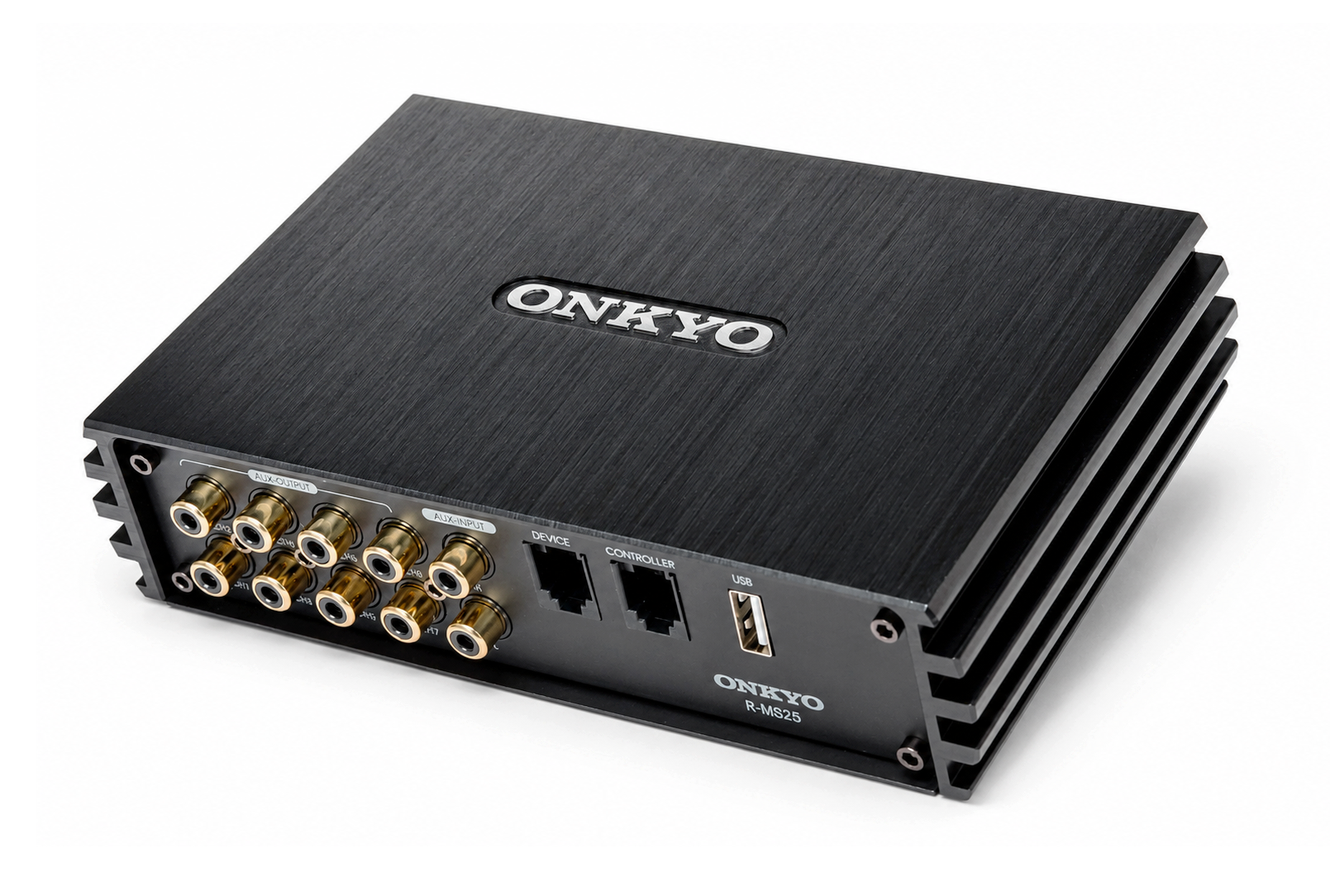
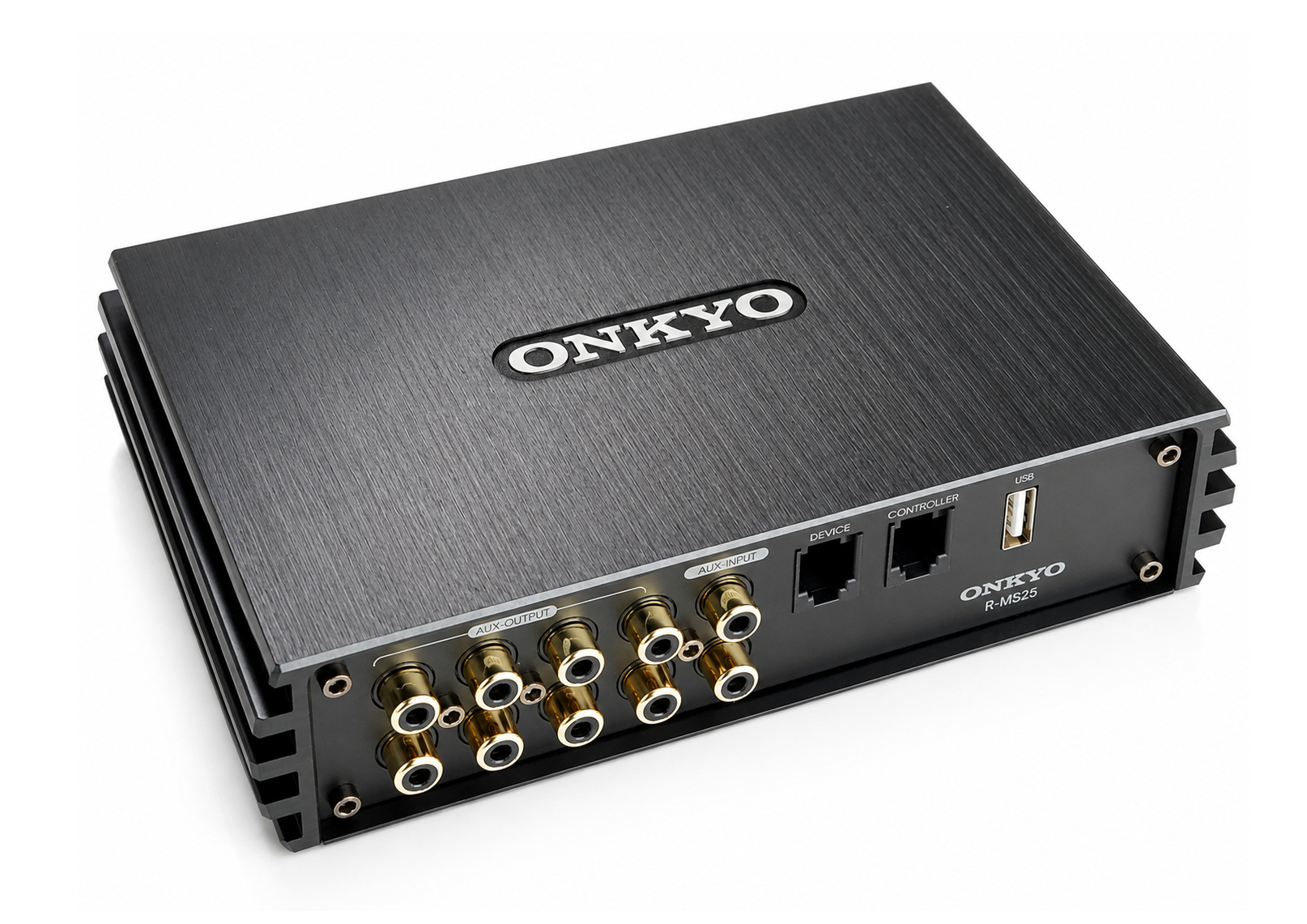
Zesilovač s DSP procesorem Onkyo R-MS25
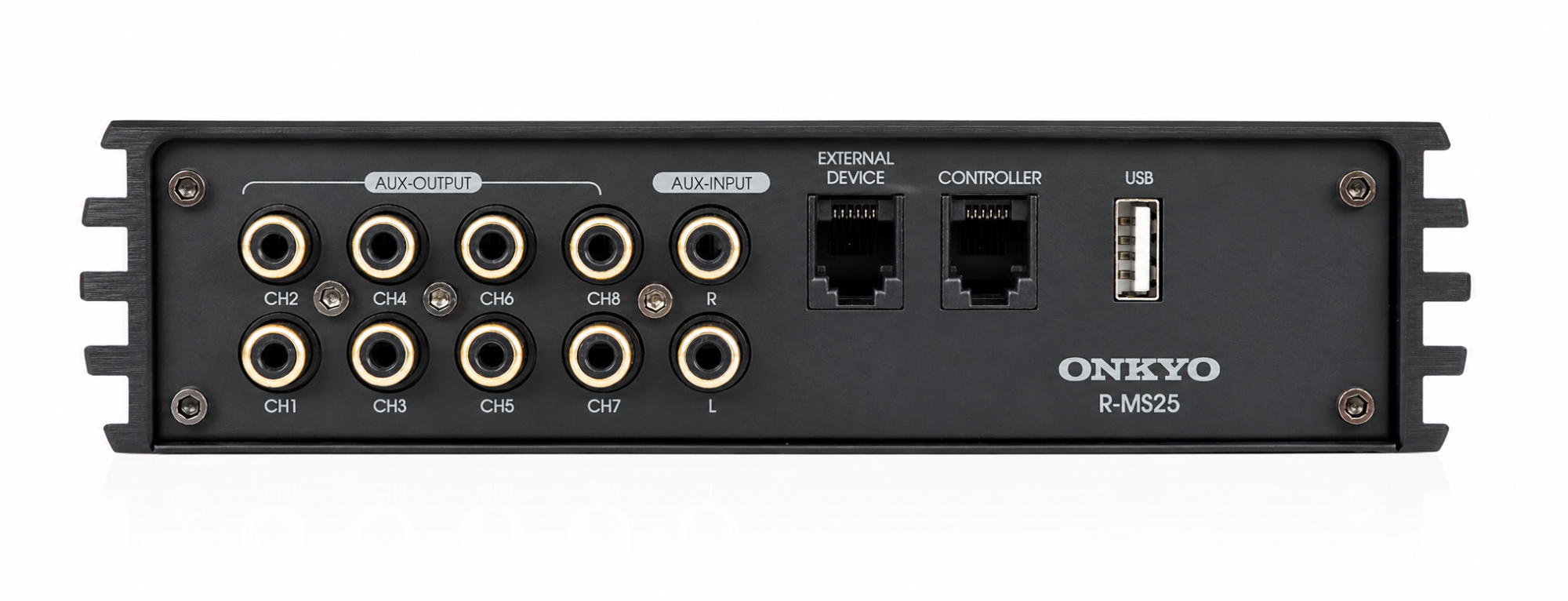
The Onkyo R-MS25 is a compact 4-channel amplifier with an integrated 8-channel DSP processor, offering significantly broader configuration and system-expansion options than the base R-MS10 model. The built-in amplifier provides 4 × 25 W RMS and the unit also offers eight processed RCA outputs for connecting additional power amplifiers. The input section includes four high-level inputs for easy connection to factory head units and two low-level RCA inputs. The full-featured DSP processor features a 31-band parametric equalizer for each output channel, active crossovers, time alignment and phase control. The equipment also includes built-in Bluetooth 5.3 and a USB player. As a result, the R-MS25 can serve both as a simple DSP amplifier to upgrade factory audio and as the control center of a larger system with external amplifiers. Despite its eight DSP channels, the R-MS25 retains a compact design. The aluminum chassis measures only 180 × 112 × 43 mm and weighs approximately 0.75 kg. Low standby consumption of up to 0.1 W allows easy installation even in modern vehicles.
8kanálový DSP s 31pásmovým ekvalizérem
The main advantage of the R-MS25 is its eight output DSP channels, which allow independent tuning of individual speakers or amplifiers in the system. Each channel offers a fully parametric 31-band equalizer spanning 20 Hz to 20 kHz, gain ±12 dB and a Q-factor range of 0.3 to 50. For accurate sound staging there are time alignment options up to 25 ms, which corresponds to approximately 850 cm, and an individual 0° / 180° phase switch for each output.
Aktivní výhybky s širokými možnostmi nastavení
Each output channel is equipped with separate high-pass and low-pass filters. You can choose Butterworth, Linkwitz or Bessel characteristics and set the filter slope from 6 to 48 dB/oct. The R-MS25 therefore allows not only a classic front/rear speaker configuration but also fully active multi-way systems with precisely defined operating ranges for each driver.
Vestavěný zesilovač a 8kanálové RCA výstupy
The integrated 4-channel amplifier provides 4 × 25 W RMS and up to 4 × 50 W. For a basic factory audio upgrade, installing an additional power amplifier is not necessary. If higher power or a more extensive active system is required, there are eight processed RCA outputs with a maximum level of up to 5.6 Vpp. The R-MS25 can thus grow with the audio system over time.
Snadná integrace do továrního systému
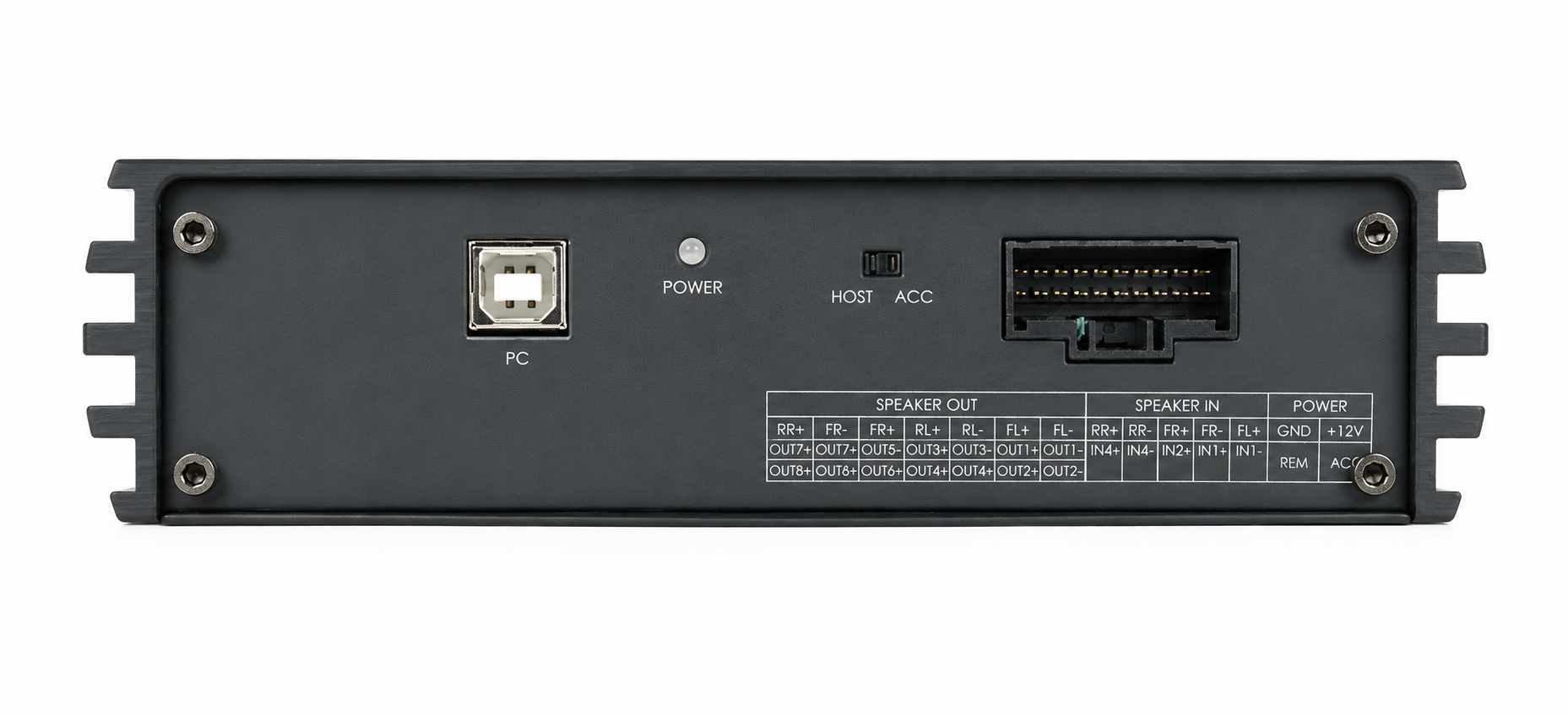
The 4-channel high-level input allows direct connection to the speaker outputs of a factory head unit and supports input signals up to 26 Vpp. There are also two low-level RCA inputs for connecting an aftermarket head unit or additional source. Automatic turn-on can be achieved via high-level signal detection or the ACC wire, and a Remote Out enables simultaneous switching of other system components.
Bluetooth 5.3, USB a několik možností ovládání
The Onkyo R-MS25 features built-in Bluetooth 5.3 for wireless music streaming and a USB input supporting MP3, WMA, FLAC and WAV formats. DSP settings can be made via PC software, a mobile app or a compatible LCD control panel. Up to six separate sound presets can be stored in internal memory.
Hlavní vlastnosti
- 4kanálový zesilovač s integrovaným 8kanálovým DSP procesorem.
- Výkon 4 × 25 W RMS, maximálně 4 × 50 W.
- 4kanálový vysokourovňový vstup pro integraci továrního autorádia.
- 2kanálový nízkoúrovňový RCA vstup.
- 8kanálový procesovaný RCA výstup.
- Výstupní úroveň RCA až 5,6 Vpp.
- 31pásmový parametrický ekvalizér pro každý výstupní kanál.
- Aktivní výhybky HPF / LPF s filtry Butterworth, Linkwitz a Bessel.
- Nastavitelná strmost filtrů od 6 do 48 dB/okt.
- Časové korekce až do 25 ms / 850 cm.
- Nastavení fáze 0° / 180°.
- Možnost uložení až 6 DSP presetů.
- Vestavěný Bluetooth 5.3.
- USB přehrávání MP3, WMA, FLAC a WAV.
- Ovládání pomocí PC softwaru, mobilní aplikace nebo LCD ovladače.
- Automatické zapnutí prostřednictvím High-Level signálu nebo ACC.
- Remote Out pro spínání externích zařízení.
- Kompaktní hliníkové šasi.
| Catalog number | R-MS25 |
| Brand | Onkyo |
| Links | Official web presentation |
| Energy class of the amplifierAmplifiers are divided into two basic classes: analog and digital . Analog amplifiers (A/B) have higher consumption requirements, but usually have a more natural sound. Digital amplifiers (D) have significantly lower consumption and higher efficiency, but the sound may not be as faithful as with classic analog amplifiers. | D |
| Number of amplifier channelsAmplifiers are divided into: - Monoblocks - 2-channel - 3-channel - 4-channel - 5-channel - 6-channel - multi-channel Each channel is used to power one speaker for the coaxial type, or one side if they are component speakers. Monoblock type amplifiers are mainly used for subwoofers. 2-channel are suitable for both subwoofers and, for example, the front pair of speakers in a car. 3-channel is used for front or rear speakers + subwoofer. 4-channel are used for front + rear speakers or 1 pair of speakers + subwoofer. 6 or 5-channel are used for 2 pairs of speakers + subwoofer, most often. Bridging means connecting the amplifier to a bridge, using the + pole from one channel and the - pole from the other channel. In most cases this is shown as "BRIDGED" on the amplifier. | 4 |
| RMS power into 4 ΩRMS power when loading speakers or subwoofer at 4 Ω. RMS power is the constant power of the amplifier and is one of the most important parameters when choosing an amplifier. | 4 x 25 W |
| Max. (maximum) power at 4 ΩPeak performance "Max." , which the amplifier can develop for a very short time. A relatively unimportant parameter. It is mainly a marketing move to attract customers to high numbers. | 4 x 50 W |
| Frequency rangeThe ability of the amplifier to reproduce the signal from the lowest frequency to the highest = faithfully reproduce the sound in a specific frequency band. Professionally: In the frequency range from 40 to 16,000 Hz, the vast majority of fundamental and overtones (harmonics) of all musical instruments are found. We are interested in the course of the radiated sound pressure in this range of frequencies when the loudspeaker system is supplied with constant power. We call this course the frequency characteristic, which tells us the level of radiated sound pressure in decibels (dB) depending on the frequency. The frequency characteristic of a speaker or speaker system can be expressed most succinctly with a graph. Mostly, however, the frequency characteristic is indicated by indicating the maximum tolerance of the sound pressure in the given frequency range, e.g. 50 to 15,000 Hz -+ 6 dB. Since the frequency characteristics of loudspeakers and systems in general are quite uneven, some manufacturers do not even specify this maximum tolerance of sound pressure in decibels in their catalogs for reasons of prestige. Data impoverished in this way is unfortunately worthless. What is valid is that the manufacturer offers a speaker system with a frequency range of 30 to 20,000 Hz, if he is worried about stating the maximum unevenness of the sound pressure in this range, because he can have a tolerance of, for example, +- 20 dB. The unevenness or undulation of the frequency curve in good speaker systems for high-quality music performance should not exceed +-3 dB in the 80 to 12,000 Hz band and +-6 dB in the 40 to 16,000 Hz band. Greater unevenness already depletes or emphasizes certain tonal areas, which can cause audible or even disturbing distortion. The proportion between fundamental tones and higher harmonics also changes, thereby changing the color of the sound, and individual musical instruments as well as the entire musical image sound unnatural. | 20 - 20000 Hz |
| Harmonic Distortion (THD)Total harmonic distortion indicates how much the input signal is distorted in the amplifier. Distortions appear as overtones contained in the output signal. The proportion of originally absent parts of the signal is given as a percentage, typical values are between 0.001% and 0.5%. Distortion is measured in their power band. If it exceeds the limit of 0.7% from a certain power, it is the value of the output power of the given amplifier, from which it no longer plays without distortion and from which the distortion usually increases steeply, so that no further increase in power can be counted on. The lower the value, the better. | < 0.1 % |
| Signal-to-noise ratioThe signal-to-noise ratio means that the output signal always contains noise. The signal-to-noise ratio expresses how much of this noise is compared to the useful signal. The so-called A value is given, which does not take deep and very high frequencies into account. This corresponds to the characteristic of human hearing, which is not so sensitive to deep frequencies, especially below 1 kHz. The higher the value, the better the amplifier is. | > 98 dB |
| Inputs | 4 × High-Level, 2 × RCA, Bluetooth, USB |
| Outputs | 4 × speaker-level, 8 × RCA |
| Input impedance | 240 Ω |
| Phase shiftPhase shift is a linear electronic oscillator that produces a sinusoidal output. It consists of an inverting part of the amplifier such as a transistor. The feedback network "shifts" the phase at the output of the amplifier by 180 degrees to the oscillation frequency and gives positive feedback. The Phase shift filter produces a phase shift that increases with increasing frequency. This is usually used when the subwoofer sub-assembly is out with the magnet, or when two amplifiers are connected externally. Phase Shift is also used with active speaker wiring, where the time shift of the speakers is set. The point is that the subwoofer does not play the bass late, and for this reason better amplifiers offer this phase reversal option. | 0° / 180° |
| Standby power consumption | ≤ 0.1 W |
| On-board voltage rangeThe ability of the amplifier to operate at a specified voltage. As the voltage decreases, so does the power of the amplifier. The ideal voltage in a car is between 13.8 and 14.4 V. | 9 – 16 V |
| High level inputsThe high-level input on the amplifier allows connection directly to the existing speakers in the car without additional purchase of an external high/low adapter. Important equipment in the case of installing an amplifier on an original car radio. | Yes |
| Automatic on and offThis function allows you to automatically switch on the amplifier. | Yes |
| Integrated DSP processor | Yes |
| Number of DSP processor channels | 8 |
| Output equalizer | 31-band parametric EQ |
| Filters | HPF / LPF |
| Filter types and slope | Butterworth / Linkwitz / Bessel, 6–48 dB/oct |
| Input for wired remote controlIf the amplifier has a remote control input. | Yes |
| Remote control included in the packageSome models of amplifiers also come with wired remote controls in the package, which on one side plug into the amplifier and on the other side you have a potentiometer that you can place anywhere in the cabin. A common place to place the remote control is under the steering wheel. The advantage is the regulation of power, and therefore volume, depending on driving conditions and the mood of the crew in the car. | No |
| Dimensions of the amplifier | 180 × 112 × 43 mm |
| Mass | 0.75 Kg |
| Other | Bluetooth 5.3, USB playback, 6 presets, time correction 0–25 ms / 0–850 cm |