
Amplifier with DSP processor Musway D8v4
More about the product
- You can return the goods to us within 14 days
Amplifier with DSP processor Musway D8v4
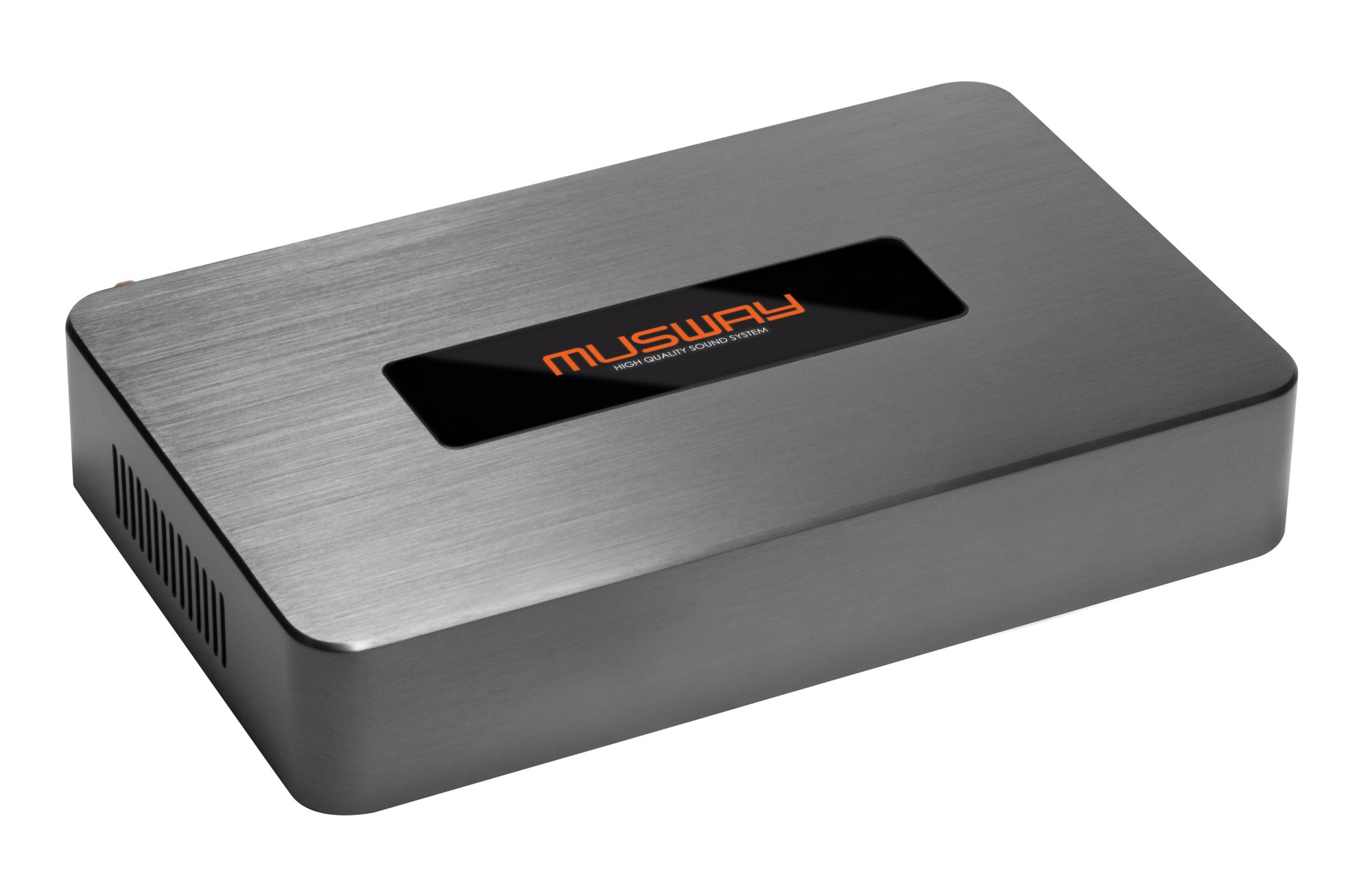
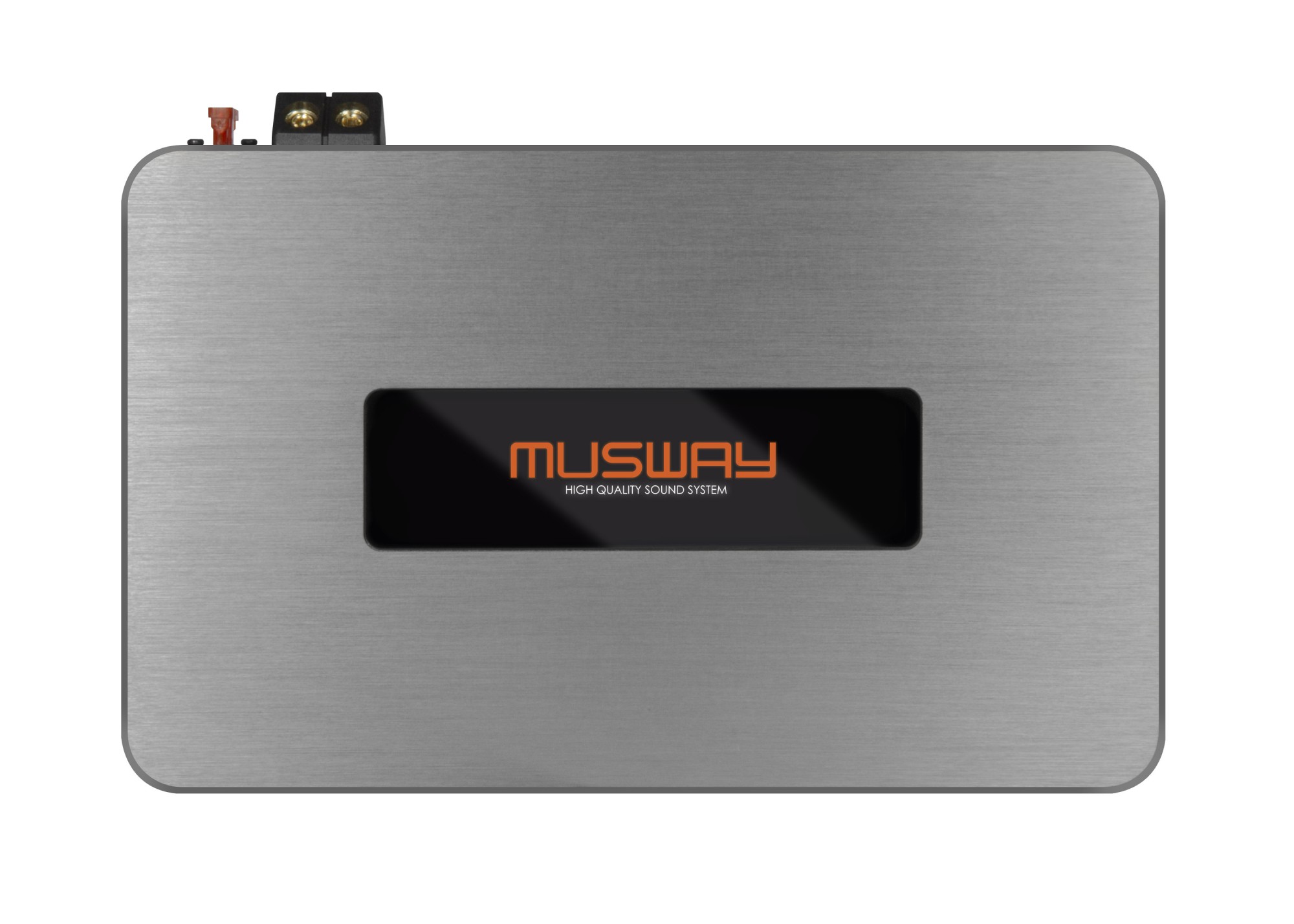
Musway D8v4 is an extremely compact 8-channel amplifier with an integrated DSP processor, representing an ideal solution for installations with limited space where a combination of power, flexibility and easy integration is required. Compared to conventional DSP amplifiers, it stands out primarily for its minimal dimensions, which allow it to be placed even in very tight spaces without compromising on power or functionality. The latest generation delivers a significant increase in power while maintaining a compact chassis, achieved through the use of modern power chips and optimization of the overall design. Full compatibility with modern vehicles is a given, including high-level inputs with EPS®, automatic turn-on and wide connectivity.
Compact solution with surprising power
The D8 is among the smallest 8-channel DSP amplifiers on the market, yet it offers performance that exceeds expectations in real-world use. In laboratory measurements it reaches approximately 8 × 82 W RMS at 4 Ω and up to 8 × 142 W RMS at 2 Ω, which represents a significant step forward compared to previous generations. Because of this, the amplifier is suitable both for active systems and for more powerful speaker configurations. A total system power exceeding 700 W confirms that despite its small dimensions it is a fully fledged solution for high-quality vehicle audio. Unlike most amplifiers, the D8 uses a specific cooling design with an internal "heatsink tunnel" and active airflow via an integrated fan. This means cooling is not dependent solely on the amplifier chassis, which allowed a significant reduction in size while maintaining stable power even under high loads.
DSP tuning and flexible configuration
At the heart of the amplifier is the proven Analog Devices ADAU1452 DSP processor combined with Burr-Brown converters, ensuring stable and accurate signal processing. The DSP offers 10 channels, allowing not only detailed control of all amplifier channels but also connection of an external amplifier via processed outputs. Available is a fully parametric 31-band equalizer for each channel, active crossovers with adjustable slopes up to 48 dB/oct., fine-step time alignment and flexible signal routing. Control is via PC software or a mobile app.
Ready for modern vehicles and advanced integration
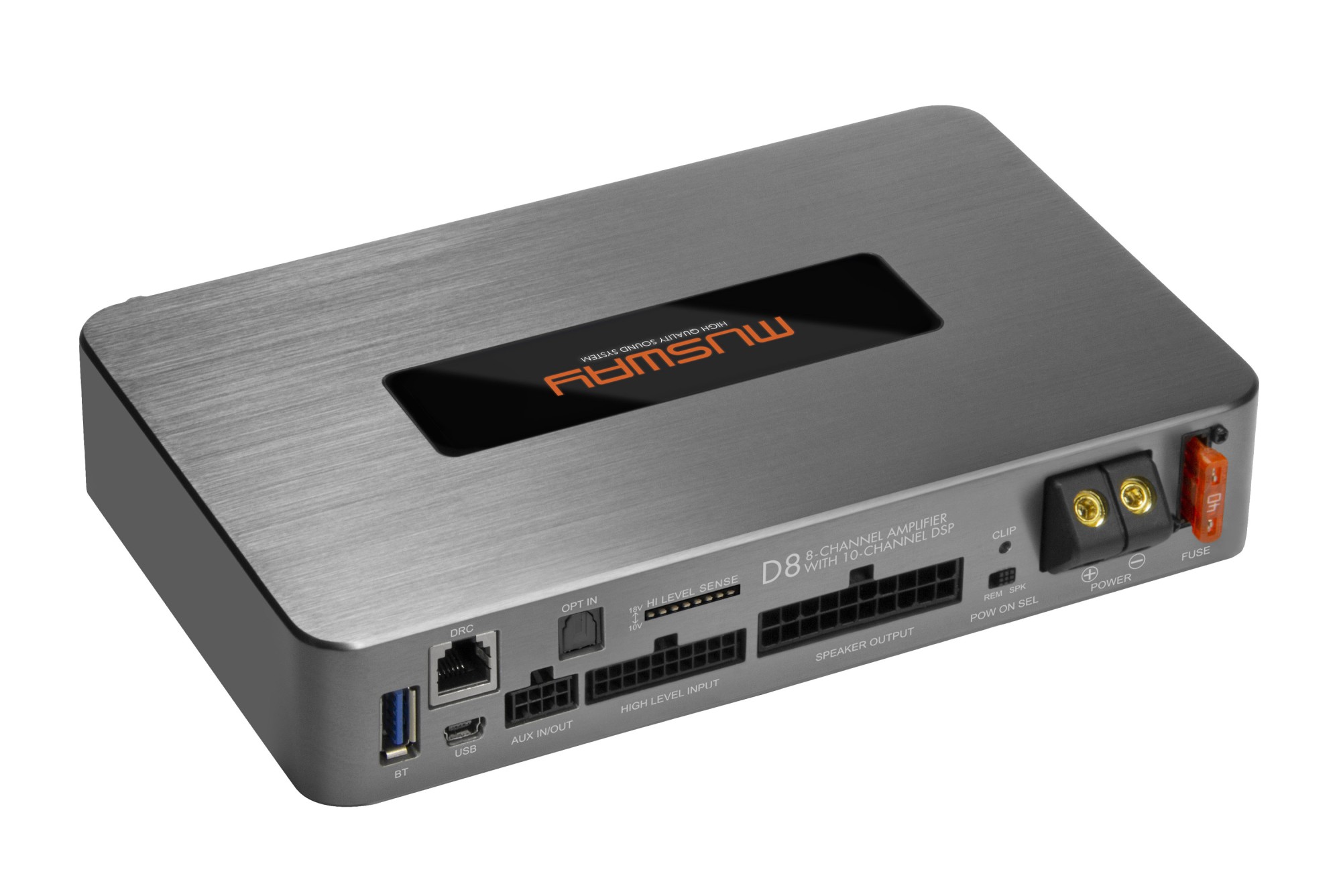
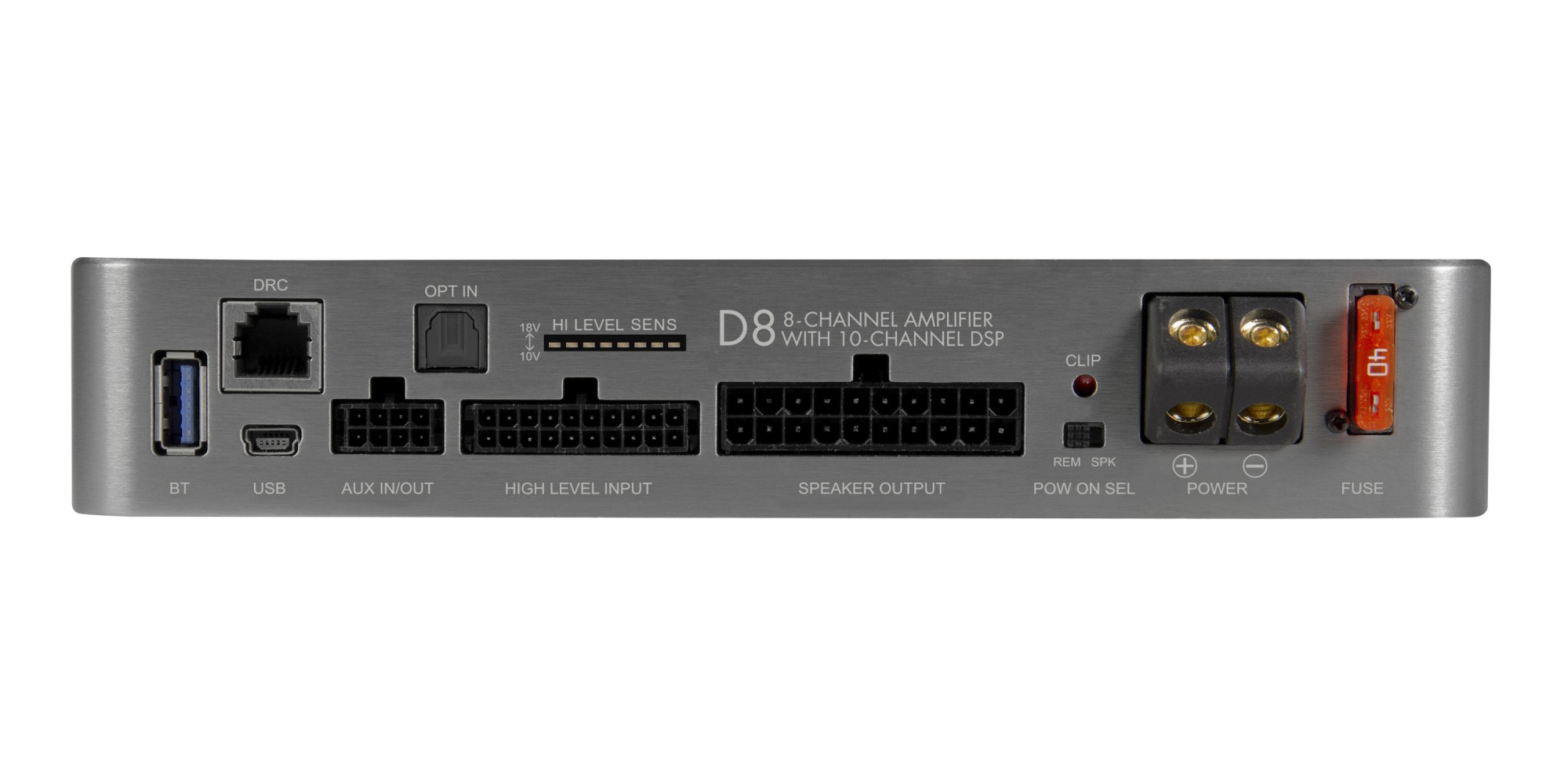
The D8 is designed as a universal DSP amplifier for a wide range of installations. It offers 8-channel high-level inputs with EPS® that handle input voltages up to 18 V and allow direct connection to factory radios. There is also an AUX input and an optical digital input for high-quality digital signal transmission. Automatic turn-on upon signal detection enables installation without a REM wire, while EPS® eliminates vehicle error messages and ensures trouble-free operation even in modern cars.
Awarded in professional tests
Musway D8v4 was tested in Car&Hifi magazine, where it received an excellent rating of 1.1 in the Absolute Spitzenklasse category and the Leistungstipp award. The amplifier was evaluated as a “universal tool” for a wide range of installations, with the test highlighting above all the combination of compact dimensions, solid power and very good equipment. Sound quality was also rated very positively – especially clarity, balance and good dynamics across the entire frequency range. The D8 thus represents an exceptionally successful solution with an excellent price-performance-functionality ratio.
Main features
- 8-channel class D amplifier with integrated 10-channel DSP.
- Power 8 × 70 W RMS at 4 Ω / 8 × 100 W RMS at 2 Ω.
- Dynamic power up to approx. 8 × 125 W RMS at 2 Ω (DHR).
- Burr-Brown converters (PCM3168A) and Analog Devices DSP processor (ADAU1452).
- Dual 32bit DSP technology (330 MHz).
- Fully parametric 31-band equalizer for each channel.
- Active filters up to 48 dB/oct.
- Time alignment and precise level adjustment.
- Freely routable inputs and outputs.
- 8-channel high-level inputs with EPS®.
- AUX input and optical digital input (SPDIF).
- 2-channel processed RCA output.
- Automatic turn-on (Auto Turn-On).
- EPS® fault protection system.
- Option for Bluetooth streaming and app control (optional).
- Support for DRC1 remote control (optional).
About the brand
MUSWAY is an abbreviation of the motto “Music is the Way” – music is the way. The brand was born out of a passion for high-quality sound reproduction and recorded its first notable successes with high-quality Hi-Res audio players and digital signal processors. The real breakthrough came with the introduction of the first class D amplifiers with integrated DSP, which gradually became internationally acclaimed products in specialist magazine tests and received a number of prestigious awards, including EISA. Since 2015 the brand has been development-anchored in Germany, where product design, technical tuning and the final concept of individual models take place. Musway has steadily built a reputation as a manufacturer of compact, technically advanced and at the same time musically natural components that combine modern digital technologies with an emphasis on clean and linear sound. The portfolio today includes standalone and DSP amplifiers, speakers and subwoofers, with each new generation continuing the brand philosophy – to offer the maximum musical experience without compromises in technology, functionality or workmanship.
| Catalog number | D8V4 |
| Brand | Musway |
| Links | Official web presentation |
| Energy class of the amplifierAmplifiers are divided into two basic classes: analog and digital . Analog amplifiers (A/B) have higher consumption requirements, but usually have a more natural sound. Digital amplifiers (D) have significantly lower consumption and higher efficiency, but the sound may not be as faithful as with classic analog amplifiers. | D |
| Number of amplifier channelsAmplifiers are divided into: - Monoblocks - 2-channel - 3-channel - 4-channel - 5-channel - 6-channel - multi-channel Each channel is used to power one speaker for the coaxial type, or one side if they are component speakers. Monoblock type amplifiers are mainly used for subwoofers. 2-channel are suitable for both subwoofers and, for example, the front pair of speakers in a car. 3-channel is used for front or rear speakers + subwoofer. 4-channel are used for front + rear speakers or 1 pair of speakers + subwoofer. 6 or 5-channel are used for 2 pairs of speakers + subwoofer, most often. Bridging means connecting the amplifier to a bridge, using the + pole from one channel and the - pole from the other channel. In most cases this is shown as "BRIDGED" on the amplifier. | 8 |
| RMS power into 4 ΩRMS power when loading speakers or subwoofer at 4 Ω. RMS power is the constant power of the amplifier and is one of the most important parameters when choosing an amplifier. | 8 x 70 / 4 x 200 W |
| RMS power into 2 ΩRMS power when loading speakers or subwoofer at 2 Ω. RMS power is the constant power of the amplifier and is one of the most important parameters when choosing an amplifier. | 8 x 100 W |
| Speaker impedance | 2 – 8 Ω |
| Frequency rangeThe ability of the amplifier to reproduce the signal from the lowest frequency to the highest = faithfully reproduce the sound in a specific frequency band. Professionally: In the frequency range from 40 to 16,000 Hz, the vast majority of fundamental and overtones (harmonics) of all musical instruments are found. We are interested in the course of the radiated sound pressure in this range of frequencies when the loudspeaker system is supplied with constant power. We call this course the frequency characteristic, which tells us the level of radiated sound pressure in decibels (dB) depending on the frequency. The frequency characteristic of a speaker or speaker system can be expressed most succinctly with a graph. Mostly, however, the frequency characteristic is indicated by indicating the maximum tolerance of the sound pressure in the given frequency range, e.g. 50 to 15,000 Hz -+ 6 dB. Since the frequency characteristics of loudspeakers and systems in general are quite uneven, some manufacturers do not even specify this maximum tolerance of sound pressure in decibels in their catalogs for reasons of prestige. Data impoverished in this way is unfortunately worthless. What is valid is that the manufacturer offers a speaker system with a frequency range of 30 to 20,000 Hz, if he is worried about stating the maximum unevenness of the sound pressure in this range, because he can have a tolerance of, for example, +- 20 dB. The unevenness or undulation of the frequency curve in good speaker systems for high-quality music performance should not exceed +-3 dB in the 80 to 12,000 Hz band and +-6 dB in the 40 to 16,000 Hz band. Greater unevenness already depletes or emphasizes certain tonal areas, which can cause audible or even disturbing distortion. The proportion between fundamental tones and higher harmonics also changes, thereby changing the color of the sound, and individual musical instruments as well as the entire musical image sound unnatural. | 15 – 20000 Hz |
| Harmonic Distortion (THD)Total harmonic distortion indicates how much the input signal is distorted in the amplifier. Distortions appear as overtones contained in the output signal. The proportion of originally absent parts of the signal is given as a percentage, typical values are between 0.001% and 0.5%. Distortion is measured in their power band. If it exceeds the limit of 0.7% from a certain power, it is the value of the output power of the given amplifier, from which it no longer plays without distortion and from which the distortion usually increases steeply, so that no further increase in power can be counted on. The lower the value, the better. | 0.01 % |
| Signal-to-noise ratioThe signal-to-noise ratio means that the output signal always contains noise. The signal-to-noise ratio expresses how much of this noise is compared to the useful signal. The so-called A value is given, which does not take deep and very high frequencies into account. This corresponds to the characteristic of human hearing, which is not so sensitive to deep frequencies, especially below 1 kHz. The higher the value, the better the amplifier is. | 95 dB |
| Inputs | 8 x high-level, AUX, SPDIF |
| Outputs | 2 x RCA, 8 x speaker-level |
| Input sensitivityIn order for the amplifier to perform its function correctly, it requires an input signal of a certain level, which is different for car radios. It is measured in "Volts" (e.g. 2 V, 4 V, etc.) The higher the value at the output of the pre-amplifier, or car radio, the less demands are placed on the power of the amplifier. However, the amplifier must allow this input sensitivity, and for that reason this value is also given for the amplifier. | High-level: 3.5 V – 18 V, RCA: 1.5 V – 4.5 V |
| Input impedance | 13 Ω (High-level), 47 kΩ (RCA) |
| Damping factorDF - Damping Factor . It is the ratio of the load (repro + cables, crossover, etc.) to the internal resistance of the amplifier. The bigger the DF, the more controlled the bass. Amplifiers with a lower DF tend to hum. Subwoofers with a higher Q in the bass reflex and sometimes in the enclosure will also cause humming. | > 70 |
| Standby power consumption | 1.5 A |
| On-board voltage rangeThe ability of the amplifier to operate at a specified voltage. As the voltage decreases, so does the power of the amplifier. The ideal voltage in a car is between 13.8 and 14.4 V. | 7.6 – 17.3 V |
| The value of the fuses on the amplifierFrom the value of the fuses on the amplifier, you can get a true picture of the real performance of the amplifier. | 1 x 40 A |
| High level inputsThe high-level input on the amplifier allows connection directly to the existing speakers in the car without additional purchase of an external high/low adapter. Important equipment in the case of installing an amplifier on an original car radio. | Yes, with EPS function |
| Automatic on and offThis function allows you to automatically switch on the amplifier. | Yes |
| Integrated DSP processor | Yes |
| Number of DSP processor channels | 10 |
| Output equalizer | 31-band parametric |
| Filters | Full / High Pass / Low Pass / Band Pass |
| Filter types and slope | Bessel / Butterworth / Linkwitz @ 12/18/24/30/36/42/48 dB |
| Socket input terminalsFerrule terminals allow better wiring contact to the amplifier. It is also a more secure form of terminals. If you are tightening the sleeve terminals, we recommend retightening them after 1 day, as the connected cable gradually compresses. | Yes |
| Input for wired remote controlIf the amplifier has a remote control input. | Yes |
| Remote control included in the packageSome models of amplifiers also come with wired remote controls in the package, which on one side plug into the amplifier and on the other side you have a potentiometer that you can place anywhere in the cabin. A common place to place the remote control is under the steering wheel. The advantage is the regulation of power, and therefore volume, depending on driving conditions and the mood of the crew in the car. | No |
| Dimensions of the amplifier | 205 x 37 x 127 mm |
| Mass | 1.5 Kg |