
Amplifier Hifonics Mercury IV/800 EVO
More about the product
- You can return the goods to us within 14 days
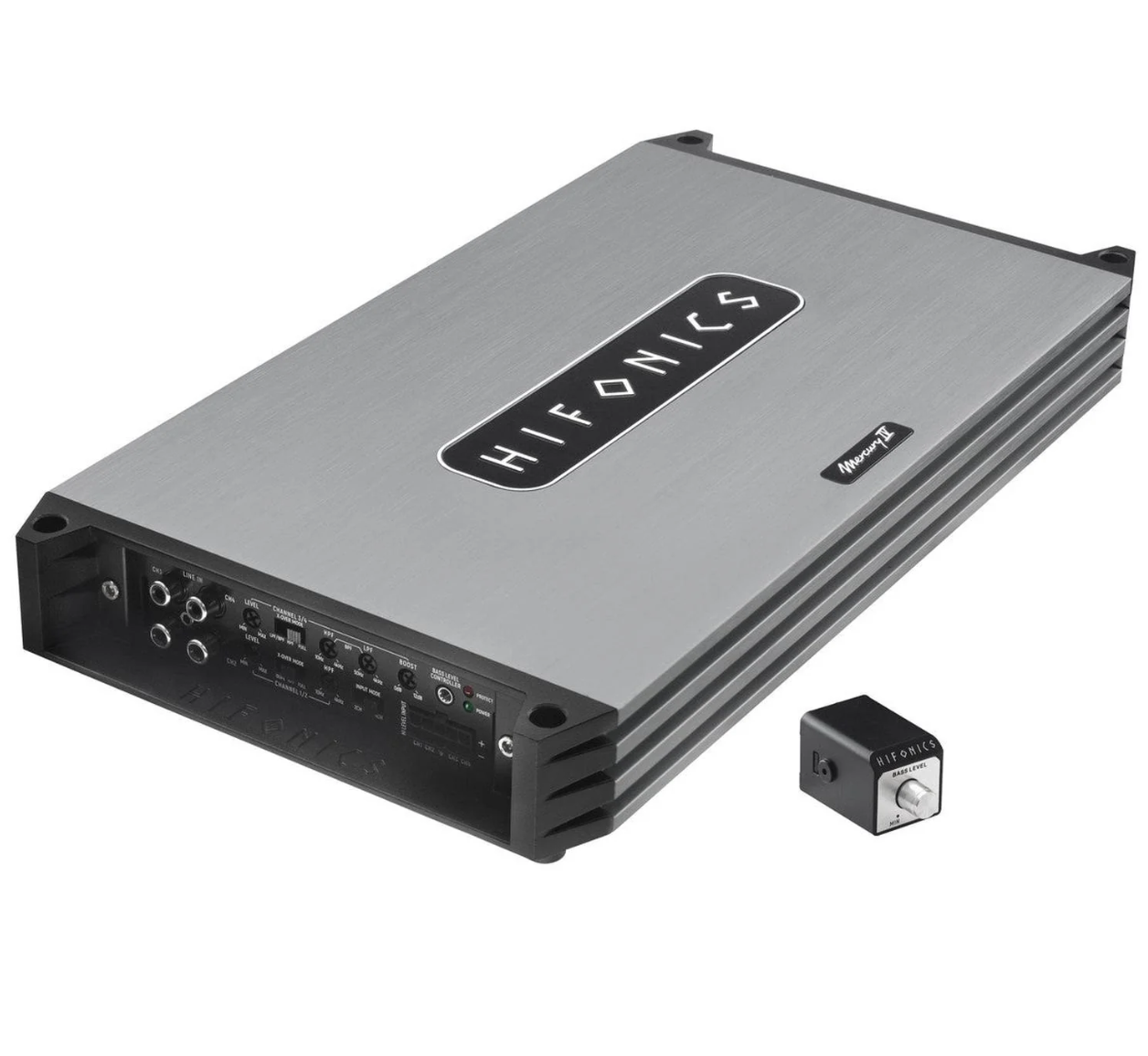
Amplifier Hifonics Mercury IV/800 EVO
For those seeking a powerful 4-channel amplifier, the new MERCURY EVO series is worth a closer look. With the new MERCURY IV/800 EVO model, HiFonics expands its range with a true powerhouse. Right upon unboxing, it's evident: an impressive heatsink weighing 4 kg and nearly 40 cm in length immediately catches the eye. It's quickly clear that you're holding a classic analog amplifier with immense power.
Thanks to its analog Class A/B design and an impressive output of 4 x 200 W RMS, the MERCURY is ideal for energy-demanding front and rear speakers, while also convincing with its excellent sound characteristics. With its enormous power reserve, it can easily be used in bridged mode on channels 3–4 to power subwoofers with 400 W RMS. A practical bass level remote control is also included in the package.
Main Features
- Heavy aluminum heatsink with optimal cooling.
- Casted end parts with hidden mounting channels.
- High efficiency and effective performance.
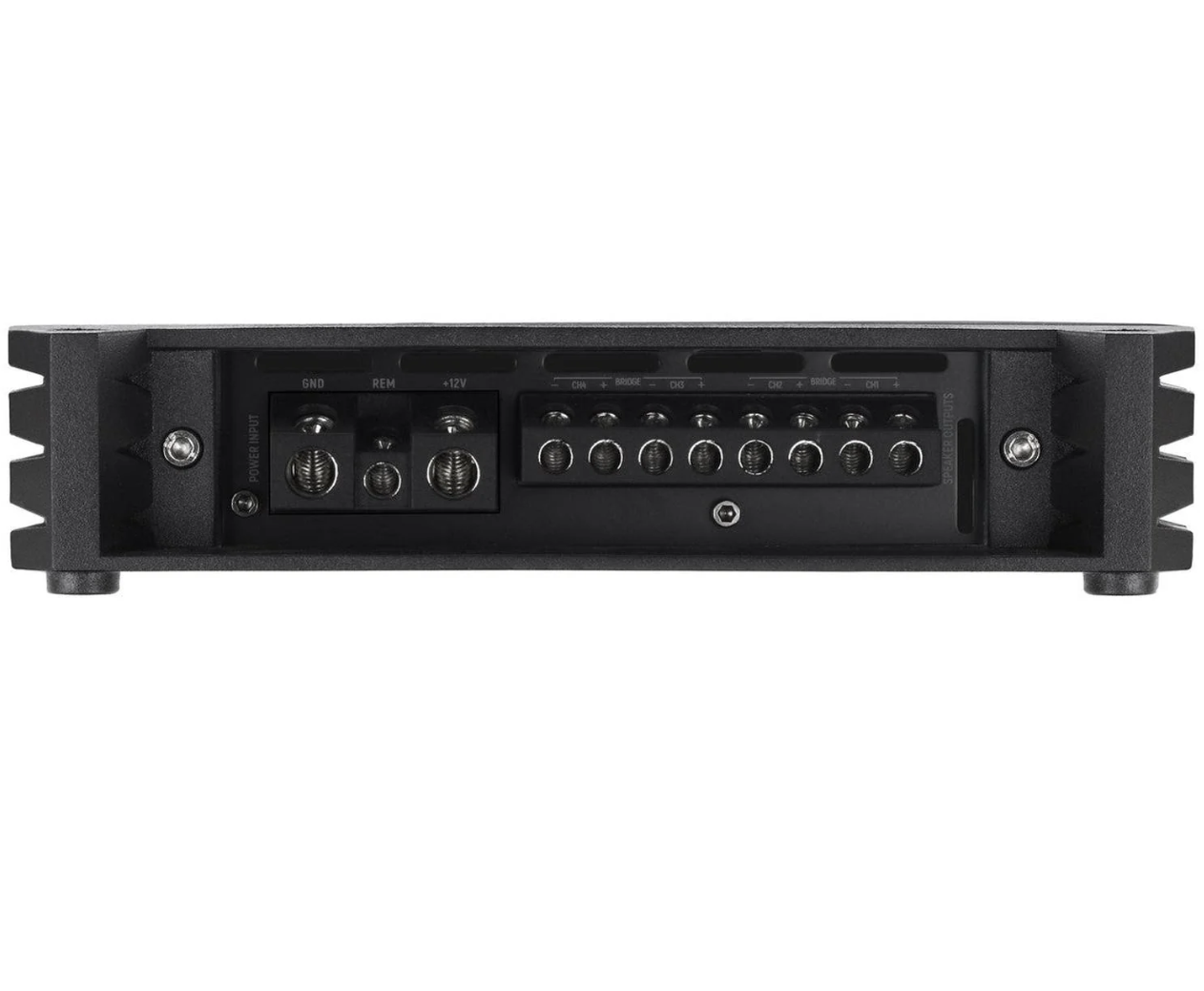
- Encapsulated power and speaker connections.
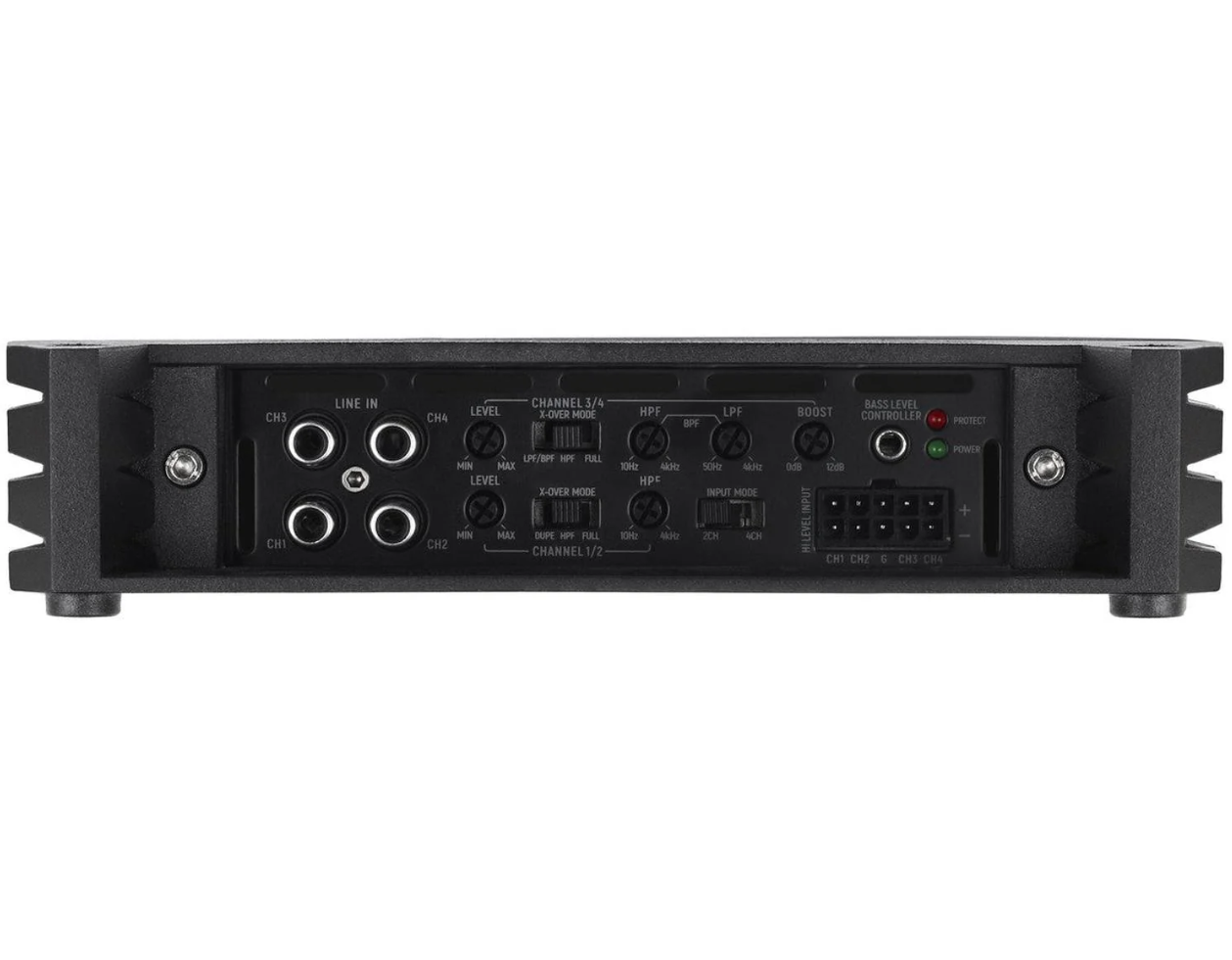
- High-level inputs with EPS® (Error Protection System).
- Automatic turn-on function.
- Bass level remote control.
| Catalog number | MERCURY IV/800 EVO |
| Brand | Hifonics |
| Links | Official web presentation |
| Energy class of the amplifierAmplifiers are divided into two basic classes: analog and digital . Analog amplifiers (A/B) have higher consumption requirements, but usually have a more natural sound. Digital amplifiers (D) have significantly lower consumption and higher efficiency, but the sound may not be as faithful as with classic analog amplifiers. | A/B |
| Number of amplifier channelsAmplifiers are divided into: - Monoblocks - 2-channel - 3-channel - 4-channel - 5-channel - 6-channel - multi-channel Each channel is used to power one speaker for the coaxial type, or one side if they are component speakers. Monoblock type amplifiers are mainly used for subwoofers. 2-channel are suitable for both subwoofers and, for example, the front pair of speakers in a car. 3-channel is used for front or rear speakers + subwoofer. 4-channel are used for front + rear speakers or 1 pair of speakers + subwoofer. 6 or 5-channel are used for 2 pairs of speakers + subwoofer, most often. Bridging means connecting the amplifier to a bridge, using the + pole from one channel and the - pole from the other channel. In most cases this is shown as "BRIDGED" on the amplifier. | 4 |
| RMS power into 4 ΩRMS power when loading speakers or subwoofer at 4 Ω. RMS power is the constant power of the amplifier and is one of the most important parameters when choosing an amplifier. | 4 x 125 / 2 x 400 W |
| RMS power into 2 ΩRMS power when loading speakers or subwoofer at 2 Ω. RMS power is the constant power of the amplifier and is one of the most important parameters when choosing an amplifier. | 4 x 200 W |
| Inputs | RCA |
| High pass filter (HPF)HPF / HP or The "hi pass filter" offers the option of setting the amplifier using a potentiometer so that medium, possibly mid-bass and treble frequencies play upwards from a certain frequency. Example: Amplifiers most often have an HPF from 40 to 300 Hz. If we set the potentiometer to a value of approx. 150 Hz, the sound will be clipped so that it plays frequencies from 150 Hz up to the maximum upper limit of the entire frequency range of the amplifier, perhaps up to 20,000 Hz. We recommend setting this potentiometer in the range of 80-160 Hz. Thanks to this setting option, the speakers can handle a higher performance, as you will not overload them with bass in the lower frequency range. | 10 - 4000 Hz |
| Low-pass filter (LPF)LPF / LP or "low pass filter" offers the possibility to adjust the amplifier using a potentiometer so that the lower band plays only the frequencies in a certain band that you need. This filter is used to adjust the frequency range for the subwoofer, so that it does not overload or distort the sound. Example: Amplifiers most often have an LPF from 20 to 300 Hz. We recommend setting this potentiometer in the range of 45-80 Hz. | 50 - 4000 Hz |
| Bass boostBass boost or bass enhancement. With this function, the bass itself can be emphasized, at a high level of bass boost, the speakers and the subwoofer can distort a lot and the sound will be worse than better. We therefore recommend using the "bass boost" function wisely. With maximum use of bass boost, there is a risk of damage to the speakers and thus to the subwoofer. | 0-12 dB |
| Socket input terminalsFerrule terminals allow better wiring contact to the amplifier. It is also a more secure form of terminals. If you are tightening the sleeve terminals, we recommend retightening them after 1 day, as the connected cable gradually compresses. | Yes |
| Remote control included in the packageSome models of amplifiers also come with wired remote controls in the package, which on one side plug into the amplifier and on the other side you have a potentiometer that you can place anywhere in the cabin. A common place to place the remote control is under the steering wheel. The advantage is the regulation of power, and therefore volume, depending on driving conditions and the mood of the crew in the car. | Yes |
| Dimensions of the amplifier | 205 x 46 x 388 mm |
Evaluation
You might also be interested
 TipQuick preview4-channel amplifier, 4 x 65 / 2 x 180 W RMS (4 Ω) / 4 x 90 W RMS (2 Ω)139,00 EURIn stockGladen RC 70c4 G2 Free transport
 Quick preview4-channel, 4 x 68 / 2 x 210 W RMS into 4 Ω, class A/B219,00 EURIn stockGladen RC 105c4 G2 Free transport
 Quick preview4-channel, 4 x 10⁵ / 2 x 300 W RMS into 4 Ω, class A/B269,00 EURIn stock