
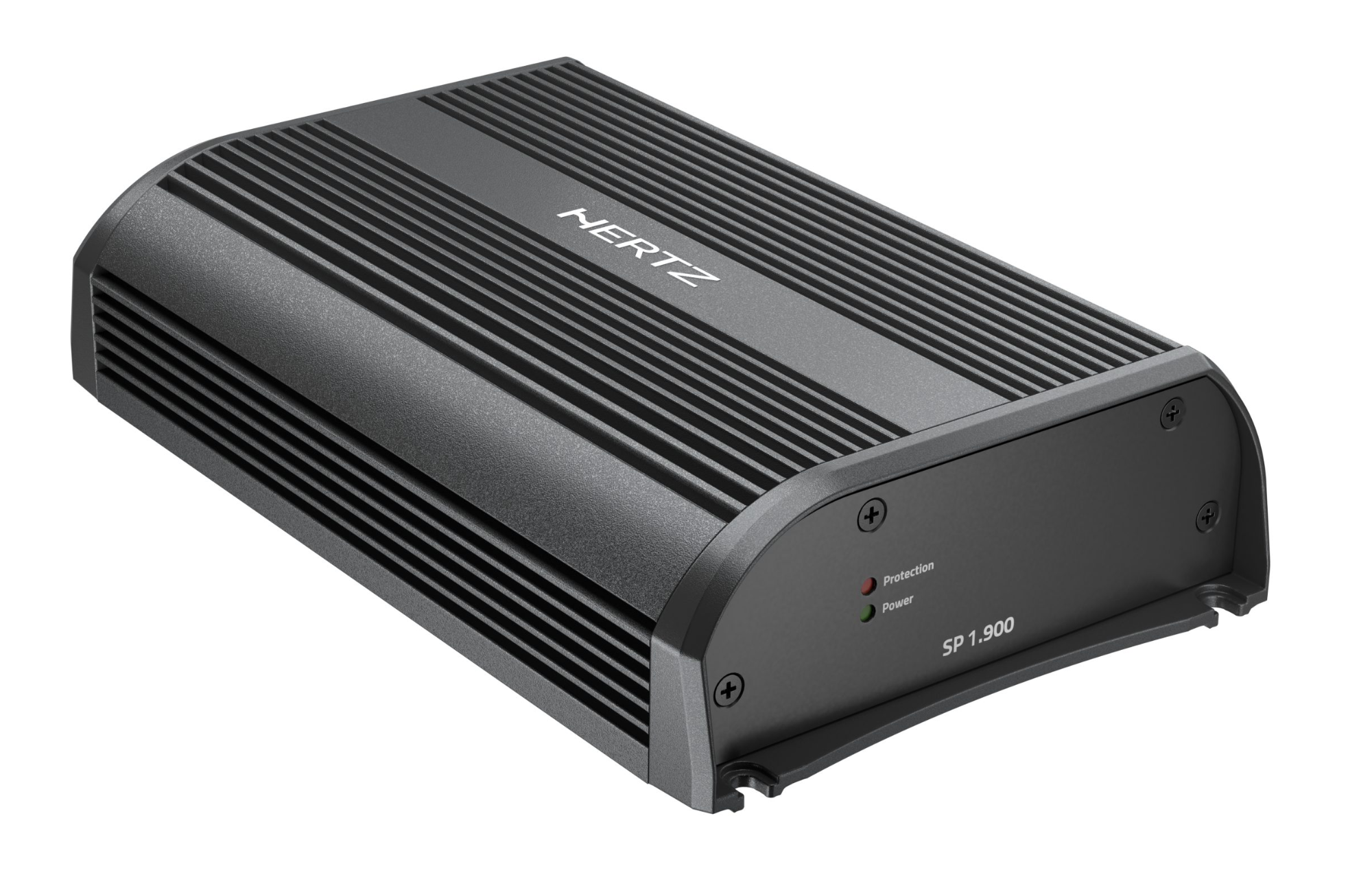
Amplifier Hertz SP 1.900
1-channel amplifier, 1 x 600 / 1000 / 1000 W RMS (4 / 2 / 1 Ω), class D
More about the product
More about the product
We will help you with your purchase
- You can return the goods to us within 14 days
Updated


Amplifier Hertz SP 1.900
The mono amplifier Hertz SP 1.900 features the Hertz ADC (Advanced D-Class) output stage, achieving an efficiency of up to 87%. A maximum RMS power of 1000 W is available at 2 Ω and remains stable even at 1 Ω. Being an ultra-compact amplifier (211.6 x 130 x 49 mm) with impressive power, the SP 1.900 is an ideal choice for motorcycle mounting, under-seat installation in sports cars, and behind-seat installation in trucks.Main Features
- Up to 87% efficiency thanks to the ADC (Advanced D-Class) stable 1 Ω output stage, ensuring high sound performance in a compact size.
- USS (Universal Speakers Simulators) allows the SP 1.900 to work with head units equipped with a "speaker load detection" circuit.
- 1000 W RMS (1 Ω) with an ultra-compact size of 211.6 x 130 x 49 mm.
- Aluminum chassis IP55 for maximum protection against moisture and external influences.
- No cooling fan to prevent internal buildup of dirt.
- Sealed power cable, line inputs, and speaker outputs to prevent oxidation.
- Cross filters and controls on one side to facilitate calibration during product installation.
- Balanced, fully differential inputs for high noise suppression.
- ART (Automatic Remote Turn-On/Off) automatically turns the amplifier on/off when the OEM head unit is turned on/off (can be enabled/disabled).
- 24 dB continuously adjustable (50 to 250 Hz) subwoofer Lo-Pass filter.
- SUBSONIC filter (24 dB – 25 Hz), removes very low infrasonic frequencies from music signals to prevent subwoofer damage.
- Optional HRC BM remote volume control provides the ability to adjust the subwoofer volume level from the dashboard.
About the Brand
The most well-known European brand in the car hi-fi segment? Hertz audio! Founded in 1998 in Italy, Hertz is part of Elettromedia, which owns Hertz, Audison, and Connection. The name Hertz comes from the unit of frequency, cycles per second (Hz). Everything in Hertz car audio reflects their passion for music and their commitment to quality. Over the years, the company has built an excellent team of talented and dedicated engineers committed to designing products at the highest level. Every new project and product stems from the needs of the brand's fans and is developed to connect them directly to the emotional power of music. The philosophy of Hertz is a unique combination of premium sound, vibrant tradition, innovative design, and high quality, embodied in a complete range of products for maximum customer satisfaction. Hertz offers a complete range of speakers, amplifiers, and subwoofers to let you experience the thrill of high-quality sound in any situation. Their deep knowledge of car interior acoustics, design requirements, and manufacturing processes keeps Hertz products at a high level. To achieve the high-quality standards of Hertz, the company uses the most advanced testing tools for component analysis through a computer-controlled process under the supervision of highly qualified staff, resulting in a negligible complaint rate and high quality of all Hertz products.| Catalog number | SP 1.900 |
| Brand | Hertz |
| Links | Official web presentation |
| Number of amplifier channelsAmplifiers are divided into: - Monoblocks - 2-channel - 3-channel - 4-channel - 5-channel - 6-channel - multi-channel Each channel is used to power one speaker for the coaxial type, or one side if they are component speakers. Monoblock type amplifiers are mainly used for subwoofers. 2-channel are suitable for both subwoofers and, for example, the front pair of speakers in a car. 3-channel is used for front or rear speakers + subwoofer. 4-channel are used for front + rear speakers or 1 pair of speakers + subwoofer. 6 or 5-channel are used for 2 pairs of speakers + subwoofer, most often. Bridging means connecting the amplifier to a bridge, using the + pole from one channel and the - pole from the other channel. In most cases this is shown as "BRIDGED" on the amplifier. | Monoblock |
| Energy class of the amplifierAmplifiers are divided into two basic classes: analog and digital . Analog amplifiers (A/B) have higher consumption requirements, but usually have a more natural sound. Digital amplifiers (D) have significantly lower consumption and higher efficiency, but the sound may not be as faithful as with classic analog amplifiers. | D |
| RMS power into 4 ΩRMS power when loading speakers or subwoofer at 4 Ω. RMS power is the constant power of the amplifier and is one of the most important parameters when choosing an amplifier. | 1 x 600 W |
| RMS power into 2 ΩRMS power when loading speakers or subwoofer at 2 Ω. RMS power is the constant power of the amplifier and is one of the most important parameters when choosing an amplifier. | 1 x 1000 W |
| RMS power into 1 ΩRMS power when the subwoofer is loaded at 1 Ω. RMS power is the constant power of the amplifier and is one of the most important parameters when choosing an amplifier. When connected to 1 Ω, significant heating of the amplifier may occur. | 1 x 1000 W |
| Frequency rangeThe ability of the amplifier to reproduce the signal from the lowest frequency to the highest = faithfully reproduce the sound in a specific frequency band. Professionally: In the frequency range from 40 to 16,000 Hz, the vast majority of fundamental and overtones (harmonics) of all musical instruments are found. We are interested in the course of the radiated sound pressure in this range of frequencies when the loudspeaker system is supplied with constant power. We call this course the frequency characteristic, which tells us the level of radiated sound pressure in decibels (dB) depending on the frequency. The frequency characteristic of a speaker or speaker system can be expressed most succinctly with a graph. Mostly, however, the frequency characteristic is indicated by indicating the maximum tolerance of the sound pressure in the given frequency range, e.g. 50 to 15,000 Hz -+ 6 dB. Since the frequency characteristics of loudspeakers and systems in general are quite uneven, some manufacturers do not even specify this maximum tolerance of sound pressure in decibels in their catalogs for reasons of prestige. Data impoverished in this way is unfortunately worthless. What is valid is that the manufacturer offers a speaker system with a frequency range of 30 to 20,000 Hz, if he is worried about stating the maximum unevenness of the sound pressure in this range, because he can have a tolerance of, for example, +- 20 dB. The unevenness or undulation of the frequency curve in good speaker systems for high-quality music performance should not exceed +-3 dB in the 80 to 12,000 Hz band and +-6 dB in the 40 to 16,000 Hz band. Greater unevenness already depletes or emphasizes certain tonal areas, which can cause audible or even disturbing distortion. The proportion between fundamental tones and higher harmonics also changes, thereby changing the color of the sound, and individual musical instruments as well as the entire musical image sound unnatural. | 10 - 500 Hz |
| Harmonic Distortion (THD)Total harmonic distortion indicates how much the input signal is distorted in the amplifier. Distortions appear as overtones contained in the output signal. The proportion of originally absent parts of the signal is given as a percentage, typical values are between 0.001% and 0.5%. Distortion is measured in their power band. If it exceeds the limit of 0.7% from a certain power, it is the value of the output power of the given amplifier, from which it no longer plays without distortion and from which the distortion usually increases steeply, so that no further increase in power can be counted on. The lower the value, the better. | 0.1 % |
| Signal-to-noise ratioThe signal-to-noise ratio means that the output signal always contains noise. The signal-to-noise ratio expresses how much of this noise is compared to the useful signal. The so-called A value is given, which does not take deep and very high frequencies into account. This corresponds to the characteristic of human hearing, which is not so sensitive to deep frequencies, especially below 1 kHz. The higher the value, the better the amplifier is. | > 95 dB |
| Damping factorDF - Damping Factor . It is the ratio of the load (repro + cables, crossover, etc.) to the internal resistance of the amplifier. The bigger the DF, the more controlled the bass. Amplifiers with a lower DF tend to hum. Subwoofers with a higher Q in the bass reflex and sometimes in the enclosure will also cause humming. | > 300 |
| High pass filter (HPF)HPF / HP or The "hi pass filter" offers the option of setting the amplifier using a potentiometer so that medium, possibly mid-bass and treble frequencies play upwards from a certain frequency. Example: Amplifiers most often have an HPF from 40 to 300 Hz. If we set the potentiometer to a value of approx. 150 Hz, the sound will be clipped so that it plays frequencies from 150 Hz up to the maximum upper limit of the entire frequency range of the amplifier, perhaps up to 20,000 Hz. We recommend setting this potentiometer in the range of 80-160 Hz. Thanks to this setting option, the speakers can handle a higher performance, as you will not overload them with bass in the lower frequency range. | 50 - 250 Hz @ 12 dB/Oct. |
| Low-pass filter (LPF)LPF / LP or "low pass filter" offers the possibility to adjust the amplifier using a potentiometer so that the lower band plays only the frequencies in a certain band that you need. This filter is used to adjust the frequency range for the subwoofer, so that it does not overload or distort the sound. Example: Amplifiers most often have an LPF from 20 to 300 Hz. We recommend setting this potentiometer in the range of 45-80 Hz. | 50 - 250 Hz @ 24 dB/Oct. |
| SubsonicA subsonic filter is essentially a high-pass filter for very low frequencies, typically 45 Hz or lower. Anything below this setting is weakened. The point is that the subwoofer does not go below the subsonic filter setting and does not overload itself with very low frequencies. A useful function, if set correctly, the subwoofer is not overloaded. | 25 Hz @ 24 dB/Oct. |
| Dimensions of the amplifier | 130 x 211.6 x 49 mm |
| Mass | 2.15 kg |
Evaluation
You might also be interested
ask us