
Active subwoofer ESB Audio 3.WB8 G
More about the product
- You can return the goods to us within 14 days
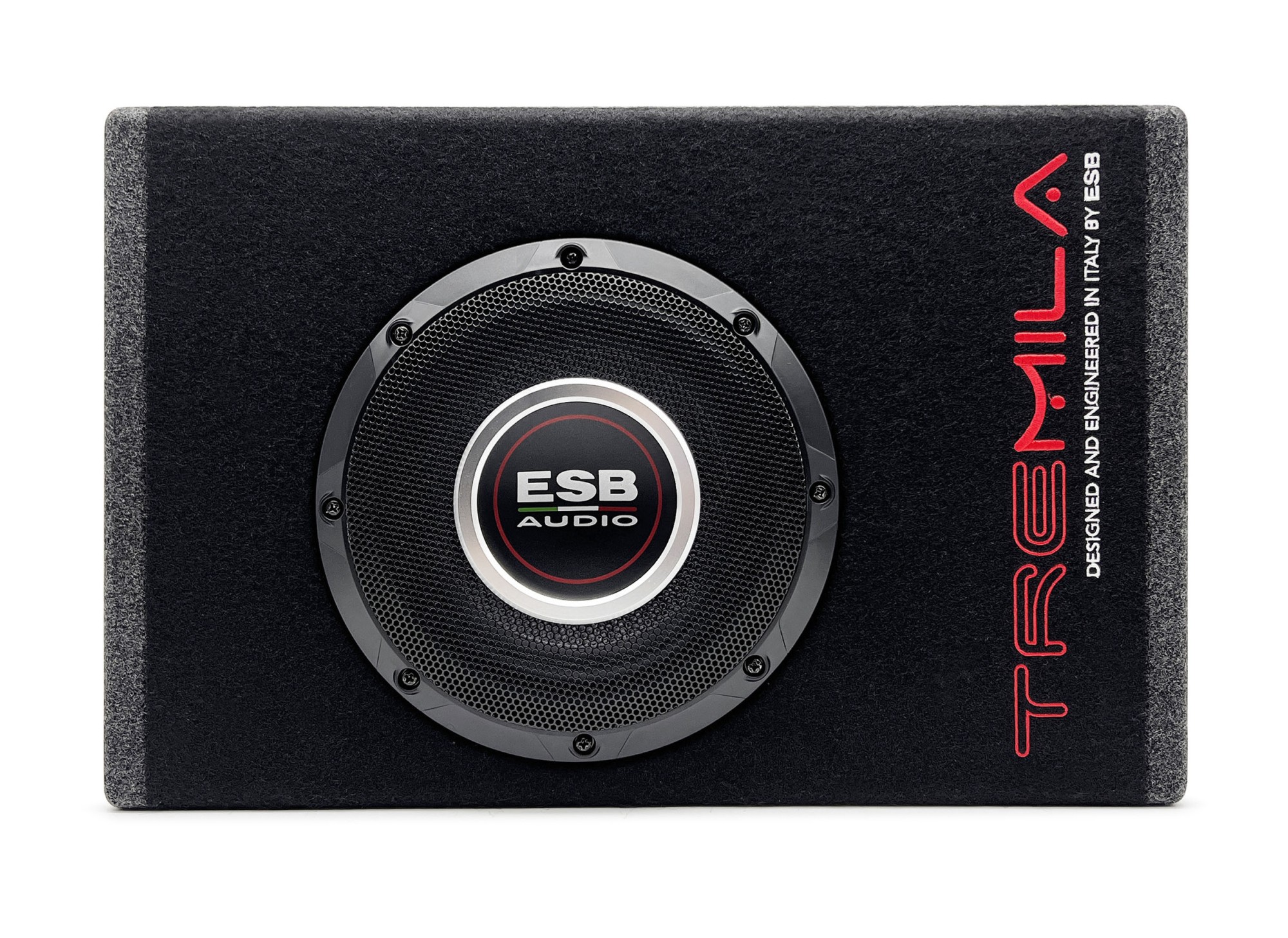
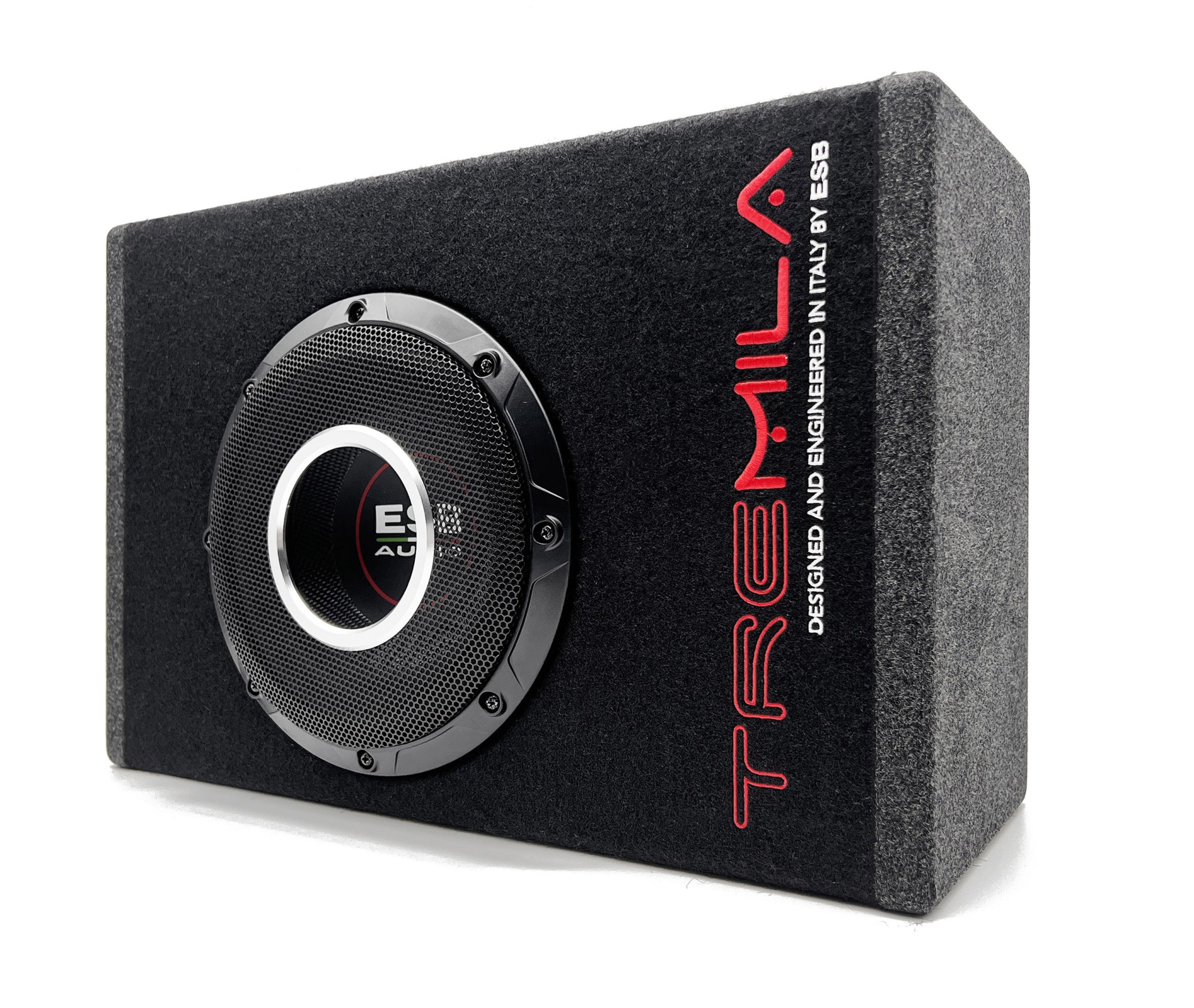
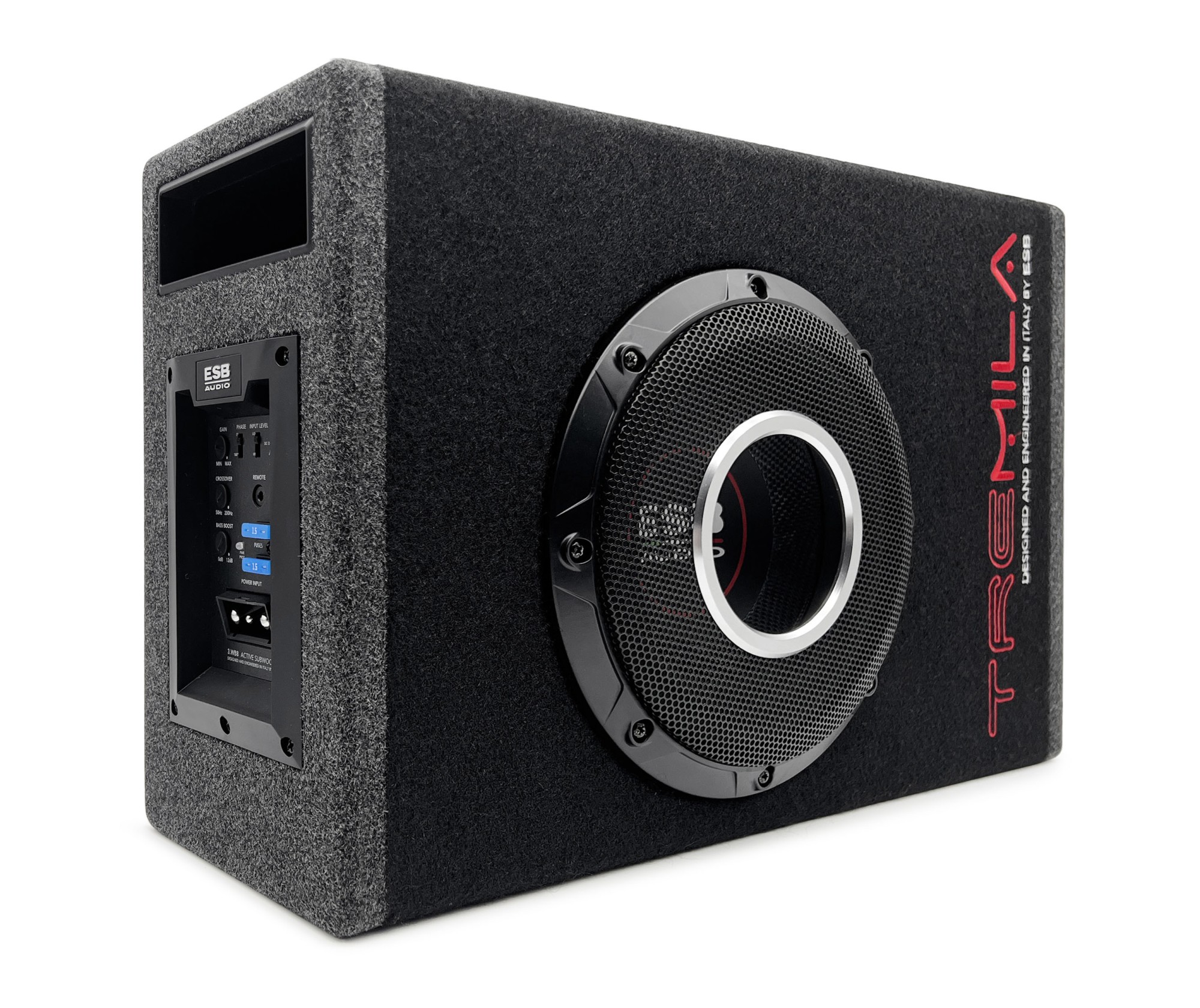
Active subwoofer ESB Audio 3.WB8 G
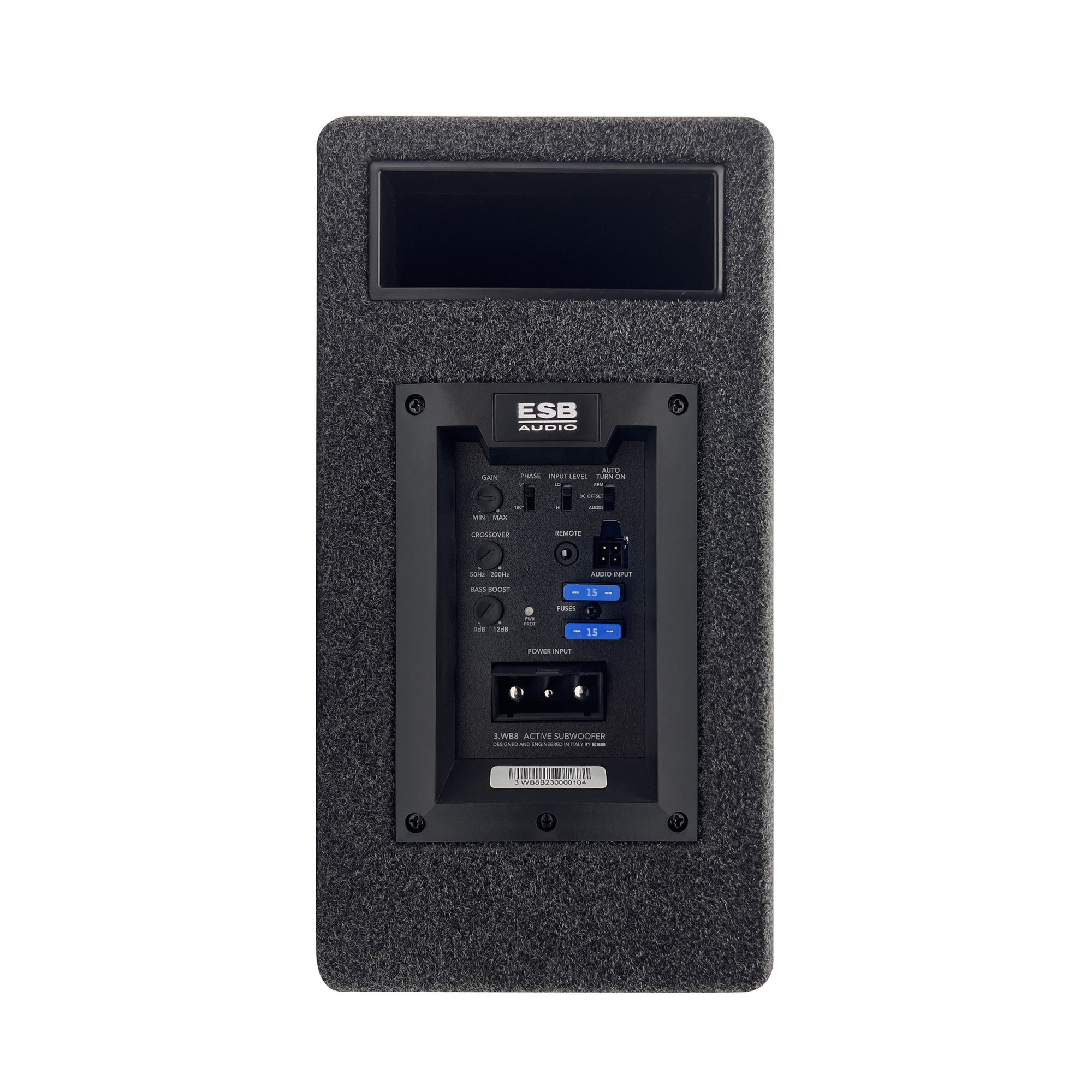
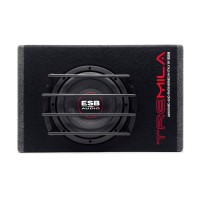
The 3000 (Tremila) model series from ESB has been developed and assembled with great commitment to materials research and top-level technical solutions. In the offer of the Tremila series, you will find a wide portfolio of products that are characterized by high-quality sound, exemplary processing and the use of the most modern technologies. And also with Tremila series subwoofers, you can count on excellent sound quality and countless innovations. The active subwoofer of this series has an 8" driver with a paper membrane reinforced with carbon fibers, a robust ferrite magnet and, in particular, an integrated digital amplifier with a power of 300 W RMS. A compact bass reflex enclosure with a thickness of only 15 cm ensures powerful bass with corresponding ESB Audio quality. The enclosure includes a control panel with plug & play connector for easy disconnection of the subwoofer. On the panel you will also find gain control, bass boost and phase adjustment. Of course, you will also find a remote control in the package.
The main features of the ESB Audio 3.WB8 G active subwoofer
- Active subwoofer with a 200 mm diameter driver.
- Integrated digital amplifier with a power of 300 W RMS.
- Subwoofer paper membrane reinforced with carbon fibers.
- Bass reflex MDF enclosure covered with black carpet with the Tremila series logo.
- Up-Firing construction for better low frequency delivery.
- Plug & play connector for easy subwoofer disconnection.
- Butterworth low-pass filter with adjustable frequency (50 - 200 Hz).
- Control of gain, phase and bass boost.
- High-level audio input for maximum OEM integration.
- Automatic on and off.
- The enclosure includes a robust metal grille to protect the subwoofer driver.
- Remote control included in the package
About the ESB Audio brand
The history of ESB Audio dates back to 1972, when this Italian brand was officially founded. ESB audio is one of the most famous speaker system manufacturers of the second half of the 20th century, and during their rich history they have launched many innovative technologies and many high-end home audio products that have achieved huge worldwide success. Based on the experience gained, in 1984, ESB engineers began to engage in research aimed at optimizing sound in the automotive environment, and two years later began the production of the first car speakers. Due to the great success, ESB began to focus more and more on the automotive industry and its demanding challenges. Car Audio is becoming a phenomenon of the time, and in 2005 a school dedicated exclusively to vehicle sound was founded in the city of Aprilia, where ESB is based. It was then that the final decision was made to leave the world of home audio and focus exclusively on vehicle sound systems. Currently, ESB is part of the Italian company Apex Group, together with the American manufacturer of audiophile amplifiers and DSP processors Zapco. In the offer you will find several model lines of speakers, led by the super high-end Diecimila three-way system, which represents probably the best quality and most expensive car speakers on the market today. And that is the main mission of ESB audio. To produce speakers of the highest quality focused on faithful sound, which will allow the user to reproduce the way the interpreter intended. Exactly according to the company's slogan "Just like live".
| Catalog number | ESB 3.WB8 G |
| Brand | ESB Audio |
| Links | Official web presentation (English) |
| The diameter of the subwoofer usedThe diameter of the subwoofer that is installed in the active box. | 200 mm (8\") |
| RMS power of the subwooferThe RMS power of an active subwoofer is the constant power that the active subwoofer can play over a long period of time. We recommend following this value. The RMS power of active subwoofers is taken as the RMS power of the integrated amplifier, which in most cases is slightly undersized, which guarantees protection against subwoofer burning. | 300 W |
| Maximum subwoofer performancePeak performance or Max. power that an active subwoofer can play for a moment (approx. 0.5 s), for example when percussion instruments are struck in a recording. But it is not as important a parameter as the RMS power. | 600 W |
| RMS power of the amplifier | 300 W |
| Energy class of the amplifierAmplifiers are divided into two basic classes: analog and digital . Analog amplifiers (A/B) have higher consumption requirements, but usually have a more natural sound. Digital amplifiers (D) have significantly lower consumption and higher efficiency, but the sound may not be as faithful as with classic analog amplifiers. | D |
| Frequency rangeThe ability of the device to reproduce a signal from the lowest frequency to the highest, or the ability of an active subwoofer to faithfully reproduce sound in a specific frequency band. Professionally: In the frequency range from 40 to 16,000 Hz, the vast majority of fundamental and overtones (harmonics) of all musical instruments are found. We are interested in the course of the radiated sound pressure in this range of frequencies when the loudspeaker system is supplied with constant power. We call this course the frequency characteristic, which tells us the level of radiated sound pressure in decibels (dB) depending on the frequency. The frequency characteristic of a speaker or speaker system can be expressed most succinctly with a graph. Mostly, however, the frequency characteristic is indicated by indicating the maximum tolerance of the sound pressure in the given frequency range, e.g. 50 to 15,000 Hz -+ 6 dB. since the frequency characteristics of loudspeakers and systems in general are quite uneven, some manufacturers do not even specify this maximum tolerance of sound pressure in decibels for reasons of prestige. Data impoverished in this way is worthless. What is valid is that the manufacturer offers a speaker system with a frequency range of 30 to 20,000 Hz, if he is worried about stating the maximum unevenness of the sound pressure in this range, because he can have a tolerance of, for example, +- 20 dB. The unevenness, i.e. the undulation of the frequency course in good speaker systems for quality music performance should not exceed +-3 dB in the 80 to 12,000 Hz band and +-6 dB in the 40 to 16,000 Hz band. Greater unevenness already depletes or emphasizes certain tonal areas, which can cause audible or even disturbing distortion. The proportion between fundamental tones and higher harmonics also changes, thereby changing the color of the sound, and individual musical instruments as well as the entire musical image sound unnatural. | 25 - 200 Hz |
| Low-pass filter (LPF) | 50 - 200 Hz |
| Bass boost functionBass boost or bass enhancement. With this function, the bass itself can be emphasized, at a high level of bass boost, the speakers and the subwoofer can distort a lot and the sound will be worse than better. We therefore recommend using the "bass boost" function wisely. | Yes (0 - 12 dB) |
| Phase rotation optionPhase shift is a linear electronic oscillator that produces a sinusoidal output. It consists of an inverting part of the amplifier such as a transistor. The feedback network "shifts" the phase at the output of the amplifier by 180 degrees to the oscillation frequency and gives positive feedback. The Phase shift filter produces a phase shift that increases with increasing frequency. This is usually used when the subwoofer sub-assembly is out with the magnet, or when two amplifiers are connected externally. Phase Shift is also used with active speaker wiring, where the time shift of the speakers is set. The point is that the subwoofer does not play the bass late, and for this reason better amplifiers offer this phase reversal option. | Yes (0° - 180°) |
| High level inputThe high-level input on the active subwoofer enables connection directly to the speakers in the car without purchasing an external high/low converter. Use in the case of mounting an active subwoofer on the original car radio. | Yes |
| Automatic on and offThis function will facilitate your installation and solve the problem of finding a remote signal, which is sometimes a problem with original car radios. The active subwoofer with the Auto sense function can recognize that the equipment in the car is active and turn itself on. A useful and practical feature. | Yes |
| Remote control included in the packageSome models of active subwoofers also have wired remote controls in the package, which on the one hand connect to the active box, and on the other hand you have a potentiometer that you can place anywhere in the cabin. A common place to place the remote control is under the steering wheel. The advantage is the regulation of power, and therefore volume, depending on driving conditions and the mood of the crew in the car. | Yes |
| Loudspeaker type | Bass reflex |
| What is the baffle made of?Active subwoofers can be made of MDF board, hardened plastic, sheet metal, aluminum or a combination of different materials. | MDF |
| Active subwoofer dimensions | 448 x 289 x 150 mm |
| Mass | 9.7 Kg |
Evaluation
You might also be interested
 Quick previewactive subwoofer, Ø 8" (200 mm), 300 W RMS, bass reflex enclosure499,00 EURIn stockESB Audio 3.10D4 Free transport
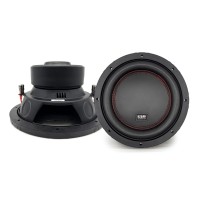 TipQuick previewsubwoofer, Ø 10", 300 W RMS, 4 + 4 Ω, 91 dB (1W/1m)199,00 EURIn stockESB Audio 3.165 Free transport
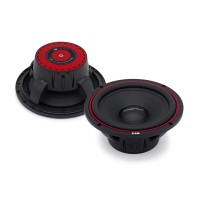 Quick previewmid-bass speakers, Ø 165 mm, 120/240 W, 4 Ω, 88.5 dB (1W/1m), installation depth 64 mm149,00 EURIn stockESB Audio 3.25
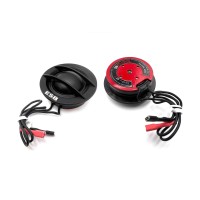 TipQuick previewtweeters, Ø 25 mm domes, 90 W RMS, 4 Ω, 91 dB (1W/1m)59,00 EURIn stockESB Audio 3.28
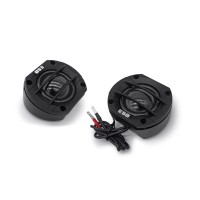 TipQuick previewtweeters, Ø 28 mm dome, 90 W RMS, 4 Ω, 91 dB (1W/1m)89,00 EURIn stockESB Audio 3.65 Free transport
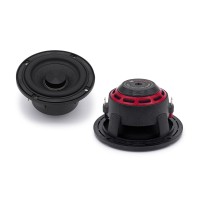 Quick previewfull-range / center speakers, Ø 65 mm, 60/120 W, 4 Ω, 83 dB (1W/1m), installation depth 36 mm179,00 EURIn stockESB Audio 3.69 Free transport
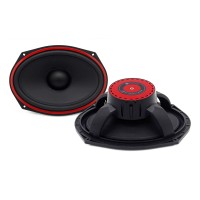 Quick previewmid-bass speakers, 6 x 9", 120/240 W, 4 Ω, 88.5 dB (1W/1m), installation depth 72 mm149,00 EURIn stockESB Audio 3.69K2.5 Free transport
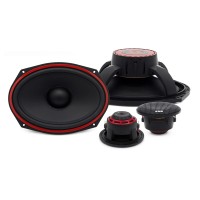 Quick previewcomponent speakers, 6 x 9", 120/240 W, 4 Ω, 88.5 dB (1W/1m), installation depth 72 mm329,00 EUR1 to 4 weeksESB Audio 3.6K2 Free transport
 TipQuick previewcomponent speakers, Ø 165 mm, 120/240 W, 4 Ω, 88.5 dB (1W/1m), installation depth 64 mm239,00 EURIn stockESB Audio 3.6K2 CX
 Quick preview2-band crossover, 4-level tweeter adjustment, price per pair89,00 EURIn stockESB Audio 3.6K3 Free transport
 TipQuick preview3-way component speakers, Ø 165 mm, 120/240 W, 4 Ω, 88.5 dB (1W/1m), installation depth 64 mm379,00 EURIn stockESB Audio 3.6K3 CX Free transport
 Quick preview3-band crossover, 4-level tweeter adjustment, price per pair179,00 EURIn stockESB Audio 3.6K3U Free transport
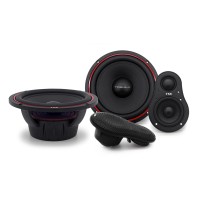 Quick preview3-way component speakers, Ø 165 mm, 120/240 W, 4 Ω, 90 dB (1W/1m), installation depth 64 mm399,00 EUR1 to 4 weeksESB Audio 3.90 Free transport
 Quick previewcenter speakers, Ø 90 mm, 60/120 W, 4 Ω, 88.5 dB (1W/1m), installation depth 38 mm149,00 EURIn stockESB Audio 3.UMA Free transport
 Quick preview2-way speakers, Ø 65 mm, 80/160 W, 4 Ω, 83 dB (1W/1m), installation depth 64 mm249,00 EURIn stock